
The Anatomy Of Your Denial Letter: Section By Section
Your denial letter follows a standard format. Here’s what each section contains and what to look for:
- Your claim number and filing date
Your claim number appears on every SSA document. The filing date is critical: it becomes your potential onset date for back pay. Write it down and protect it. - "We have determined that you are not entitled to disability insurance benefits"
The formal denial. It sounds final but it’s not — it’s the starting line for your appeal. - The date of the letter
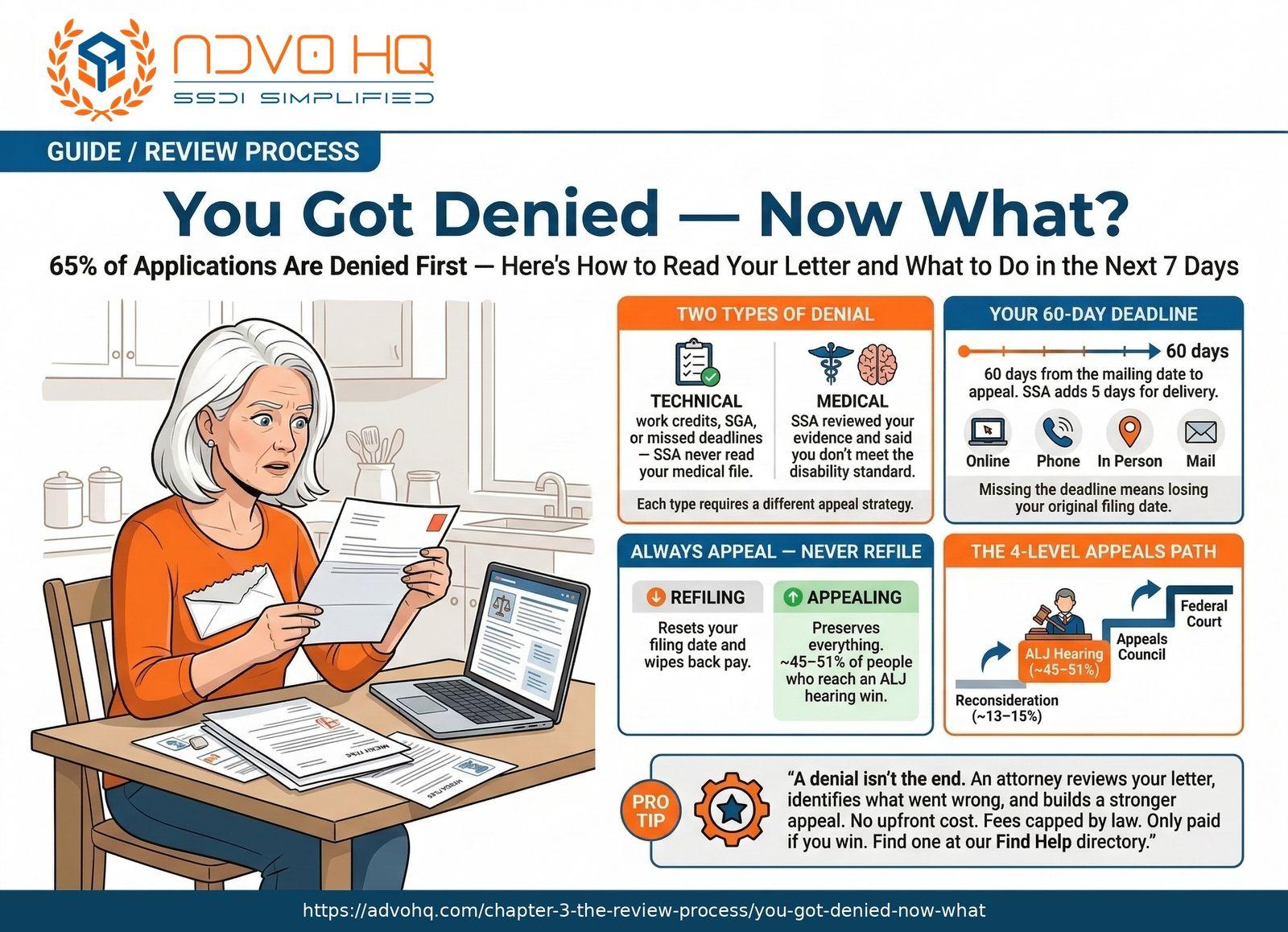
Your 60-day appeal clock starts when you receive this letter. SSA assumes you received it 5 days after the date shown. Mark your calendar: 65 days from the letter date is your hard deadline.
- A brief explanation of why you were denied
The high-level reason, typically one or two sentences. It will reference one of the medical denial categories covered below. - A list of conditions SSA considered
If a condition you have is NOT listed, that’s a problem: they either didn’t know about it or didn’t consider it. This becomes evidence to add on appeal. - A statement about your ability to work
Something like "you are able to do work that is less demanding than your past work." This is their conclusion — not the evidence. The evidence is in the rationale.
- How to appeal and the deadline
You have 60 days from receipt (effectively 65 days from the letter date). File Form SSA-561 for reconsideration. Do NOT miss this deadline. - Where to file
Instructions for filing online at ssa.gov, by phone, in person, or by mail. Online is fastest. - Right to review your file
You can request a copy of your complete case file. DO THIS. It contains the Disability Determination Rationale — the detailed explanation of exactly why you were denied.
The Disability Determination Rationale: The Real Denial Letter
The 2–3 page letter you received in the mail is the summary. The Disability Determination Rationale is the detailed explanation—and it’s the document that actually matters for your appeal. You may need to request your case file from SSA to see this document. It’s also sometimes called the "technical rationale." Here’s what it contains:
Which conditions SSA considers "severe" (more than a minor limitation on your ability to work).
Whether your condition was compared to SSA’s Blue Book listings.
The Residual Functional Capacity the examiner assigned to you — the most critical part. It states what they believe you can still do: how much you can lift, how long you can sit/stand/walk, and any non-exertional limitations.
Whether the examiner believes you can still perform any of your past jobs based on the RFC they assigned.
If they found you can’t do past work, they’ll state whether other jobs exist you can do. This is where the Grid Rules and your age, education, and work history matter.
Which medical records and providers the examiner reviewed.
If SSA ordered a consultative exam (CE), the examiner’s findings will be referenced here.
The RFC determination drives every conclusion that follows about your work capacity and eligibility.
The 8 Medical Denial Reasons: What They Mean And How To Fight Each One
Every medical denial falls into one of these categories. Find yours and you’ll know exactly what evidence to build for your reconsideration:
They believe your condition causes only minor limitations. This is a Step 2 denial — SSA stopped evaluating before they got to your RFC or past work.
Your condition was compared to SSA’s Blue Book listings and your evidence didn’t match all the criteria. This is a Step 3 denial.
SSA believes you can still do at least one job you’ve held in the past 5 years. This is a Step 4 denial.
SSA agrees you can’t do past work, but believes other jobs exist you could do. This is a Step 5 denial — the most common for ages 49–64.
SSA didn’t have enough records to evaluate your functional limitations. This is the #1 reason for denial — not that they think you’re faking, but that they literally lacked information.
SSA found you stopped medications, missed appointments, or didn’t follow treatment recommendations — and argues that following treatment might allow you to work.
SSA believes your condition hasn’t lasted or isn’t expected to last 12 months. SSDI requires a condition expected to last at least 12 continuous months or result in death.
SSA requested something — a consultative exam, records, or a form — and you didn’t respond. They decided your case on insufficient information.
Find your denial reason above and you have your appeal strategy. Most reconsiderations fail because people re-submit the same evidence that got them denied the first time. Your denial letter tells you exactly what needs to change — use it.
Finding The RFC In Your Denial: The Number That Decides Your Case
Buried in your Disability Determination Rationale is the RFC the DDS examiner assigned to you. This is the most important piece of information in your entire denial. Here’s how to read it:
Can lift 50–100+ lbs. Very few physical limitations.
Can lift up to 50 lbs occasionally, 25 lbs frequently. Can stand/walk 6 hrs, sit 6 hrs.
Can lift up to 20 lbs occasionally, 10 lbs frequently. Requires significant standing/walking.
Can lift no more than 10 lbs. Primarily sitting with occasional standing/walking.
Cannot perform even the minimal requirements of sedentary work.
Get your treating physician to complete an RFC showing more restrictive limitations than the examiner assigned. If SSA gave you a "light" RFC but your doctor documents "sedentary" or "less than sedentary" — backed by treatment records and objective findings — you've changed the entire equation.
Building Your Counter-Evidence Checklist From The Denial Letter
Now that you’ve decoded your denial, turn it into an action plan. For each finding in your denial, identify the evidence needed to counter it:
Request Your Complete Case File: Don’t Skip This Step
The denial letter is the summary. The case file is the whole story. You need both. Here’s how to get it:
In Person
Visit your local SSA office and request a copy of your complete disability case file. They can usually provide it same day or within a few days.
By Phone
Call 1-800-772-1213 and request your file be mailed to you. This takes longer — plan for 2–4 weeks.
Through Your Attorney
If you have an attorney, they can request the file with an SSA-1696 on file. Requesting your case file is typically one of the first things an attorney does.
The file contains the complete Disability Determination Rationale, every medical record SSA reviewed, the CE report (if any), the RFC assessment form the examiner completed, your Function Report and work history, and internal notes. This is the playbook for your appeal.
Frequently Asked Questions
A technical denial is based on non-medical factors — not enough work credits, earnings above the SGA limit ($1,690/month in 2026), being past your Date Last Insured, or non-cooperation — and SSA never reviews your medical evidence. A medical denial means SSA reviewed your records and concluded your condition doesn't prevent all work. The fixes are completely different, so identify your type first.
It's the detailed analysis document — sometimes called the "technical rationale" — listing your severe impairments, the listing comparison, the RFC assigned, and the work-capacity conclusions. It's the real explanation behind the short denial letter. It may not arrive with the letter; request your complete case file from SSA to get it.
Your RFC — Heavy, Medium, Light, Sedentary, or Less Than Sedentary — is SSA's statement of what work they believe you can still do. It's the number that drives the outcome. A sedentary RFC is especially powerful if you're 50 or older, because SSA's Grid Rules favor a finding of disabled at that RFC-and-age combination.
Request it in person at any SSA field office (fastest), by calling 1-800-772-1213 (2–4 weeks by mail), or have your attorney request it with an SSA-1696 on file. The file contains the Disability Determination Rationale, CE reports, all medical records SSA collected, and the examiner's notes — everything you need to build your reconsideration.
That usually means SSA either didn't know about it or didn't count it as severe — and it's one of the most common gaps in a denied file. Any condition that isn't listed is evidence you can add on reconsideration: get it diagnosed and documented, then report it as a new or worsening condition when you file your reconsideration forms. Mental health conditions, medication side effects, and secondary diagnoses are the ones people most often leave out.
What They Don't Tell You
Insider knowledge that can make or break your application:
Your denial letter is only the summary — the real answer is in your case file
The 2–3 page letter gives you the conclusion. The Disability Determination Rationale gives you the reasoning, the specific evidence reviewed, the RFC assigned, and where the analysis fell short. Most people appeal from the letter alone. The people who win appeals work from the case file.
SSA often misses conditions you didn't emphasize
If your denial doesn't mention a condition you have — depression, anxiety, cognitive issues, sleep disorders, medication side effects — SSA likely didn't consider it. That's an opportunity, not an oversight you have to accept. Add these conditions with supporting evidence on reconsideration.
The DDS examiner who denied you never met you
Your initial claim was reviewed on paper by an examiner and a medical consultant who never examined you, never saw you struggle to walk across a room. Any consultative exam was likely 15–30 minutes. Your treating physician, who has known you for months or years, understands your limitations far better.
The RFC in your denial is the number your attorney will target
An experienced disability attorney reads your denial, finds the RFC the examiner assigned, and immediately knows what has to change. If you were given a "light" RFC but your real limitations are "sedentary," the attorney knows exactly which doctors to contact, which forms to get, and how to build the file that changes that number.
Most people get denied — the ones who win understand why
About 65% of initial SSDI applications are denied (SSA, Annual Statistical Report on the SSDI Program, 2024). That's not a verdict on whether you're truly disabled; it's a reflection of whether your file had the right evidence in the right format. Now that you've decoded your denial, you know what was missing — and the next step is filing your reconsideration with the evidence that fills those gaps.
The denial letter is only a summary — get the real explanation
The short letter you got in the mail is only a summary. Behind it, Disability Determination Services wrote a far more detailed document — the Disability Determination Explanation (DDE), which SSA also condenses into a "personalized disability explanation" — that names every source it reviewed, the exact RFC it assigned you, and the specific past or "other" jobs it decided you can still do. Request a copy of your complete file/DDE so your reconsideration attacks the actual reasons you lost, not the vague ones in the letter. That list of real reasons becomes the roadmap for the forms that officially start your appeal.
Your denial letter isn’t the end—it’s the instruction manual for your appeal.
Your denial letter isn't the end — it's the instruction manual for your appeal. Read it carefully. Request your complete case file. Identify which of the 8 denial reasons applies to you. Find the RFC the examiner assigned and understand what it means for your age and work history. Then build your counter-evidence checklist: the specific documents, records, and RFC forms that address every weakness SSA identified. That checklist becomes the foundation for everything that comes next.
Up Next: Filing The Reconsideration: SSA-561 and SSA-3441 Field By Field—the step-by-step guide to filling out the forms that officially start your appeal, with example language you can adapt for your situation.
An Attorney Reads Your Denial Letter Differently Than You Do
Where you see a rejection, an experienced disability attorney sees the specific evidence gaps, the RFC that needs to change, and the strategy for your reconsideration. Free consultations. No upfront cost.
→ Find An Attorney Who Knows How To Read Denial Letters
→ Request Free Help Understanding Your Denial
New To The SSDI Process?
If you haven’t read our Review Process series, start with Article 1: You Got Denied — Now What? for the big picture of every appeal level. Then come back here for the deep dive on reconsideration.
Not affiliated with SSA or any government agency. For informational purposes only — not legal advice.
- 20 C.F.R. § 404.909, "Request for reconsideration" (60-day filing deadline). ecfr.gov
- 20 C.F.R. § 404.901, definition of "Date you receive notice" (5-day mailing presumption). ecfr.gov
- 20 C.F.R. § 404.900, "Introduction" (the four-level administrative review process). ecfr.gov
- Social Security Administration, Form SSA-561, "Request for Reconsideration". ssa.gov
- Social Security Administration, "Appeal a Decision We Made". ssa.gov
- 20 C.F.R. § 404.1520, "Evaluation of disability in general" (five-step sequential evaluation). ecfr.gov
- 20 C.F.R. § 404.1545, "Your residual functional capacity" (RFC); SSR 96-8p. ecfr.gov
- 20 C.F.R. § 404.1520c, "How we consider and articulate medical opinions" (supportability + consistency; claims filed on/after March 27, 2017). ecfr.gov
- 20 C.F.R. Part 404, Subpart P, Appendix 1, "Listing of Impairments" (Blue Book). ecfr.gov
- 20 C.F.R. Part 404, Subpart P, Appendix 2, "Medical-Vocational Guidelines" (Grid Rules). ecfr.gov
- Past relevant work window (5 years): 89 Fed. Reg. 27653 (Apr. 18, 2024); SSR 24-2p; 20 C.F.R. §§ 404.1560, 404.1565. federalregister.gov
- Attorney fee cap ($9,200, eff. Nov. 30, 2024): 42 U.S.C. § 406(a)(2); 20 C.F.R. § 404.1720; 89 Fed. Reg. (May 10, 2024), "Maximum Dollar Limit in the Fee Agreement Process". federalregister.gov
- Social Security Act, Title II — 42 U.S.C. §§ 401–434. ssa.gov
- SSA POMS DI 26530.020, "Personalized Disability Explanation (PDEX) in Initial Denials"; DI 27025.020, "Personalized Explanations in Reconsideration Denials" (detailed rationale, RFC, and vocational findings in your case file). secure.ssa.gov