
Before You Start: What You Need In Front Of You
Gather these items before you sit down with the forms. Don’t start without them:
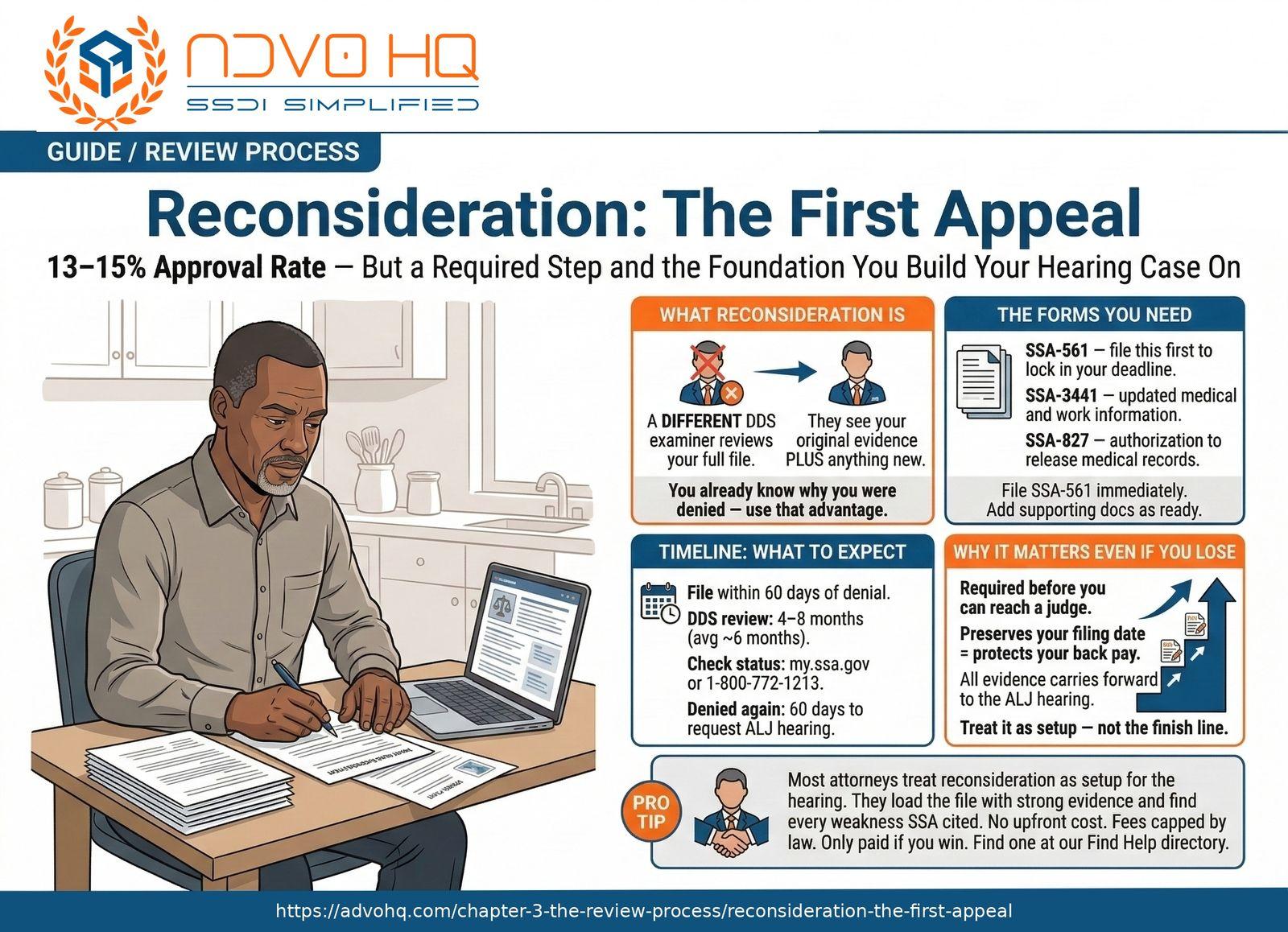
The Three Forms: What Each One Does
SSA-561-U2
Request for Reconsideration. The official form that says "I disagree and want you to review my case again." This is where you state why you disagree with the denial. One page — filled out by you.
SSA-3441-BK
Disability Report — Appeal. The detailed update form. Ten pages covering changes in your condition, new providers, medications, hospitalizations, and work activity since your initial application.
SSA-827
Authorization to Disclose Information. Your permission slip — gives SSA authorization to request medical records from your doctors and hospitals. Without this, SSA can’t access your updated records.
You have 60 days from when you received the denial letter (SSA assumes 5 days after the letter date). That gives you effectively 65 days from the letter date. Mark your calendar. Missing this deadline means starting over with a brand new application — and losing your original filing date, which affects your back pay.
Form SSA-561-U2: Request For Reconsideration — Field By Field
This is a one-page form, but the "reason you disagree" section is where most people go wrong. Here’s every field:
Top Section: Claimant Information
- Name of Claimant
Your full legal name exactly as it appears on your Social Security card. Don’t use nicknames. If your name has changed since your initial application, use the name SSA has on file and note the change. - Claimant SSN
Your 9-digit Social Security number. Double-check every digit — a wrong number means your appeal could go into the wrong file. - Claim Number
If different from your SSN, enter the claim number from your denial letter (it’s on page 1). Often the same as your SSN.
The Disagreement Statement: The Most Important Field On The Form
The form says: "I do not agree with the determination made on the above claim and request reconsideration." Below this is a small space for you to explain why you disagree. This is your opening argument. Here’s the strategy:
✅ Write This
- "I disagree with the RFC assessment. My treating physician documents limitations more restrictive than the light RFC assigned. See attached letter for full explanation."
- "New medical evidence from [Dr. Name] dated [date] documents additional conditions not considered in the initial determination, including [condition]. I am submitting updated records and a treating physician RFC form."
- "The determination did not consider my [depression/anxiety/cognitive issues]. I am submitting a mental health evaluation and mental RFC from [provider] documenting limitations in concentration, persistence, and pace."
- "See attached letter." (Then attach a detailed 1–2 page letter addressing each denial reason with specific evidence references.)
❌ Don’t Write This
- "I am disabled and can’t work. This isn’t fair."
- "I have a lot of pain every day and I can’t do anything."
- "The examiner was wrong about everything."
- [Leaving it blank or writing "see above"]
Appeal Type Selection (SSI/SVB Only)
If you’re filing for SSDI reconsideration on a medical denial, this section doesn’t apply to you—the appeal type is automatically a case review. But here’s what the three options mean in case you see them on the form:
Case Review
A different DDS examiner reviews your entire file — all old evidence plus anything new you submit. You do NOT meet with anyone. This is the standard for SSDI medical reconsideration.
Informal Conference
Available for SSI non-medical issues only. You meet with the reviewer in person to explain your case and can bring witnesses.
Formal Conference
Available only for SSI or SVB payment reductions/stoppages. Similar to the informal conference but with additional procedural protections.
Contact Information And Signature
- Claimant’s Address / Phone
Enter your current mailing address and best phone number. If this has changed since your application, update it here — SSA needs to reach you. - Representative Info
If you have an attorney or authorized representative, their name and contact info goes here. If you don’t have one yet, leave blank — you can add a representative at any time by filing Form SSA-1696. - Signature and Date
Sign and date the form. The date you sign should be within the 60-day appeal window. - Page 2 (SSA Use Only)
Do NOT fill out page 2. It’s for SSA internal use. Only submit page 1.
Form SSA-3441-BK: Disability Report — Appeal — Section By Section
This is the longer form—10 pages, 10 sections. SSA estimates it takes about 50 minutes to complete. That estimate is generous if you’re prepared. Here’s every section with guidance on what to write:
- 1A. Name
Full legal name. Same as your SSA-561. - 1B. Social Security Number
Your 9-digit SSN. - 1C. Daytime Phone Number
Best number where SSA can reach you during business hours. - 1D. Alternate Phone Number
A backup number if you’re not reachable at the primary. - 1E. Friend or Relative Contact
Name someone who knows about your conditions and can speak on your behalf if SSA can’t reach you. Choose someone reliable who understands your limitations.
This is the most important section of the SSA-3441. This is where you tell SSA what has changed—for better or worse—since your initial application. Be honest and detailed:
- 2A. Any change in conditions?
Answer YES if your conditions have gotten worse, stayed the same but you have better documentation, or you have new diagnoses. Example: "Yes. My lower back pain has worsened. MRI on [date] shows [finding]. I now also have numbness and tingling in both legs that was not present at the time of my initial application." - 2B. New physical or mental limitations?
Describe specifically what you can no longer do or what has become harder. Use quantities. Example: "Yes. I can now only sit for 15 minutes before needing to change positions. I cannot lift more than a gallon of milk. I need to lie down 2–3 times per day due to pain and fatigue." - 2C. New conditions since last report?
List any new diagnoses. Critical: if you’ve been diagnosed with depression, anxiety, sleep apnea, or any other condition since your initial application, list it. Example: "Yes. I have been diagnosed with major depressive disorder and generalized anxiety disorder. Treatment began [date] with [provider name]."
Describe your WORST days, not your best. SSA is evaluating whether you can work 8 hours a day, 5 days a week, consistently. One good day doesn't mean you can sustain employment. Be specific: "I can walk about half a block before the pain forces me to stop" is stronger than "I have trouble walking." Use numbers: minutes you can sit, hours you can stand, pounds you can lift, times per week a symptom occurs.
- 3A. Doctor / HMO / Therapist
List each provider separately with full name, address, phone, dates of treatment, and what they treated. One provider per space. Include upcoming appointments too. - 3B. Hospital / Clinic
Same format for any hospital visits, ER visits, urgent care, or outpatient clinics since your last report. - 3C. Other names on records
If your medical records are under a different name (maiden name, previous married name), list all names here.
If you've seen a therapist, counselor, psychiatrist, or psychologist — even once — list them here. Mental health evidence is one of the most commonly missing pieces in denied claims. If you haven't seen a mental health provider but experience depression, anxiety, or cognitive issues related to your disability, consider getting an evaluation before your reconsideration is reviewed.
- 4A. Tests since last report
List every diagnostic test: MRIs, X-rays, CT scans, blood work, nerve conduction studies, EKGs, pulmonary function tests, psychological testing. Include the date, facility, and what the test was for. - 4B. Tests scheduled
List any upcoming tests. SSA may wait for results before making a decision, which can help your case.
- 5A. Current medications
List every medication you take. For each: name, dose, frequency, prescribing doctor, and what it’s for. Include over-the-counter medications you take regularly for your conditions. - 5B. Side effects
Often overlooked, but critically important. Side effects like drowsiness, dizziness, nausea, brain fog, and fatigue are functional limitations. Example: "Oxycodone causes drowsiness, difficulty concentrating, and dizziness. I cannot drive or operate equipment for 4–6 hours after taking it."
Medication side effects are functional limitations. If your pain medication makes you drowsy, that's a limitation on concentration. If your anti-anxiety medication causes dizziness, that's a safety issue for standing work. List every side effect for every medication. These add up and can push your RFC into a more restrictive category.
- 6A. Hospitalizations since last report
List any inpatient hospital stays with facility name, dates, and reason. Even overnight ER visits count. - 6B. Emergency room visits
List all ER visits, even if you weren’t admitted. ER visits for pain, falls, breathing problems, or mental health crises document the severity and unpredictability of your conditions.
- 7A. Have you worked since last report?
Answer honestly. If you attempted to work and couldn’t sustain it, that’s actually helpful evidence. A failed work attempt shows you tried but your condition prevented sustained employment. - 7B. Job details
If you did any work, provide employer name, dates, hours, pay, and why you stopped. If you had special conditions or accommodations, note them.
If you tried to go back to work and couldn't maintain it because of your condition, document this carefully. A work attempt that lasted less than 6 months and ended because of your disability is classified by SSA as an "unsuccessful work attempt" and does NOT count against you. In fact, it demonstrates that even with effort, your disability prevents sustained employment.
- 8A–8B. Classes or training
If you’ve enrolled in or completed any classes, trade school, or vocational training since your last report, note it here. If not, write "none."
- 9A–9C. Vocational rehab or support services
If you’ve participated in vocational rehabilitation, employment services, Ticket to Work, or any other support program, note it here. If not, write "none" or "does not apply."
This is your overflow section. Use it for anything that didn’t fit elsewhere. This is also a good place to:
- Explain treatment gaps
"I was unable to see a doctor between [dates] because I lost my health insurance when I stopped working. I resumed treatment on [date] when I obtained Medicaid coverage." - Add conditions that didn’t fit in Section 2
"In addition to the conditions listed above, I also experience chronic insomnia, tinnitus, and frequent migraines (2–3 per week) that further limit my ability to concentrate and maintain a work schedule." - Clarify medication side effects
"My combination of medications (gabapentin, oxycodone, and trazodone) creates cumulative side effects including cognitive impairment, excessive drowsiness, and impaired balance that make sustained work activity unsafe." - Note daily living limitations
"I require assistance from my [spouse/family member] for bathing on days when I cannot stand long enough, meal preparation because I cannot stand at the stove, and driving to medical appointments because medication side effects make driving unsafe." - Reference attached evidence
"Please see the attached RFC form from [Dr. Name] dated [date], new MRI results from [facility] dated [date], and mental health evaluation from [provider] dated [date]."
Form SSA-827: Authorization To Disclose — Quick Notes
The SSA-827 is straightforward—it’s your permission slip. A few things to know:
What It Does
Authorizes SSA to request your medical records from every provider you listed on the SSA-3441. Without it, SSA cannot access your records.
How Many To Sign
Sign one for each medical provider. Your attorney (if you have one) can help manage this.
Duration
The authorization is valid for 12 months from signature.
Don’t Wait For SSA
While SSA will request records using your SSA-827, you should also submit copies of records you already have. Don’t rely solely on SSA to gather everything—records sometimes get lost or arrive late.
How To Submit: Four Options
Online
Appeal at ssa.gov. The system walks you through the SSA-561 and SSA-3441 digitally and lets you upload supporting documents. Fastest method — creates an automatic timestamp and lets you save and return.
In Person
Bring completed forms to your local SSA office. Good if you have questions or need help. Ask for a stamped copy as proof of your filing date.
By Mail
Send to the address on your denial letter using certified mail with return receipt. Creates a paper trail — keep copies of everything you send and allow extra time for delivery.
By Phone
Call 1-800-772-1213 to start the appeal by phone — SSA will complete the forms for you. Best if you cannot write or access a computer, though you'll have less control over the exact language used.
Your Complete Submission Checklist
Frequently Asked Questions
Three: the SSA-561-U2 (Request for Reconsideration), the SSA-3441-BK (Disability Report — Appeal), and the SSA-827 (Authorization to Disclose Information). The SSA-561 states that you disagree, the SSA-3441 updates SSA on what's changed, and the SSA-827 lets SSA pull your medical records. Skipping any one of them can stall your appeal.
You have 60 days from the date you received your denial letter. SSA assumes you received it 5 days after the letter date, so in practice that's about 65 days from the date printed on the letter. Miss it and you generally have to start over with a new application — losing your original filing date and the back pay tied to it.
A different DDS examiner than the one who denied you — someone who did not make the original decision. For SSDI medical denials it's a "case review": they look at your entire file plus any new evidence, and you don't meet with anyone in person.
Reconsideration is the level where the fewest applicants win: in SSA's Annual Statistical Report on the SSDI Program (2024 ed.), only about 2% of all applicants are ultimately allowed at the reconsideration stage — but note that figure is a share of all applicants (a "waterfall" share), not the grant rate among the people who actually reach and file a reconsideration. Either way, it's a required step in almost every state before you can request a hearing, and a well-documented appeal with new evidence improves your odds. It also preserves your original filing date and back pay.
File on time anyway. You can keep submitting evidence after you file — new records, an RFC from your doctor, test results. Just reference your claim number on everything you send. Filing late to "wait for records" risks your entire claim; filing on time and supplementing does not.
What They Don't Tell You
Insider knowledge that can make or break your application:
The SSA-561 is your first impression with the new examiner
A different DDS examiner reviews your reconsideration — not the one who denied you. The SSA-561 disagreement statement (or your attached letter) is the first thing they read. A vague "I disagree" tells them nothing. A specific, organized response that references denial reasons and points to new evidence tells them exactly where to look.
You can submit additional evidence after filing
Filing the forms doesn't mean you're done. You can — and should — continue submitting evidence as it becomes available. Getting an RFC from your doctor? Submit it as soon as it's ready. New test results? Send them in. Just make sure to reference your claim number on everything.
"Don't know" is better than blank
Never leave a field empty. The SSA-3441 instructions say it explicitly: write "don't know," "none," or "does not apply." A blank field can look like you didn't read the question, or worse, that you skipped it intentionally.
Your disability attorney will file these for you — and write the appeal letter
If this feels overwhelming, that's normal. Disability attorneys file these forms every day. They know exactly what language to use, which denial reasons to target, and what evidence to reference. They'll also write the attached appeal letter — which is where the real strategy lives. And they do all of this at no upfront cost.
Filing online creates a stronger paper trail
When you file online at ssa.gov, the system timestamps everything and creates a digital record. If there's ever a dispute about whether you filed on time, the digital record is your proof. If you file by mail, use certified mail with return receipt. If you file in person, get a stamped receipt.
The SSA-3441 is where you report what changed
The SSA-3441 (Disability Report – Appeal) is not a formality — it's the official place to tell SSA what has changed since your denial. Report every new or worsening condition, every new doctor, clinic, hospital, ER visit, test, and medication since the last decision. Reconsiderations are usually won on new evidence, so leaving those sections blank or writing "no change" throws away your best chance at a reversal.
The forms themselves aren’t the hard part—building the right evidence and knowing what to say is.
The forms themselves aren't the hard part — building the right evidence and knowing what to say is. Fill out the SSA-561 with specific, organized reasons for your disagreement (or write "see attached" and include a detailed letter). Complete the SSA-3441 honestly with worst-day descriptions and quantified limitations. Sign the SSA-827 authorizations. Submit everything together with any new medical evidence you have. Then keep submitting evidence as it becomes available.
Up Next: Writing A Function Report That Actually Helps (SSA-3373)—the deep dive into the form that describes your daily life with your disability, with side-by-side examples of weak vs. strong answers for every major section.
Let An Attorney Handle The Paperwork
Disability attorneys file reconsideration appeals every day. They know which language works, which evidence to highlight, and how to write the attached letter that targets your specific denial reasons. Free consultation. No upfront cost.
→ Find A Disability Attorney In Your County
→ Request Free Help With Your Reconsideration
Haven’t Read Your Denial Letter Yet?
Start with Article 1: Decoding Your Denial Letter Line By Line. Understanding why you were denied is essential before you fill out these forms—every answer should be informed by the specific reasons SSA gave for the denial.
Not affiliated with SSA or any government agency. For informational purposes only — not legal advice.
- Social Security Administration — Form SSA-561-U2, Request for Reconsideration. ssa.gov
- Social Security Administration — Form SSA-3441-BK, Disability Report — Appeal. ssa.gov
- Social Security Administration — [Form SSA-827, Authorization to Disclose Information](. ssa.gov
- Social Security Administration — [Appeal a Decision](. ssa.gov
- 20 C.F.R. § 404.907, "Reconsideration — general" — ecfr.gov. ecfr.gov
- 20 C.F.R. § 404.909, "How to request reconsideration" — ecfr.gov. ecfr.gov
- 20 C.F.R. § 404.901, definition of "Date you receive notice" — receipt presumed 5 days after the date on the notice unless rebutted (the source of the "+5 days" / effective 65-day window). ecfr.gov
- 20 C.F.R. § 404.933, "How to request a hearing before an administrative law judge" — ecfr.gov. ecfr.gov
- SSA, Annual Statistical Report on the Social Security Disability Insurance Program, 2024, Sec. 4 (Outcomes of Applications), Table 60 & Chart 11 — ssa.gov. ssa.gov
- SSA POMS DI 12095.030, "SSA-3441-BK (Disability Report – Appeal)" — secure.ssa.gov. secure.ssa.gov