
Why A Second Denial Doesn’t Mean Your Case Is Weak
A DDS examiner reviews your paper records without ever meeting you. The majority are denied at this stage.
A different DDS examiner reviews the same file with any new evidence you submit. Still no face-to-face meeting.
An Administrative Law Judge reviews your entire file, hears live testimony from you and medical/vocational experts, and makes an independent decision. The first time a human looks you in the eye.
At reconsideration, a DDS examiner reviews your paper file. At the hearing, a judge sees you, hears your story in your own words, asks questions, and considers testimony from medical and vocational experts. They can observe your pain, your difficulty sitting through the hearing, and your emotional state. This human element changes everything.
How To File For A Hearing: Form HA-501
Filing for a hearing is straightforward. You need Form HA-501, Request for Hearing by Administrative Law Judge.
- Deadline
60 days from the date you received the reconsideration denial (SSA assumes receipt 5 days after the letter date, giving you effectively 65 days from the letter date). - The form
Form HA-501 (Request for Hearing by Administrative Law Judge). Available at ssa.gov or your local SSA office. - Where to file
Submit to your local SSA office, by mail to the address on your denial letter, or online at ssa.gov. - Key fields
Your name, SSN, claim number, and a statement of why you disagree. Same strategy as the SSA-561: write "See attached" and include a detailed letter. - Wait time
Currently 12–18 months for a hearing date in most areas. This wait is the time to build additional evidence.
What’s Different About The ALJ Hearing
DDS Reconsideration
- Who decides: A DDS examiner (not a doctor, not a judge) reviewing paper files
- How: Reading medical records, CE reports, and function reports
- Face-to-face: Never — the DDS examiner never meets you
- Your testimony: What you wrote on forms (SSA-3441, SSA-3373)
- Expert testimony: None
- Attorney role: Limited — submitting evidence, writing letters
ALJ Hearing
- Who decides: An Administrative Law Judge — an attorney with specialized training in disability law
- How: Reviewing the entire file PLUS live testimony from you, medical experts, and vocational experts
- Face-to-face: Yes — the ALJ sees you, observes your physical limitations, and assesses credibility in person
- Your testimony: You testify under oath; your attorney asks questions designed to highlight your limitations
- Expert testimony: VE testifies about available jobs; medical expert may testify; your attorney can cross-examine both
- Attorney role: Full advocacy — presenting your case, questioning you, cross-examining experts, making legal arguments
The 12–18 Month Wait: How To Use It
The wait for a hearing date is frustrating, but it’s also an opportunity. Here’s what to do during this time:
More treatment records = stronger case. Gaps in treatment between filing and hearing can be used against you.
New MRIs, blood work, or specialist evaluations showing your condition has persisted or worsened are powerful evidence at hearing.
If your RFC is more than 6 months old by the hearing date, get an updated one to show the ALJ your limitations are current.
The waiting period is the perfect time to establish a mental health treatment record. Even 6–12 months of monthly therapy creates significant evidence.
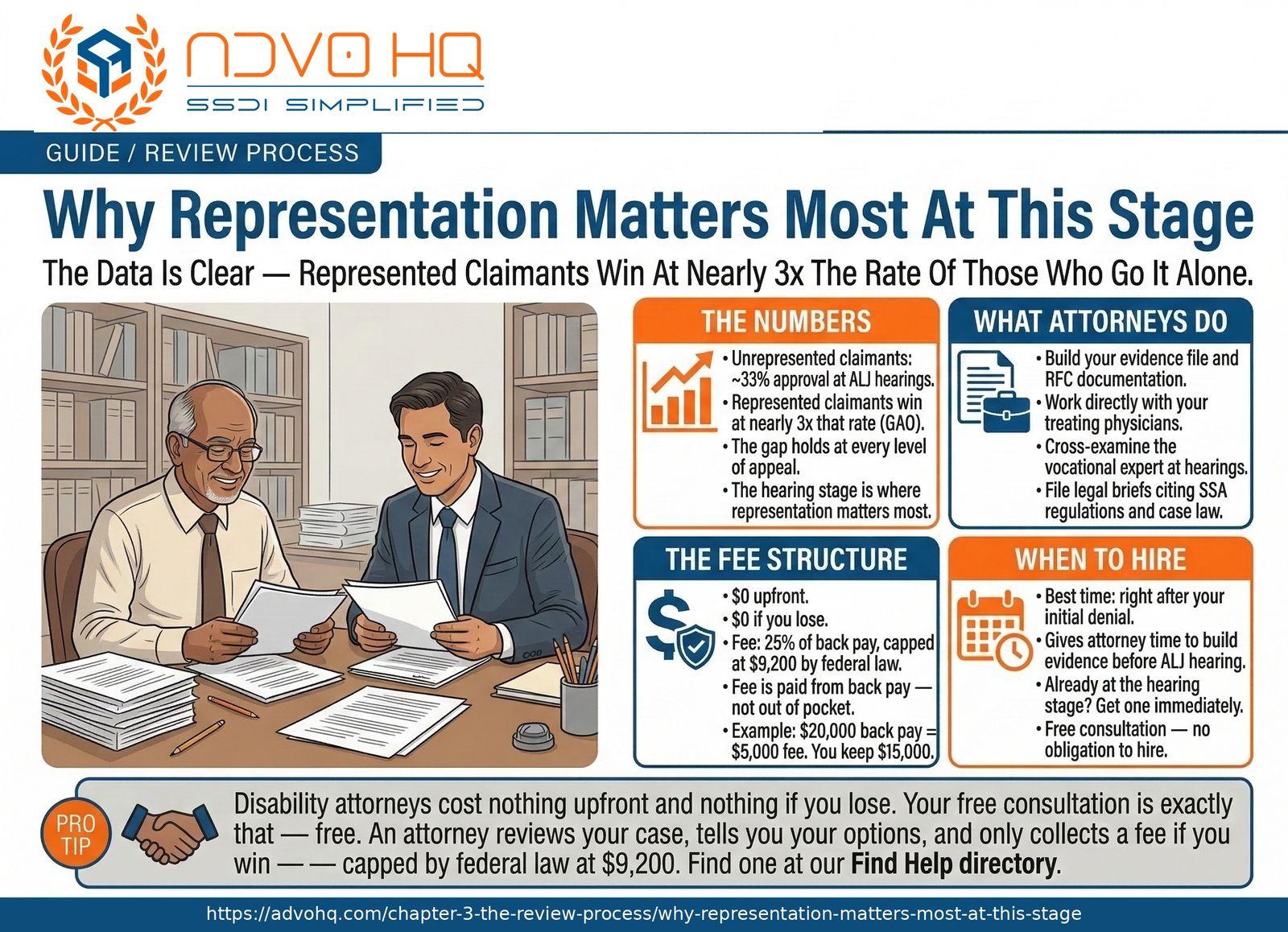
Claimants with attorneys win at the hearing level at significantly higher rates. Most disability attorneys work on contingency — no fee unless you win, capped by SSA at 25% of back pay.
Daily notes about pain levels, activities you couldn’t do, bad days, medication side effects. Your attorney can use this to prepare your testimony.
Why Attorney Representation At The Hearing Level Is Critical
- Reviews your entire file for weaknesses
CE reports, function report answers, or treatment notes that undermine your case are identified and addressed before the hearing. - Writes a pre-hearing brief
A legal argument telling the ALJ exactly why you meet the disability standard, citing specific evidence and legal rules. Frames your case before you walk in the room. - Prepares your testimony
They know what the ALJ needs to hear and how to elicit it: worst-day limitations, medication side effects, inability to sustain work. - Cross-examines the vocational expert
The VE testifies about what jobs someone with your RFC can do; your attorney asks hypothetical questions adding limitations until the VE admits no jobs exist. This is the make-or-break moment. - Challenges the CE report
If the CE report was inaccurate or superficial, your attorney presents your treating physician’s contrary evidence and argues for greater weight. - Knows the specific ALJ
Experienced attorneys know the tendencies of the ALJ assigned to your case and adjust strategy accordingly.
Disability attorneys work on contingency — they don't get paid unless you win. The fee is 25% of your back pay (the months of benefits between your application date and approval date), capped by SSA at $9,200 (effective November 30, 2024). If you don't win, you owe nothing. Given that represented claimants win at significantly higher rates, the math is overwhelmingly in your favor.
What The Hearing Actually Looks Like
The ALJ confirms your identity, swears you in, and outlines the process. Your attorney makes a brief opening statement.
Your attorney asks about your conditions, limitations, daily life, work history, and why you can’t sustain employment. The ALJ may also ask questions.
A doctor may testify about your conditions, whether you meet a listing, and your functional limitations based on the file. Your attorney can cross-examine.
The VE testifies about what jobs exist for someone with your specific limitations. Your attorney asks hypothetical questions adding each limitation to narrow or eliminate available jobs.
Your attorney may make closing remarks. The ALJ takes the case under advisement. You typically receive a written decision 1–3 months after the hearing.
Since the pandemic, many ALJ hearings are conducted by video conference or phone rather than in person. Your attorney will prepare you for whichever format applies to your hearing. Video hearings work in your favor if you're in visible pain or have difficulty sitting through the proceeding — the ALJ can still observe this on camera.
The Full Journey: What This Series Has Prepared You For
This is the final article in the Reconsideration Series. Here’s what you’ve learned across all 8 articles:
- Article 1
How to decode your denial letter: technical vs. medical denials, the Disability Determination Rationale, and the 8 most common medical denial reasons. - Article 2
How to file the reconsideration forms (SSA-561, SSA-3441, SSA-827) field by field, with strategic guidance for each section. - Article 3
How to write a Function Report (SSA-3373) that strengthens your case using worst-day descriptions, specific numbers, and side-by-side examples. - Article 4
What actually happens during a consultative exam, how to prepare, and how to counter an inaccurate CE report. - Article 5
How to get your treating physician to complete an RFC form — the most powerful evidence in your case — with conversation scripts and field-by-field guidance. - Article 6
How to build a medical evidence file from scratch when you don’t have insurance, a regular doctor, or specialist documentation. - Article 7
Why mental health evidence is the case-changer that turns physical-only denials into combined-limitation approvals. - Article 8
What happens when reconsideration is denied and how to file for the ALJ hearing where most people actually win their cases.
Frequently Asked Questions
You have 60 days from the date you received the reconsideration denial. SSA assumes you received the letter 5 days after its date, so in practice you have about 65 days from the date on the letter. Miss the deadline without good cause and you may have to start over. File Form HA-501 as soon as you can.
Form HA-501, Request for Hearing by Administrative Law Judge. You can get it at ssa.gov or your local SSA office, and you can also request the hearing online. On the "why you disagree" field, write "See attached" and include a detailed letter rather than trying to cram your argument into the box.
Much better than at reconsideration. Non-official estimates commonly quoted put ALJ hearings around 45–55%, compared with about 10–15% at reconsideration — and represented claimants win at higher rates than unrepresented ones. Keep in mind that SSA's own primary source (the Annual Statistical Report, 2024) reports outcomes as shares of all applicants (about 7% allowed at the hearing level or above, and about 29% approved overall across all stages), not as per-stage grant rates, so treat these estimates as directional. Outcomes vary widely by hearing office, so ranges matter more than a single number.
SSA reports an average of about 267 days — roughly 9 months — from hearing request to decision (SSA, Disability Appeals Time, May 2026), though some offices run longer. Rather than treating this as dead time, use it to continue treatment, get updated diagnostic tests, refresh your RFC, and build a mental health record if relevant.
You still have options. You can request review by the Appeals Council (Form HA-520, within 60 days), and beyond that you can file a civil action in federal district court. The hearing is the single most important step, so give it everything — but a loss there isn't necessarily the end of the road.
What They Don't Tell You
Insider knowledge that can make or break your application:
The hearing is the primary decision point for contested cases
It typically carries the highest per-level grant rate of any appeal stage, and it's the first time a legally trained decision-maker independently evaluates your case — initial applications and reconsiderations are decided by DDS examiners on paper. (SSA's published figures are "waterfall" shares of all applicants — roughly 20% allowed at initial, 2% at reconsideration, and about 7% at the hearing level or above, per the Annual Statistical Report on the SSDI Program, 2024 — not per-stage grant rates, so the point is where contested cases get resolved, not a claim that most applicants win here.)
Everything you filed at initial and reconsideration follows you
Your Function Report, your SSA-3441, your appeal letters — the ALJ has all of it. If you submitted strong, specific evidence at each level, you've been building your hearing case all along.
The back pay clock keeps ticking
Your back pay is calculated from 5 months after your disability onset date. The longer approval takes, the larger your back-pay lump sum. Someone who applied in 2024 and is approved at hearing in 2026 can be owed a substantial amount.
The vocational expert cross-examination is where cases are won
Your attorney asks the VE: "If a person with these limitations also had to lie down 2 hours per day, miss 4 days per month, and was off-task 20% of the time, would there be any jobs?" When the VE says no, that's your case won — if the ALJ accepts those limitations.
If you lose at the hearing, the Appeals Council mostly checks for legal error — it rarely awards benefits outright
You can request Appeals Council review (within 60 days) and then file in federal district court, but neither re-decides your case from scratch the way the ALJ did: a win at these levels usually means a remand for a new hearing, not an approval. That's exactly why the hearing itself is the step to give everything you have.
Calendar the 5-day rule the day your notice arrives
Two moves almost everyone skips. First, calendar the "5-day rule" the moment your hearing notice arrives: under 20 CFR 404.935(a) you must submit or at least identify all written evidence no later than 5 business days before the hearing, or the ALJ can refuse to consider it. Second, ask the hearing office for a copy of your electronic folder and the exhibit list before that deadline — it shows you exactly what evidence the ALJ will see, so you can spot missing records or a bad CE and get them in while there's still time.
Getting denied at reconsideration is not the end—for most people, it’s the middle.
Getting denied at reconsideration is not the end — for most people, it's the middle. The ALJ hearing is where cases are actually decided, and it's the first time a human being looks at you, listens to your story, and weighs all the evidence. File the hearing request within 60 days. Use the wait time to strengthen your evidence. And get an attorney if you haven't already. You've done the work. You know your case. The hearing is your opportunity to have it heard.
Get An Attorney For Your Hearing—It’s The Most Important Step
Claimants with attorney representation win at the hearing level at significantly higher rates. The attorney works on contingency—no fee unless you win, and the fee is capped by SSA. They’ll review your file, write your pre-hearing brief, prepare your testimony, and cross-examine the vocational expert. This is what they do every day.
→ Find A Disability Attorney In Your County
→ Get Free Help Preparing For Your Hearing
Start From The Beginning
If you’re new to this series, start with Article 1: Decoding Your Denial Letter Line By Line and work through all 8 articles. Together, they provide a complete roadmap from your first denial through the ALJ hearing.
Not affiliated with SSA or any government agency. For informational purposes only — not legal advice.
- 20 CFR § 404.929 — Hearing before an administrative law judge (right to hearing; de novo review). ecfr.gov
- 20 CFR §§ 404.930–404.933 — Availability of a hearing; requesting a hearing; time and place for filing (Form HA-501; written request within 60 days of receiving notice of the prior determination). ecfr.gov
- 20 CFR § 404.901 — Definition of "date you receive notice" (rebuttable 5-day mailing presumption applied to the 60-day deadline). ecfr.gov
- 20 CFR § 404.938(a) — Notice of hearing mailed or served at least 75 days before the hearing date. ecfr.gov
- 20 CFR § 404.935(a) — Submitting written evidence no later than 5 business days before the hearing. ecfr.gov
- 20 CFR § 404.968 — Appeals Council review (Form HA-520; 60-day deadline). ecfr.gov
- Social Security Act § 205(g), 42 U.S.C. § 405(g) — Judicial review (civil action within 60 days; substantial-evidence standard). ssa.gov
- Attorney fee cap: 42 U.S.C. § 406(a)(2); 20 CFR § 404.1720; Federal Register, "Maximum Dollar Limit in the Fee Agreement Process," 89 FR (May 10, 2024) — 25% of past-due benefits capped at $9,200, effective November 30, 2024. federalregister.gov
- SSA, Form HA-501, "Request for Hearing by Administrative Law Judge.". ssa.gov
- SSA, Annual Statistical Report on the Social Security Disability Insurance Program, 2024, Sec. 4 (Outcomes of Applications), Table 60 & Chart 11 — waterfall shares of all applicants (~20% initial / ~2% reconsideration / ~7% hearing or above; final award rate ~29%). ssa.gov
- SSA, "Social Security performance — Disability Appeals Time" — average time from hearing request to decision ~267 days (~9 months), May 2026 (latest published month). ssa.gov
- Social Security Administration — The Appeals Process. ssa.gov
- 20 CFR § 404.935(a) — "Submitting written evidence to an administrative law judge" (all written evidence must be submitted or informed of no later than 5 business days before the hearing). ecfr.gov
- SSA HALLEX I-2-1-35, "Access to the Claim(s) File" (claimant/representative may review or obtain a copy of the electronic folder and exhibit list before the hearing). ssa.gov