
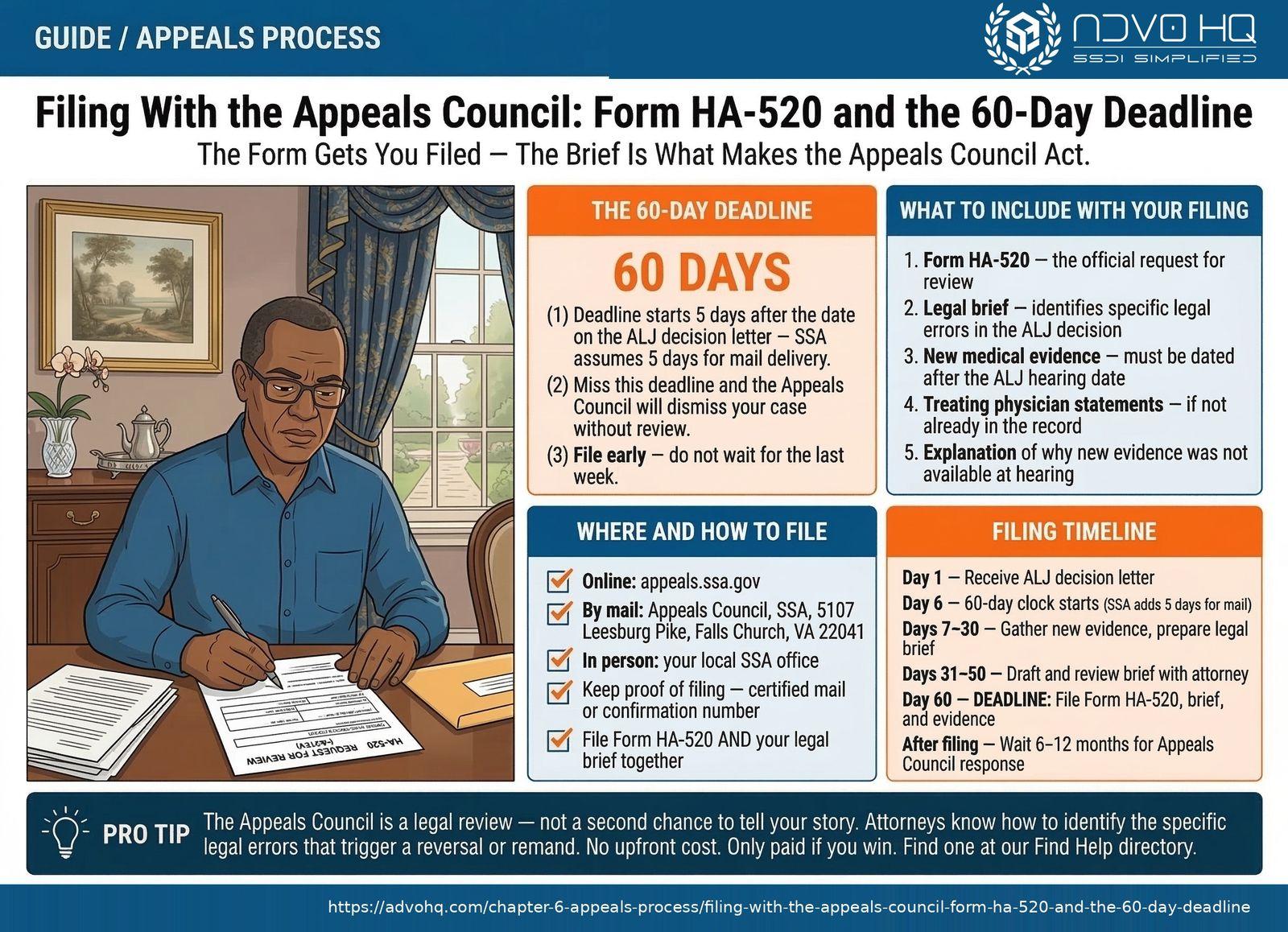
The 60-Day Deadline: How It's Calculated
- When the clock starts — SSA assumes you received the decision 5 days after the date on the letter. Your 60-day clock starts from that assumed receipt date.
- Example — Decision dated March 1. Assumed receipt: March 6. Deadline: May 5 (60 days from March 6).
- If you miss the deadline — You can request an extension by showing "good cause"—such as serious illness, natural disaster, or not receiving the decision. But this is not guaranteed. Don't rely on extensions.
- How to file — Submit Form HA-520 to SSA. You can file online at ssa.gov, by mail, by fax, or in person at your local SSA office.
- File the form first, brief later — If you need more time to prepare your legal brief, file Form HA-520 within the deadline and request additional time to submit your written argument. This protects your appeal rights.
If you miss the 60-day window without good cause, you lose your right to Appeals Council review AND federal court review. Your only option becomes filing a completely new application, losing your original onset date and the back pay that goes with it. This is one of the most consequential deadlines in the entire SSDI process.
Form HA-520: What It Asks And How To Complete It
If you have an attorney, they file the HA-520, write the legal brief, and submit any new evidence. If you don't have an attorney, file the form yourself to meet the deadline and then find one. Many attorneys take cases at the Appeals Council stage on contingency.
The Legal Brief: The Document That Matters Most
Form HA-520 gets your appeal filed. The legal brief is what actually persuades the Appeals Council to act. Here's what a strong brief includes:
Submitting New Evidence: The Rules
- New and material — The evidence must be something new (not already in the record) and material (could change the outcome). A new RFC from your doctor showing greater limitations qualifies. A duplicate of records already submitted does not.
- Relates to the period before the decision — The evidence must address your condition during the period the ALJ evaluated—not new conditions that developed after the decision.
- Good cause for not submitting earlier — You must explain why this evidence wasn't available at the hearing level. Valid reasons: the medical appointment occurred after the hearing, the doctor's office delayed providing records, or you didn't know the evidence existed.
- Types of strong new evidence — Updated treating physician RFC forms, new diagnostic results confirming your conditions, medical opinions from specialists you've seen since the hearing, mental health evaluations.
Sometimes the ALJ's decision was technically correct based on the record at the time, but new evidence changes the picture. A new MRI showing worsened disc disease, an updated RFC showing greater limitations, or a new mental health diagnosis can make a previously weak appeal much stronger. But the Appeals Council's gate is narrow: the evidence must be new and material, relate to the period on or before the date of the ALJ's decision, and show a reasonable probability of changing the outcome, and you must show good cause for not submitting it earlier (20 CFR 404.970(b)).
Where To File And How
File at ssa.gov through your my Social Security account. Fastest method — you get immediate confirmation.
Send to: Appeals Council, Office of Appellate Operations, SSA, 5107 Leesburg Pike, Falls Church, VA 22041. Use certified mail with return receipt for proof of filing.
Fax directly to the Appeals Council. Get the current fax number from your hearing office or ssa.gov.
File at your local SSA field office. Ask them to stamp the date received on your copy as proof.
Filing Timeline: When To Do What
Contact your attorney immediately. Calculate your 60-day deadline.
Attorney identifies legal errors and discusses appeal potential with you.
Schedule appointments if needed for updated RFC or specialist evaluation.
You obtain and submit any new medical records.
Don't wait until the last day.
Request additional time for the brief. Meeting the deadline is more important than a complete filing.
Frequently Asked Questions
Exactly 60 days from the date you received the ALJ decision. SSA presumes you received it 5 days after the date printed on the letter, so a decision dated March 1 is treated as received March 6 — making the deadline May 5. Miss the window without good cause and you lose both Appeals Council and federal court review.
Form HA-520 (Request for Review of Hearing Decision/Order). You can file it online at ssa.gov, by mail, by fax, or in person at your local SSA field office. If your brief isn't ready, file the form alone to protect the deadline and request more time for the written argument.
Of the requests for review that the Appeals Council acts on, most are denied. When it does grant relief, it rarely awards benefits outright — a remand back to an ALJ for a new hearing is the more common favorable outcome, and often the more realistic goal. These are outcomes measured among the people who request Appeals Council review, not shares of all disability applicants: SSA's overall application "waterfall" (roughly 20% approved at the initial level, about 2% at reconsideration, and about 7% at the hearing level or above, for a final award rate near 29% of all applicants) is a separate statistic and does not translate into a per-stage Appeals Council grant rate. SSA does not publish a single official grant-or-remand rate for Appeals Council review, so any specific percentage you see is an estimate, not a primary-sourced figure — which is exactly why a well-argued legal brief matters so much. For the full picture of how the Appeals Council reviews and decides cases, see What The Appeals Council Actually Does With Your Case.
Plan for a long wait — often a year or more. SSA does not publish a current average processing time for Appeals Council review, and case-to-case timing varies widely, so build in a generous cushion rather than counting on a fixed date. During that time, continue medical treatment and keep all of your records organized so you're ready if the case is remanded for a new hearing.
Yes, but it must be new and material, relate to the period the ALJ evaluated (not conditions that developed afterward), and you must show good cause for not submitting it earlier. Updated treating-physician RFC forms and new diagnostic results are among the strongest types.
What They Don't Tell You
Insider knowledge that can make or break your application:
Filing the form is easy — writing the brief is hard
Form HA-520 is a simple one-page document. The legal brief that accompanies it is the real work: it requires analyzing the ALJ's decision against SSA regulations and case law. This is why attorney representation matters at the Appeals Council level.
You can file the form and add the brief later
If the deadline is approaching and your brief isn't ready, file Form HA-520 with a note requesting additional time to submit your legal argument. Protecting the deadline is more important than having a perfect filing.
The Appeals Council takes a long time
After filing, expect a long wait — often a year or more. SSA does not publish a current average processing time for this stage, and it varies widely case to case. During that time, continue medical treatment and keep all records organized.
You can still hire an attorney at this stage
If you went to the hearing without an attorney and lost, it's not too late. Many disability attorneys take cases at the Appeals Council stage, especially if the decision contains clear legal errors.
File the bare HA-520 to protect your deadline
You don't need your legal brief or new records ready to protect your appeal — file the bare Form HA-520 (or even a plain letter saying you want review) within the deadline, then request extra time to submit your argument. And the clock is more generous than it looks: your 60 days runs from receipt, and SSA presumes you got the decision 5 days after its date, so you effectively have about 65 days from the date on the notice. If you're self-represented, lock in the deadline first and bring in an attorney to draft the brief that pins each error to a specific regulation and the exact pages of the decision. Learn more in What The Appeals Council Actually Does With Your Case.
Filing with the Appeals Council requires Form HA-520 submitted within 60 days.
Filing with the Appeals Council requires Form HA-520 submitted within 60 days. But the form is just the vehicle — the legal brief and any new evidence are what determine whether the Appeals Council acts on your case. File early, include a detailed brief identifying specific legal errors, and submit any new medical evidence that strengthens your case. If you don't have an attorney, get one. Appeals Council review is a legal analysis, not a retelling of your story.
Up Next: What The Appeals Council Actually Does With Your Case—the review process, three possible outcomes, and realistic expectations.
Don't Miss The 60-Day Deadline
A disability attorney can review your unfavorable decision, identify legal errors, write a strong Appeals Council brief, and file everything within the deadline. Free consultation. No upfront cost.
→ Find A Disability Attorney In Your County
→ Get Your Decision Reviewed Before The Deadline
Not affiliated with SSA or any government agency. For informational purposes only — not legal advice.
- Social Security Administration — [Request for Review of Hearing Decision/Order (Form HA-520)](. ssa.gov
- Social Security Administration — [The Appeals Process](. ssa.gov
- Code of Federal Regulations — [20 C.F.R. § 404.967 (Appeals Council review — general)](. ecfr.gov
- Code of Federal Regulations — [20 C.F.R. § 404.968 (Time and place to request Appeals Council review)](. ecfr.gov
- Code of Federal Regulations — [20 C.F.R. § 404.970 (Cases the Appeals Council will review; new and material evidence)](. ecfr.gov
- Code of Federal Regulations — [20 C.F.R. § 404.901 (Definition of "date you receive notice" — the 5-day mailing presumption)](. ecfr.gov
- Social Security Administration — Annual Statistical Report on the SSDI Program, 2024, Sec. 4: Outcomes of Applications for Disability Benefits. ssa.gov
- Social Security Administration — Social Security performance: Disability appeals processing time. ssa.gov
- Social Security Administration — HALLEX I-3-1-1, Filing a Request for Review of Hearing Decision/Order; [20 C.F.R. § 404.968](. ssa.gov