
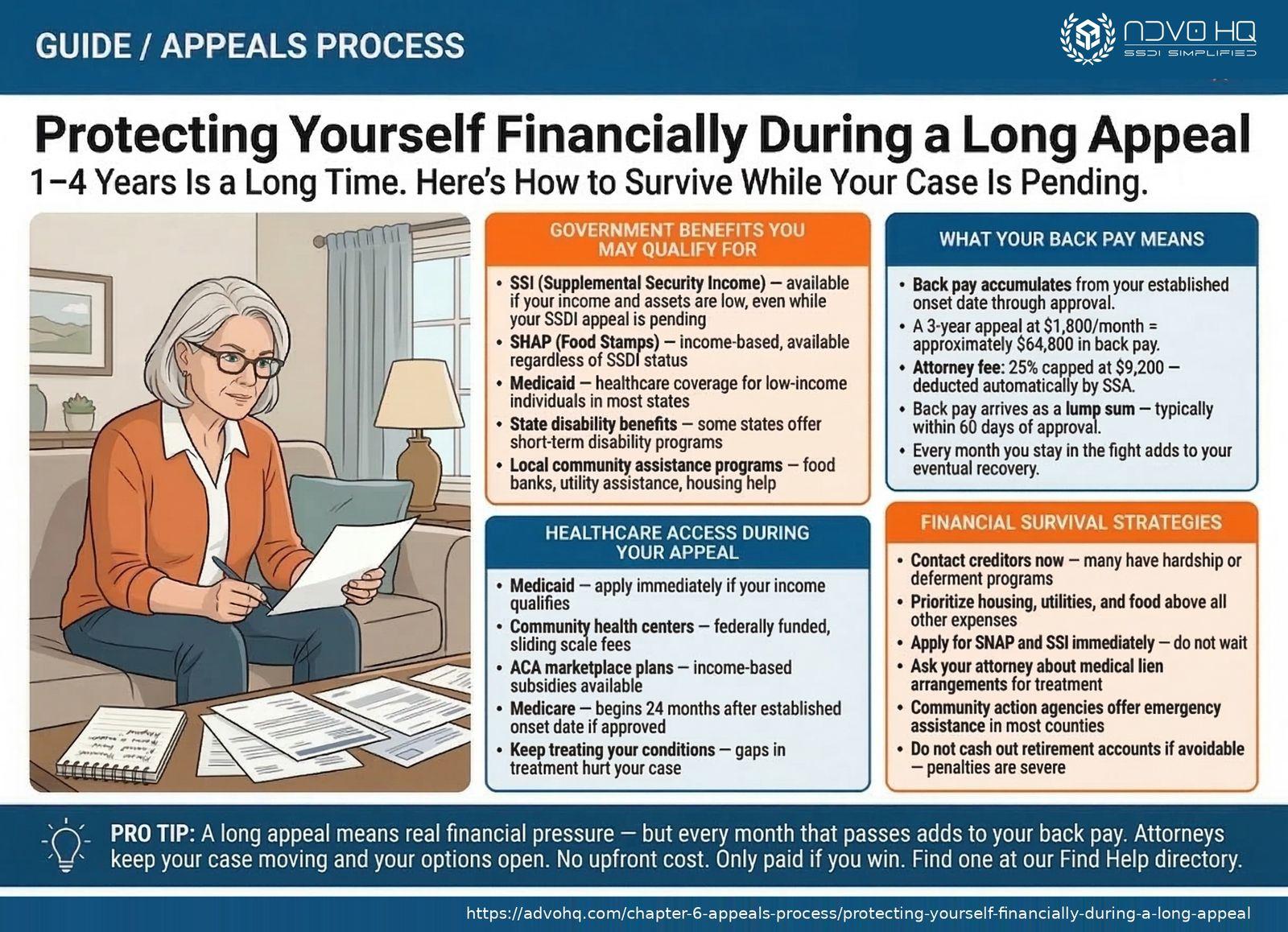
Government Benefits You May Qualify For Now
Who qualifies: Low-income individuals who are disabled, blind, or 65+. Asset limits: $2,000 individual, $3,000 couple. SSI uses the same disability definition as SSDI.
Who qualifies: Low-income households. Income limits vary by state and household size. Disability may increase your allotment.
Who qualifies: Low-income individuals. Expanded Medicaid covers adults under 138% of the federal poverty level in most states.
Who qualifies: Low-income households struggling with heating/cooling costs.
Who qualifies: Some states offer short-term disability benefits. Availability and eligibility vary by state.
Who qualifies: If you're a veteran with a service-connected disability, you may qualify for VA disability compensation separately from SSDI.
If you qualify for SSI based on low income and assets, you can receive SSI payments while your SSDI appeal is pending. When SSDI is eventually approved, SSI adjusts or stops — the SSI payments bridge the gap, and your SSDI back pay automatically repays any SSI overpayment.
Healthcare Access During Your Appeal
If you qualify based on income, Medicaid covers medical treatment at little or no cost.
If your income is low, you may qualify for significant premium subsidies through healthcare.gov.
Federally Qualified Health Centers provide care on a sliding fee scale based on income. They cannot turn you away for inability to pay.
Many communities have free clinics that provide basic medical care.
Most hospitals have financial assistance programs for uninsured patients.
Patient assistance programs from drug manufacturers provide medications free or at reduced cost.
Healthcare access isn't just about your wellbeing during the appeal — it's about your case. If you stop treatment, SSA can argue your condition improved. Continuous treatment records are evidence that your disability persists. Find a way to maintain treatment even if it means using free or reduced-cost options.
Financial Survival Strategies
SNAP, Medicaid, LIHEAP, SSI, state programs—every program reduces your monthly expenses.
Most creditors (credit cards, medical bills, utilities) have hardship programs that reduce or pause payments during financial difficulty.
If you're struggling with rent or mortgage, contact your local housing authority about Section 8, emergency rental assistance, or mortgage forbearance programs.
Local food banks, churches, and community organizations provide food, clothing, and emergency financial assistance.
Payday loans, title loans, and high-interest personal loans can create a debt spiral that makes your financial situation dramatically worse.
You can earn up to the SGA limit (around $1,690/month in 2026) without affecting your SSDI claim. Even part-time work within your limitations can help financially.
Medicare And Medicaid Timing
You become eligible for Medicare 24 months after your disability onset date—NOT 24 months after approval.
Medicaid is available based on income, regardless of your SSDI status. Apply now if you qualify.
Once approved for SSDI and Medicare, you may qualify for both Medicare and Medicaid simultaneously ("dual eligible").
In some states, Medicaid can be applied retroactively for up to 3 months before your application date.
What Your Back Pay Means Financially
Understanding your potential back pay helps with financial planning during the appeal:
While the appeals process is agonizingly slow, each month adds to your eventual back pay award. A case that takes 4 years from application to approval can result in six figures of back pay. This doesn't help you today, but it provides significant financial recovery once approved. The attorney fee cap means more stays in your pocket as back pay grows.
The Complete Appeals Process Series: What You've Learned
- Reading Your Unfavorable Decision — the decision structure, 10 most common legal errors, finding appeal-worthy issues.
- Filing With The Appeals Council — Form HA-520, the 60-day deadline, the legal brief, new evidence rules.
- What The Appeals Council Does — the review process, three outcomes, realistic expectations, denial of review.
- Your Case Gets Remanded — what the remand order says, strengthening your case, the second hearing.
- Federal Court Review — when it makes sense, the process, standard of review, costs, realistic outcomes.
- New Application vs. Appeal — the decision framework, dual track strategy, onset date protection.
- Winning Strategies — errors that get reversed, attorney approaches, mental health strategy, age-based tactics.
- Financial Protection — other benefits, healthcare access, survival strategies, back pay planning.
Frequently Asked Questions
Yes, if your income and assets are low enough. In 2026 the SSI asset limit is $2,000 for an individual and $3,000 for a couple. SSI uses the same disability definition as SSDI, so it can also help establish your disability. When SSDI is approved, SSI adjusts or stops and your SSDI back pay automatically repays any overlapping SSI you received.
You can earn up to the Substantial Gainful Activity (SGA) limit — about $1,690/month in 2026 for non-blind claimants — without it counting against your claim. Limited part-time work within your restrictions can actually support your case by showing you can't sustain full-time employment. Talk to your attorney before you start.
No. Medicaid is income-based and separate from SSDI. Once approved, you may be "dual eligible" for both Medicare and Medicaid. Your SSDI back pay is generally protected from most creditor garnishments, though federal debts (taxes, student loans, child support) are exceptions.
Dial 211. It's a free, confidential line available in most communities that connects you to food banks, utility and rental assistance, housing help, transportation, and healthcare resources.
It can be, depending on your total combined income for the year. Because a lump sum covers several past years, the IRS lets you allocate it back across those years with a special election that can lower the tax owed. Consult a tax professional when your award arrives.
What They Don't Tell You
Insider knowledge that can make or break your application:
You can work part-time without killing your case
Earning below SGA (about $1,690/month in 2026 for non-blind claimants) doesn't disqualify you from SSDI. Limited work within your restrictions can help financially and may actually support your case by showing you can't sustain full-time employment. Discuss with your attorney first.
SSI payments can bridge the gap
If you qualify for SSI based on low income and assets, you receive monthly payments while your SSDI case is pending. When SSDI is approved, the back pay automatically repays any SSI overlap. This is a legitimate, intended safety net.
211 is the number for community resources
Dialing 211 connects you to local services: food banks, utility assistance, housing help, transportation, healthcare, and more. It's free, confidential, and available in most communities.
There are tax implications to back pay
When you receive a large SSDI back pay lump sum, it may be taxable depending on your total income. The IRS lets you allocate back pay across the years it covers using a special calculation that may reduce your tax burden. Consult a tax professional when you receive your award.
Your SSDI back pay cannot be garnished by most creditors
Social Security benefits are protected from most creditor garnishments (credit cards, medical bills, personal loans). Federal debts (taxes, student loans, child support) are exceptions. This means your back pay is generally safe from creditor seizure.
Apply for SSI now while your appeal drags on
While your SSDI appeal drags on, apply for SSI as a concurrent claim if your income and assets are low — SSI can pay something now, and in most states an SSI approval automatically opens the door to Medicaid, giving you cash and health coverage during the wait. The limits are strict (a $2,000 individual resource cap and low income thresholds), so higher earners often won't qualify, but for those who do it's a genuine safety net that runs in parallel with your SSDI appeal rather than replacing it. When SSDI is finally approved, your back pay automatically repays any overlapping SSI you received — so it truly bridges the gap rather than costing you.
The appeals process is long, and the financial pressure is real.
The appeals process is long, and the financial pressure is real. But you're not without options. Government benefit programs, healthcare access through community health centers and Medicaid, creditor hardship programs, and community resources can help you survive while your case is pending. Continue medical treatment — it protects both your health and your case. And remember: every month that passes adds to your eventual back pay. When you're finally approved, the financial recovery can be substantial. Stay in the fight.
Still Fighting? An Attorney Can Help At Any Stage.
Whether you're at the Appeals Council, considering federal court, preparing for a remand hearing, or filing a new application, an experienced disability attorney can evaluate your case and guide your next step. Contingency fee—no upfront cost. Your attorney only gets paid when you win.
→ Find A Disability Attorney In Your County
→ Request A Free Case Review
Start From The Beginning
New to MyGoveBenefits? Start with our Initial Application Series to learn the complete SSDI process from step one. Or explore our Reconsideration Series and ALJ Hearing Series for guidance at every stage.
Not affiliated with SSA or any government agency. For informational purposes only — not legal advice.
- Social Security Administration — Substantial Gainful Activity (SGA). See also SSA, [2026 Social Security Changes Fact Sheet](. ssa.gov
- Social Security Administration — [Supplemental Security Income (SSI)](; 2026 SSI asset limits $2,000 individual / $3,000 couple, and federal payment standard $994 individual / $1,491 couple ([SSI Overview](. ssa.gov
- 20 C.F.R. § 404.621 — [Retroactive (back-pay) benefits: up to 12 months before filing, net of the 5-month waiting period]( Back pay continues to accrue while an appeal is pending. ecfr.gov
- Attorney fee cap — 42 U.S.C. § 406(a)(2) and 20 C.F.R. § 404.1720; maximum fee-agreement fee = 25% of past-due benefits or $9,200, effective November 30, 2024 ([Fed. Reg. 2024-10248, "Maximum Dollar Limit in the Fee Agreement Process"](; SSA [Fee Agreements]( The May 6, 2025 partial rescission left the $9,200 cap unchanged. federalregister.gov
- Medicaid — Medicaid.gov and HealthCare.gov. medicaid.gov
- Medicare 24-month qualifying period — 42 U.S.C. § 426(b) (Cornell LII. law.cornell.edu
- Benefits.gov — SNAP and LIHEAP](. benefits.gov
- IRS — Publication 915, Social Security and Equivalent Railroad Retirement Benefits. irs.gov
- Social Security Administration — Supplemental Security Income (SSI) eligibility and resource limits; SSI–Medicaid linkage in most states — SSI Eligibility. ssa.gov