
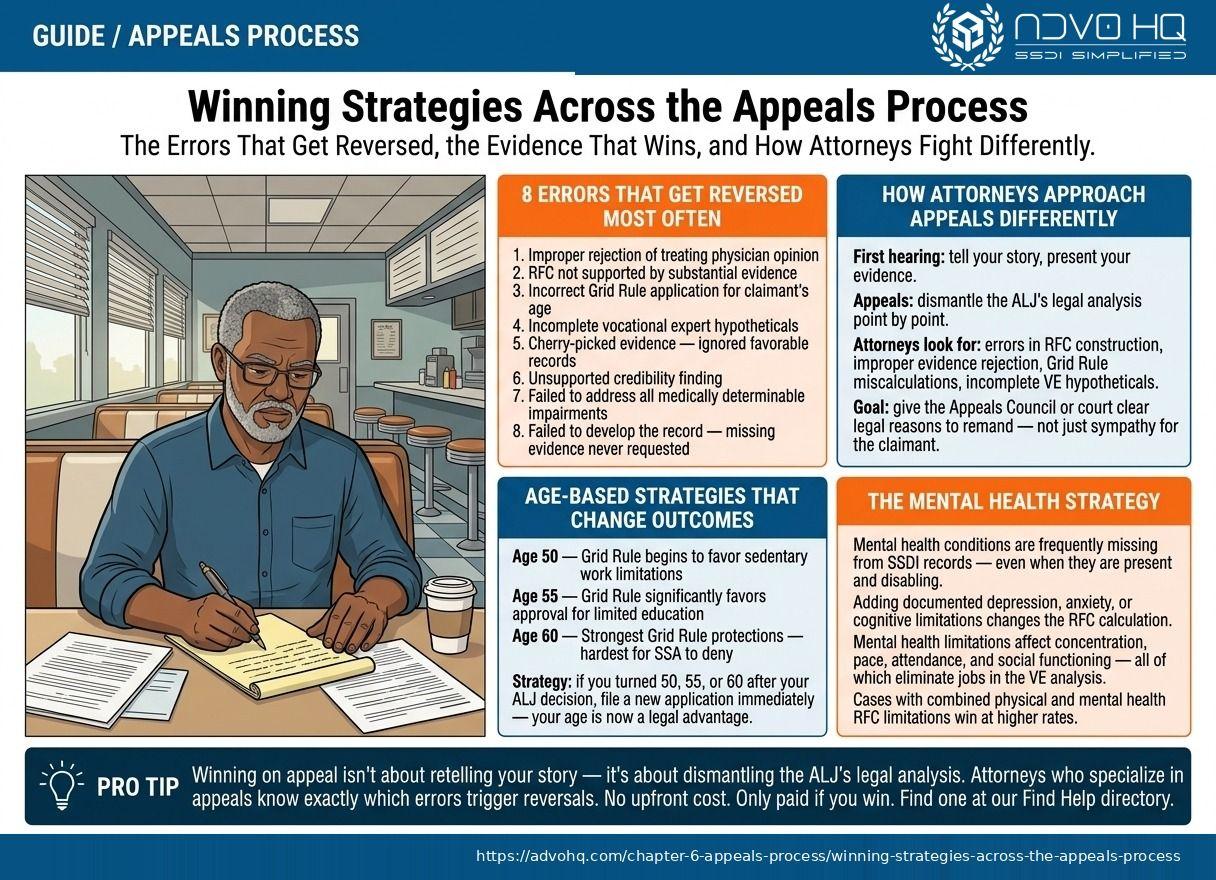
The 8 Errors That Get Reversed Most Often
- Rejecting treating physician without specific reasons — SSA rules require the ALJ to explain why they rejected a treating source’s opinion using specific factors. Conclusory rejections are consistently reversed.
- Wrong Grid Rule application — Pure legal error with a clear remedy. The Appeals Council or court simply applies the correct rule. Common when claimants cross age thresholds.
- RFC not supported by any medical source — An RFC that doesn’t match any doctor’s opinion—treating, consulting, or reviewing—suggests the ALJ substituted their own medical judgment.
- Incomplete Vocational Expert hypothetical — When the ALJ’s own RFC includes limitations not presented to the Vocational Expert, the vocational testimony is unreliable and the Step 5 finding is unsupported.
- Failure to consider combined impairments — Evaluating conditions in isolation rather than considering their combined effect violates SSA’s requirement to assess the whole person.
- Ignoring favorable Medical Expert or Vocational Expert testimony — If an expert testified in the claimant’s favor and the ALJ didn’t address it, that’s a failure to evaluate all the evidence.
- Boilerplate credibility analysis — Using SSA’s template language without case-specific analysis of which statements are inconsistent and why. Courts have repeatedly criticized this.
- Failure to develop the record — The ALJ had gaps in the medical record and didn’t take steps to fill them, particularly when the claimant was unrepresented.
How Attorneys Approach Appeals Differently Than First Hearings
- Focus: building evidence and presenting your case persuasively
- Key document: pre-hearing brief that frames the case for the ALJ
- Evidence strategy: gather all evidence, get RFCs, fill gaps
- Audience: a single ALJ who evaluates credibility and weighs evidence
- Tone: persuasive — "here’s why my client is disabled"
- Focus: identifying specific legal errors in the ALJ’s decision and arguing they require reversal or remand
- Key document: Appeals Council brief or federal court brief that dissects the decision for legal errors
- Evidence strategy: focus on what the ALJ ignored, mischaracterized, or improperly rejected — new evidence is targeted to specific weaknesses
- Audience: Appeals Council staff attorneys or federal judges who evaluate whether the ALJ followed the law
- Tone: legal — "here’s where the ALJ violated SSA regulations"
Building The Strongest Record At Every Stage
Continue medical treatment and keep your record current while the appeal is pending.
You can submit new, material evidence with a good cause explanation.
The record is generally closed — no new evidence can be submitted.
This is your biggest opportunity — the remand order is a blueprint for exactly what needs to be strengthened.
Start with the strongest possible evidence from day one — don’t wait for SSA to request records.
The Mental Health Strategy: Why It Wins Appeals
If the ALJ’s decision didn’t account for mental health because evidence was thin, new mental health documentation creates a fundamentally different case for remand.
If the ALJ found only mild limitations in the four areas of mental functioning but the evidence supports moderate or marked limitations, this is a clear analytical error.
Even if your physical RFC alone allows some sedentary work, adding mental limitations — concentration, absences, off-task time — can eliminate all remaining jobs at Step 5.
Cognitive fog, drowsiness, and concentration problems from pain medications are mental health evidence. If the ALJ didn’t account for them, that’s a documented RFC error.
Many initial applications and hearings focus on physical limitations. Adding comprehensive mental health evidence at the appeals stage — through new evaluations, mental RFCs, and medication side-effect documentation — can transform a case that was weak on physical grounds into a winner on combined grounds.
Age-Based Strategies That Change Outcomes
Grid Rules become significantly more favorable at 50. A sedentary RFC with limited education and medium/heavy past work directs disability.
Grid Rules become even more favorable at 55. A light RFC now directs disability for older individuals with limited transferable skills.
If you’re within months of 50 or 55, delaying a new hearing or application to cross the threshold may be strategically beneficial.
Frequently Asked Questions
It depends heavily on the stage. The Appeals Council directly approves only a small share of cases (an outcome commonly estimated at roughly 1–2%), but it remands a larger share back to an ALJ for a new hearing. Federal district court reverses outright in only a minority of cases, but it remands a substantially larger share — SSA's official public data put court remands at about 69.9% of new court cases filed in FY2023 (a case-processing outcome, not a per-applicant success rate). (These stage-level figures come from secondary compilations of SSA and federal court data, not from SSA's primary Annual Statistical Report, whose published outcome figures are shares of all applicants ultimately allowed at each level — about 20% at the initial level, 2% at reconsideration, and 7% at hearing or above, for a ~29% final award rate — not per-stage grant rates.) The takeaway holds regardless of the exact percentages: most appeal "wins" are second chances, not instant approvals.
Remand. Rather than awarding benefits directly, the Appeals Council or court usually sends your case back for another hearing with instructions to fix the identified errors. Winning at appeals most often means winning at the hearing on remand — which is why building targeted evidence for that next hearing matters so much.
At the Appeals Council, yes — new evidence must be new, material, and accompanied by a good-cause explanation for why it wasn't submitted earlier. In federal court the record is generally closed, with only a narrow "sentence six" remand allowing new, material evidence. Before a remand hearing, new evidence is not just allowed — it's your biggest opportunity.
Appeals are legal work, not just storytelling. They turn on identifying regulatory errors in the ALJ's written decision and framing them for reviewers who judge whether the law was followed. An experienced disability attorney knows which errors get cases remanded and how to build the record for a second chance. Representation is typically offered with no upfront cost.
Appeals Council review often takes about a year or more (SSA does not publish a current average), and a federal court case adds more time on top of that. A remand then routes you back for another ALJ hearing. The wait is real — but every additional month you're eventually approved for adds to your accrued back pay.
What They Don't Tell You
Insider knowledge that can make or break your application:
The appeals process rewards persistence
Many people who are eventually approved went through multiple denials before winning. The process is designed to filter out weak cases, but it also catches people who should have been approved the first time. Persistence with the right evidence and the right attorney matters.
Every month of delay adds to your back pay
While the wait is painful, the financial math works in your favor. As an illustration, a case that takes 3 years from application to approval at $2,200/month would generate about $79,200 in past-due benefits — before the attorney fee is deducted. (These figures are illustrative; your monthly benefit and back-pay period will differ.) Under the fee-agreement process, that fee is 25% of past-due benefits capped at $9,200 (effective November 30, 2024), so on a $79,200 back-pay award the fee is the $9,200 cap. The system's slowness, paradoxically, increases your financial award.
The strongest appeals combine legal-error arguments with new evidence
Don't rely on just one strategy. The best Appeals Council filings identify legal errors in the decision AND submit new evidence that addresses the weaknesses. This gives the Appeals Council multiple reasons to remand.
Winning at appeals often means winning at the hearing on remand
The most common successful appeal outcome is remand — you get a second hearing. The appeals process doesn't typically end with a direct approval; it gives you another chance to present your case with specific advantages.
New evidence at the Appeals Council goes through a narrow gate
New evidence at the Appeals Council goes through a very narrow gate — it isn't enough that a record is simply newer. It must be new, material, and relate to the period on or before the date of the hearing decision, with a reasonable probability it would change the outcome, and you must show good cause for not submitting it earlier (20 C.F.R. § 404.970(b)). A brand-new MRI dated after your hearing usually won't qualify unless it documents your condition during the covered period — so tie every late exhibit back to the closed period. An experienced attorney knows how to frame that connection, and works on contingency with no upfront cost.
Winning at the appeals level requires a fundamentally different approach than winning at the hearing level.
Winning at the appeals level requires a fundamentally different approach than winning at the hearing level. It's about identifying legal errors, building targeted evidence to address specific weaknesses, leveraging age-based Grid Rule advantages, and adding mental health documentation that may have been missing. The attorneys who win appeals aren't just retelling your story — they're dismantling the ALJ's legal analysis and giving the Appeals Council or court clear reasons to send your case back.
Up Next: Protecting Yourself Financially During A Long Appeal—other benefits you may qualify for, financial survival strategies, and what to do while you wait.
Winning Appeals Requires A Different Kind Of Attorney Work
Appeals require legal analysis, not just case presentation. An experienced disability attorney identifies the errors that get cases remanded and builds the evidence to support a second chance. Free consultation. No upfront cost.
→ Find A Disability Attorney In Your County
→ Get A Free Appeals Strategy Review
Not affiliated with SSA or any government agency. For informational purposes only — not legal advice.
- Social Security Administration — [The Appeals Process](. ssa.gov
- 20 C.F.R. § 404.900 — Introduction: steps in the administrative review process. ecfr.gov
- 20 C.F.R. § 404.970 — Appeals Council standards of review sets the new-evidence gate: evidence must be new, material, relate to the period on or before the hearing decision, show a reasonable probability of changing the outcome, and be accompanied by good cause under § 404.970(b)(1)–(3). ecfr.gov
- 42 U.S.C. § 405(g) (Social Security Act § 205(g)) — [Judicial review; substantial-evidence standard](. ssa.gov
- 20 C.F.R. § 404.1520c — Evaluating medical opinions (supportability and consistency). ecfr.gov
- Social Security Administration — [Medical-Vocational Guidelines (Grid Rules)]( 20 C.F.R. Part 404, Subpart P, Appendix 2. ssa.gov
- Social Security Administration — *Annual Statistical Report on the Social Security Disability Insurance Program, 2024, Table 60 & Chart 11 (award/allowance figures are shares of all applicants, not per-stage grant rates). ssa.gov
- Social Security Administration — [Court Remands as a Percentage of New Court Cases Filed]( OARO/OHO Public Data Files (FY2023 ≈ 69.9%, remands ÷ new court cases filed; landing: [Appeals public data files](. ssa.gov
- Attorney fee cap ($9,200, 25% of past-due benefits, effective November 30, 2024): 42 U.S.C. § 406(a)(2); 20 C.F.R. § 404.1720; [Maximum Dollar Limit in the Fee Agreement Process, 89 Fed. Reg. (May 10, 2024)](; SSA — [Fee Agreements](. federalregister.gov