
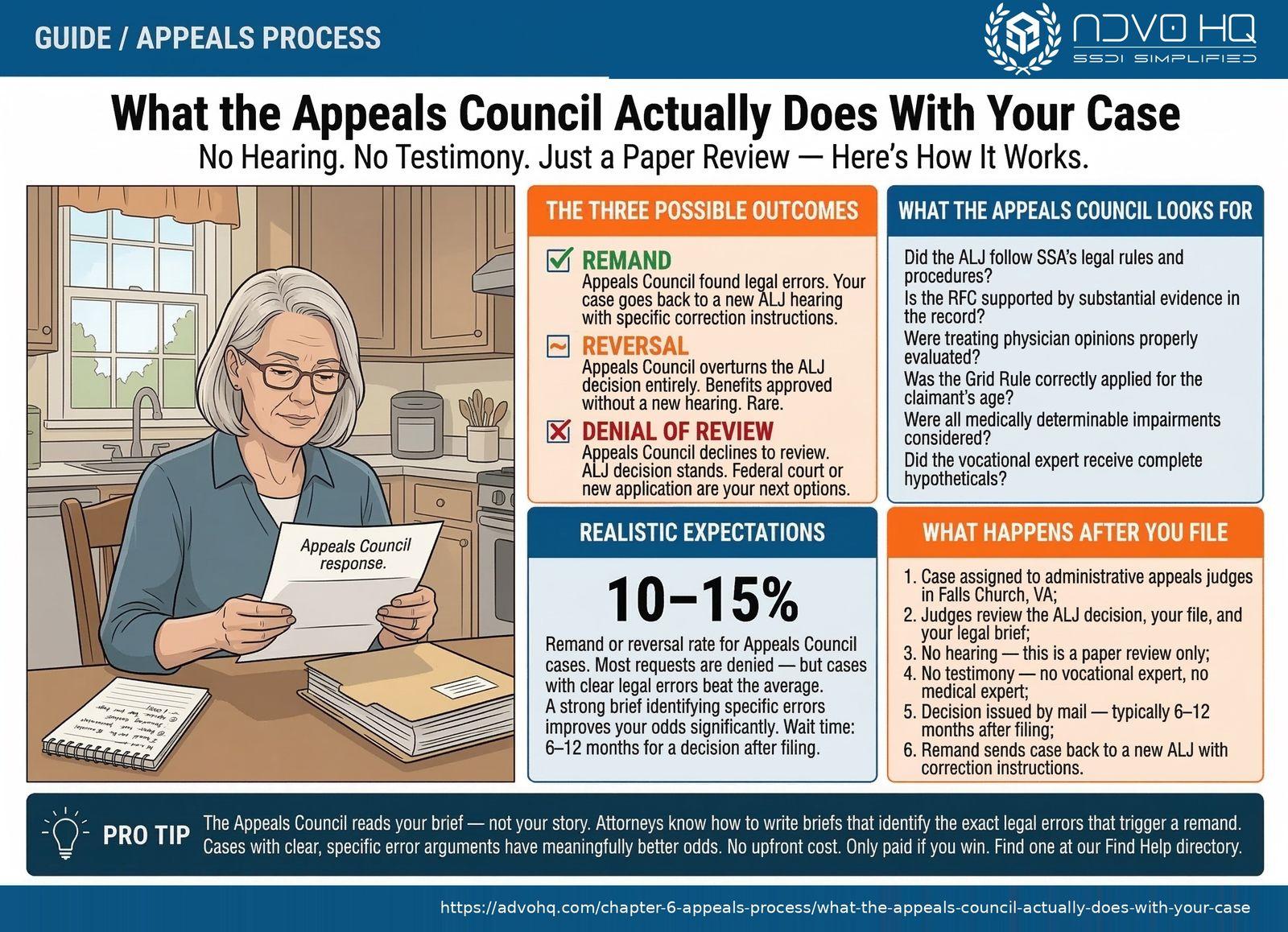
The Review Process: What Happens After You File
Your request is logged and assigned a docket number. You or your attorney receive written confirmation.
A staff attorney reviews your request and brief to determine whether the case warrants full review. They look for clear legal errors, new evidence, or procedural problems.
If the case passes screening, an Administrative Appeals Judge reviews the complete record: all medical evidence, the ALJ’s decision, your brief, and any new evidence submitted.
The Appeals Council issues one of three outcomes: denial of review, remand, or a new decision. You receive a written notice explaining the outcome. Expect 6–12+ months from filing to decision. Complex cases or cases with new evidence can take longer. There’s no way to speed up the process.
The Three Possible Outcomes
The Appeals Council declines to review the ALJ’s decision. The ALJ’s unfavorable decision stands as SSA’s final decision. This is the most common outcome—roughly 85–90% of requests.
The Appeals Council sends your case back to an ALJ for a new hearing. They identify specific errors and instruct the ALJ to address them. This is the most favorable outcome short of winning outright.
The Appeals Council issues its own decision—either favorable or unfavorable—replacing the ALJ’s decision entirely. This is rare but possible.
The Appeals Council rarely issues its own favorable decision. More commonly, they remand the case for a new hearing with instructions — such as "properly evaluate the treating physician's RFC" or "apply the correct Grid Rule." A remand gives you a second chance at the hearing level, often with a stronger position because the Appeals Council has identified what went wrong.
What The Appeals Council Looks For
- Legal errors in the ALJ’s decision — Did the ALJ follow SSA regulations? Did they properly evaluate medical evidence? Did they apply the correct legal standards?
- Abuse of discretion — Did the ALJ make decisions that no reasonable judge would make given the evidence? Were conclusions arbitrary or unsupported?
- Factual errors — Did the ALJ get basic facts wrong—your age, education level, work history, or the content of medical records?
- New and material evidence — If you submitted new evidence, does it change the picture enough to potentially alter the outcome?
- Constitutional or procedural issues — Were your due process rights violated? Was the hearing conducted properly?
The Appeals Council generally doesn't substitute its own judgment for the ALJ's on questions like "how much pain is this person in?" They look for whether the ALJ followed the rules in reaching that conclusion. This is why your brief must identify specific legal errors, not just argue that the ALJ should have believed you.
Denial Of Review: What The Letter Means
- "We found no reason under our rules to review the ALJ’s decision." — The Appeals Council determined the ALJ’s decision was legally adequate. They may not agree with the outcome, but they found no reviewable error.
- "We considered the additional evidence you submitted." — They looked at your new evidence but determined it didn’t change the analysis enough to warrant review or remand.
- "The ALJ’s action, findings, or conclusion is not contrary to the weight of the evidence." — Standard language meaning the decision was within the ALJ’s discretion given the record.
- Your 60-day federal court deadline — The denial letter includes your right to file a civil action in federal court within 60 days. This is your next appeal option.
Realistic Expectations: The Numbers
These numbers seem discouraging, but context matters. The 10–15% remand rate represents cases where the Appeals Council found genuine legal errors. If your brief identifies clear, specific errors—like improper rejection of treating physician opinions or wrong Grid Rule application—your odds are better than the overall average.
Frequently Asked Questions
No. It's a paper review — there's no testimony, no vocational expert, and no in-person appearance. A relatively small corps of Administrative Appeals Judges (and their staff attorneys) reads your file, the ALJ's decision, and your brief, then decides whether the ALJ made a reviewable error.
Denial of review (the ALJ's decision stands), remand (your case goes back to an ALJ for a new hearing), or the Appeals Council issuing its own decision. Denial is by far the most common; remand is the realistic goal.
Under 20 C.F.R. § 404.970, it reviews for abuse of discretion, error of law, or a conclusion not supported by substantial evidence — plus a broad policy or procedural issue affecting the public interest, or qualifying new and material evidence. It generally does not reweigh the evidence or re-decide whether you're disabled — it checks whether the ALJ followed the rules.
Most decisions land in the year-or-more range, though complex cases or cases with new evidence can run longer. There's no expedite option at this level.
You have 60 days from the denial notice to file a civil action in federal district court (see Federal Court Review: Taking SSA To Court), or you can start a new SSDI application. A denial here is not necessarily the end of the road.
What They Don't Tell You
Insider knowledge that can make or break your application:
The Appeals Council can also review cases on its own
Even without your request, the Appeals Council can review any ALJ decision within 60 days of the decision date. This is called "own motion review." It's rare, but it means favorable decisions can occasionally be pulled back and reversed.
You almost never get to talk to the Appeals Council
Review is essentially all on paper — no phone call, no meeting, and in the ordinary case no hearing. The Appeals Council can grant oral argument, but only in the rare case it decides a significant question of law or policy makes it necessary (20 CFR 404.976(c)), so you should assume your written brief is the only voice you have at this stage — which is why its quality matters so much.
Continue medical treatment while you wait
The year-or-more wait is time you should use to keep building your medical record. If you get a remand, you'll go back to a hearing with updated evidence already in hand.
A denial isn't necessarily the end
Federal court review is another opportunity, and filing a new application is always an option. Many people who are ultimately approved went through multiple rounds of the process first.
A small panel handles a huge caseload
A comparatively small group of Administrative Appeals Judges nationwide reviews every request that reaches this level. That volume is part of why the process is slow and why a tightly argued brief that points to a specific legal error stands out.
The Appeals Council does one of three things
The Appeals Council never holds a hearing, never takes new testimony, and rarely awards benefits outright — it mostly does one of three things: deny review (leaving the ALJ decision final), remand your case to an ALJ for a do-over, or, rarely, issue its own decision. Know the flip side too: the Council can open your case on its own motion and can issue a decision that is less favorable than the ALJ's, so requesting review is not entirely risk-free. That is one more reason your brief should point to a concrete legal error — an abuse of discretion, an error of law, findings not supported by substantial evidence — rather than simply re-arguing the facts.
The Appeals Council is a paper review that looks for legal errors in the ALJ’s decision.
The Appeals Council is a paper review that looks for legal errors in the ALJ's decision. Most requests are denied, but cases with clear legal errors have a meaningful chance of remand. The quality of your legal brief determines whether the Appeals Council takes your case seriously. If you receive a denial, federal court and new applications remain available. If you receive a remand, you're getting a second hearing with specific instructions for the ALJ to get it right.
Up Next: Your Case Gets Remanded: The Second Hearing—what remand means, what changes, and how to build the strongest case for round two.
Your Brief Is Your Only Voice At The Appeals Council
An experienced disability attorney writes the legal brief that gives your case the best chance at remand. They know what the Appeals Council looks for and how to present legal errors persuasively. Free consultation. No upfront cost.
→ Find A Disability Attorney In Your County
→ Request A Free Case Review
Not affiliated with SSA or any government agency. For informational purposes only — not legal advice.
- 20 C.F.R. § 404.967 — Appeals Council review (general; right to request review). ecfr.gov
- 20 C.F.R. § 404.970 — Cases the Appeals Council will review (standards: abuse of discretion, error of law, findings/conclusions not supported by substantial evidence, broad policy or procedural issue, new and material evidence). ecfr.gov
- 20 C.F.R. § 404.979 — Decision of the Appeals Council (Council may affirm, modify, or reverse the ALJ, or remand). ecfr.gov
- 20 C.F.R. § 404.981 — Effect of the Appeals Council's decision or denial of review; 60-day right to a civil action. ecfr.gov
- 20 C.F.R. § 404.968 — Time and place to request Appeals Council review (60-day deadline). ecfr.gov
- 20 C.F.R. § 404.969 — Appeals Council initiates review (own-motion review within 60 days). ecfr.gov
- 42 U.S.C. § 405(g) — Judicial review (civil action within 60 days; findings conclusive if supported by substantial evidence). ssa.gov
- Social Security Administration — Form HA-520, Request for Review of Hearing Decision/Order. ssa.gov
- Social Security Administration — Appeals process overview. ssa.gov
- 20 C.F.R. §§ 404.967, 404.970, 404.977, 404.979 (Appeals Council actions: deny review, remand, or issue its own decision; own-motion review and the power to issue a less favorable decision); HALLEX I-3 (Appeals Council). ecfr.gov
- Social Security Administration — Annual Statistical Report on the SSDI Program, 2024, Sec. 4 (Outcomes of Applications for Disability Benefits; Table 60 / Chart 11 — applicant-share award "waterfall": ~20% initial, ~2% reconsideration, ~7% hearing or above, ~29% final award; shares of ALL applicants, distinct from the Appeals Council review-request outcomes cited above). ssa.gov