
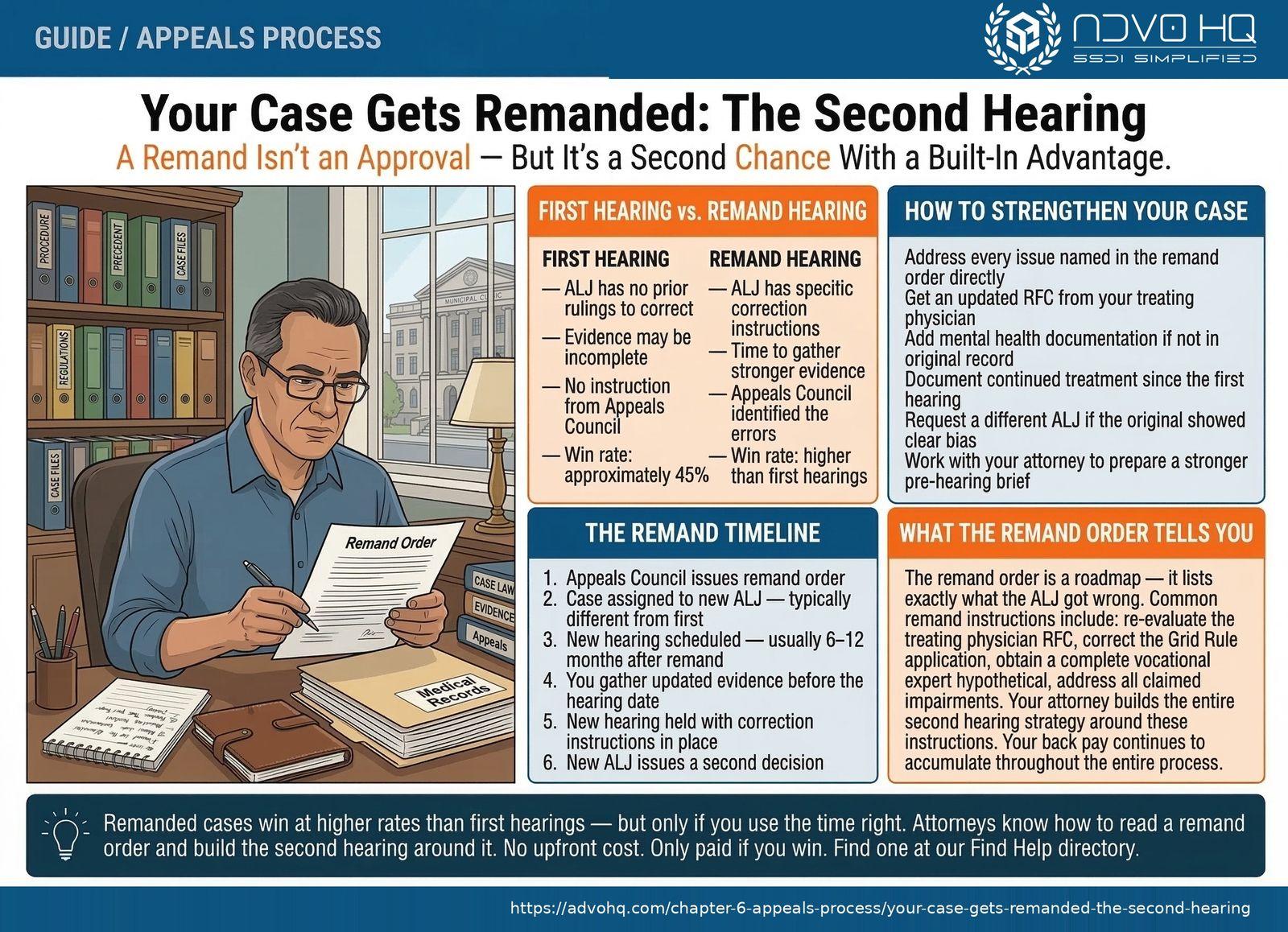
What The Remand Order Says
- Specific errors identified — The Appeals Council tells the ALJ exactly what they got wrong—failure to properly evaluate a treating physician’s opinion, incorrect Grid Rule application, incomplete analysis, etc.
- Instructions to the ALJ — The remand order includes specific instructions: "Give further consideration to the claimant’s RFC," "Obtain a medical expert," "Properly evaluate the treating source opinion."
- Scope of the new hearing — The ALJ may be required to address only the specific issues identified, or the entire case may be open for de novo (fresh) review.
- Assignment of ALJ — Your case may go back to the same ALJ or be assigned to a different one. If the remand was based on bias or procedural problems, you can request a new ALJ.
Examine the remand order thoroughly with your legal representative. The Appeals Council has communicated precisely what went wrong and what corrective steps are needed. Preparation for the second hearing should specifically target every concern the remand has raised.
First Hearing vs. Remand Hearing: What’s Different
- ALJ evaluates your case fresh with no prior instructions
- Record contains only what was submitted before or at the hearing
- Preparation depth depends on when you hired your attorney
- Back pay runs from onset date through the decision date
- Approval rate: 45–55% nationally
- ALJ must address the specific errors the Appeals Council identified — they know the Council is watching
- Everything from before plus all new evidence gathered during the appeals process — a bigger, stronger record
- The remand order is a blueprint — you know exactly what to strengthen
- Back pay runs through the new decision date — potentially years more due to the extended timeline
- Approval rate: higher than first hearings — the ALJ knows specific errors must be corrected
How To Strengthen Your Case Before The Second Hearing
Requesting A Different ALJ
- Remand goes to the same ALJ — This is the default. The ALJ who denied you may now have to correct their own errors. Some ALJs approach remands fairly. Others are less receptive.
- Requesting a different ALJ — You can request reassignment to a different ALJ. Valid reasons include: the remand was based on bias, procedural irregularities, or the ALJ’s demonstrated hostility during the first hearing.
- When the Appeals Council assigns a new ALJ — The remand order itself may assign the case to a different ALJ, particularly when the errors suggest bias or a pattern of improper analysis.
- Strategic considerations — Your attorney knows the local ALJs and their tendencies. Sometimes keeping the same ALJ (who now has clear instructions) is actually better than getting a random reassignment.
The Remand Timeline
Appeals Council sends the case back to the hearing office.
Administrative transfer from the Appeals Council back to the local hearing office.
You receive a scheduled hearing date from the hearing office.
Sometimes longer depending on hearing office backlog.
ALJ issues a written decision following the remand hearing.
Often 2–4 years from the original hearing to the remand decision.
The months between remand and your second hearing are an opportunity. Every month of continued treatment, every new diagnostic test, every updated RFC strengthens your case. Don't passively wait — actively build your evidence file.
Frequently Asked Questions
A remand means the Appeals Council reviewed your ALJ denial and found enough legal or evidentiary error to send the case back to the hearing level for a new decision. It isn't an approval — it's a fresh hearing with the Appeals Council's specific instructions attached. About 10–15% of Appeals Council reviews end in a remand, compared with only 1–2% that are approved outright.
Usually yes — sending the case back to the same ALJ is the default. If the remand was based on bias, procedural irregularities, or the judge's hostility, you can request reassignment, and the Appeals Council sometimes assigns a new ALJ in the remand order itself. Keeping the same ALJ isn't always bad: they now have clear instructions they must follow.
Generally, yes. Approval odds at the ALJ hearing level are often cited in the 45–55% range, but that figure varies widely by hearing office and individual judge, and it is not an official SSA statistic — the only primary-source figures SSA publishes are share-of-all-applicants "waterfall" rates (roughly 20% allowed at the initial level, ~2% at reconsideration, and ~7% at the hearing level or above, for a final award rate around 29%), not per-hearing grant rates. Remanded cases tend to do better because the ALJ must correct identified errors and knows the Appeals Council may review the decision again. Combined with a stronger evidence file, that institutional pressure works in your favor — but it is not a guarantee.
Plan on 6–12 months from the remand order to the new hearing, plus 1–3 months for the decision. Administrative transfer back to the hearing office takes 1–3 months, and the hearing notice typically issues 3–6 months after remand. From the original denial to a second decision, the full arc is often 2–4 years.
Yes. A remand removes specific errors, but the ALJ can still deny the claim if they properly follow the remand instructions and find the evidence doesn't establish disability. That's exactly why the months before the second hearing should be spent building — updated RFCs, new imaging, and continued treatment records.
What They Don't Tell You
Insider knowledge that can make or break your application:
A remand often puts you in a stronger position than the first hearing
Many disability attorneys observe that remanded cases can fare better the second time around: the ALJ knows the Appeals Council found errors and will review the second decision if you appeal again, and that institutional pressure combines with your stronger evidence file. It is not a guarantee of approval, but it is a meaningful advantage.
Your back pay keeps growing
Every month between your onset date and the eventual approval adds another month of back pay. A case that takes 3–4 years from application to approval can produce tens of thousands of dollars — still subject to the $9,200 attorney fee cap (effective November 30, 2024).
The second hearing is a fresh start with an institutional advantage
You have everything from the first hearing, plus new evidence, plus the Appeals Council's identification of errors the ALJ must now address. You are in a stronger position than the first time around.
You can still lose a remand hearing
Remand doesn't guarantee approval. If the ALJ properly addresses the remand instructions and finds the evidence doesn't support disability, the case can still be denied — which is why building evidence during the wait is critical.
A remand is often the real win — the order is your leverage
A remand is often the real win, and the remand order is your leverage. By regulation the ALJ "shall take any action that is ordered by the Appeals Council" (20 CFR 404.977(b)), so read the order line by line: whatever the Council told the judge to fix — re-evaluate a specific opinion, get updated vocational testimony, address a listing — the judge is required to do. Treat every issue it names as a checklist item to close before you walk back in, and use the months beforehand to build the evidence that answers each one. If you handled the first hearing alone, a remand is the moment to bring in help — the fee comes out of your back pay, so there's no upfront cost.
A remand is your second chance with a built-in advantage: the Appeals Council has told the ALJ what they got wrong.
A remand is your second chance with a built-in advantage: the Appeals Council has told the ALJ what they got wrong. Use the time before the second hearing to address every issue in the remand order — updated RFC, new evidence, mental health documentation, continued treatment. Work with your attorney to build the strongest possible case. Many attorneys find remanded cases can fare better than first hearings, and your back pay continues to accumulate throughout the process.
Up Next: Federal Court Review: Taking SSA To Court—when and how to file, what the court evaluates, and realistic expectations for this stage.
Your Second Hearing Deserves Expert Preparation
A remand hearing requires targeted preparation based on the specific errors the Appeals Council identified. An experienced disability attorney builds your evidence file to address exactly what went wrong the first time. Free consultation. No upfront cost.
→ Find A Disability Attorney In Your County
→ Prepare For Your Remand Hearing
Not affiliated with SSA or any government agency. For informational purposes only — not legal advice.
- 20 C.F.R. § 404.977 — Case remanded by Appeals Council (Appeals Council may remand a case to an administrative law judge, who takes any action ordered and may take any additional action not inconsistent with the remand order). ecfr.gov
- 20 C.F.R. § 404.979 — Decision of administrative law judge on a case remanded by the Appeals Council (the ALJ issues a new decision addressing the remand issues). ecfr.gov
- 20 C.F.R. § 404.929 — Hearing before an administrative law judge (de novo review: the ALJ looks at all the issues and may consider evidence not before the state agency, making a new decision). ecfr.gov
- 20 C.F.R. § 404.983 — Case remanded by a Federal court (procedure when a court remands a case for further consideration). ecfr.gov
- 20 C.F.R. § 404.1520c — How we consider and articulate medical opinions (for claims filed on/after March 27, 2017, no controlling weight to any medical opinion; supportability and consistency govern). ecfr.gov
- 42 U.S.C. § 406(a)(2) & 20 C.F.R. § 404.1720 — Representative fee cap (25% of past-due benefits, capped at $9,200 effective November 30, 2024). ssa.gov
- 42 U.S.C. § 405(g) — Federal court review and remand authority. ssa.gov
- Social Security Administration — Appeal a Decision. ssa.gov
- SSA, Annual Statistical Report on the SSDI Program, 2024 ed., Sec. 4 (Table 60 / Chart 11) — approval "waterfall" figures are shares of all applicants, not per-stage grant rates. ssa.gov
- 20 C.F.R. § 404.977(b) — "The administrative law judge shall take any action that is ordered by the Appeals Council and may take any additional action that is not inconsistent with the Appeals Council's remand order.". law.cornell.edu