
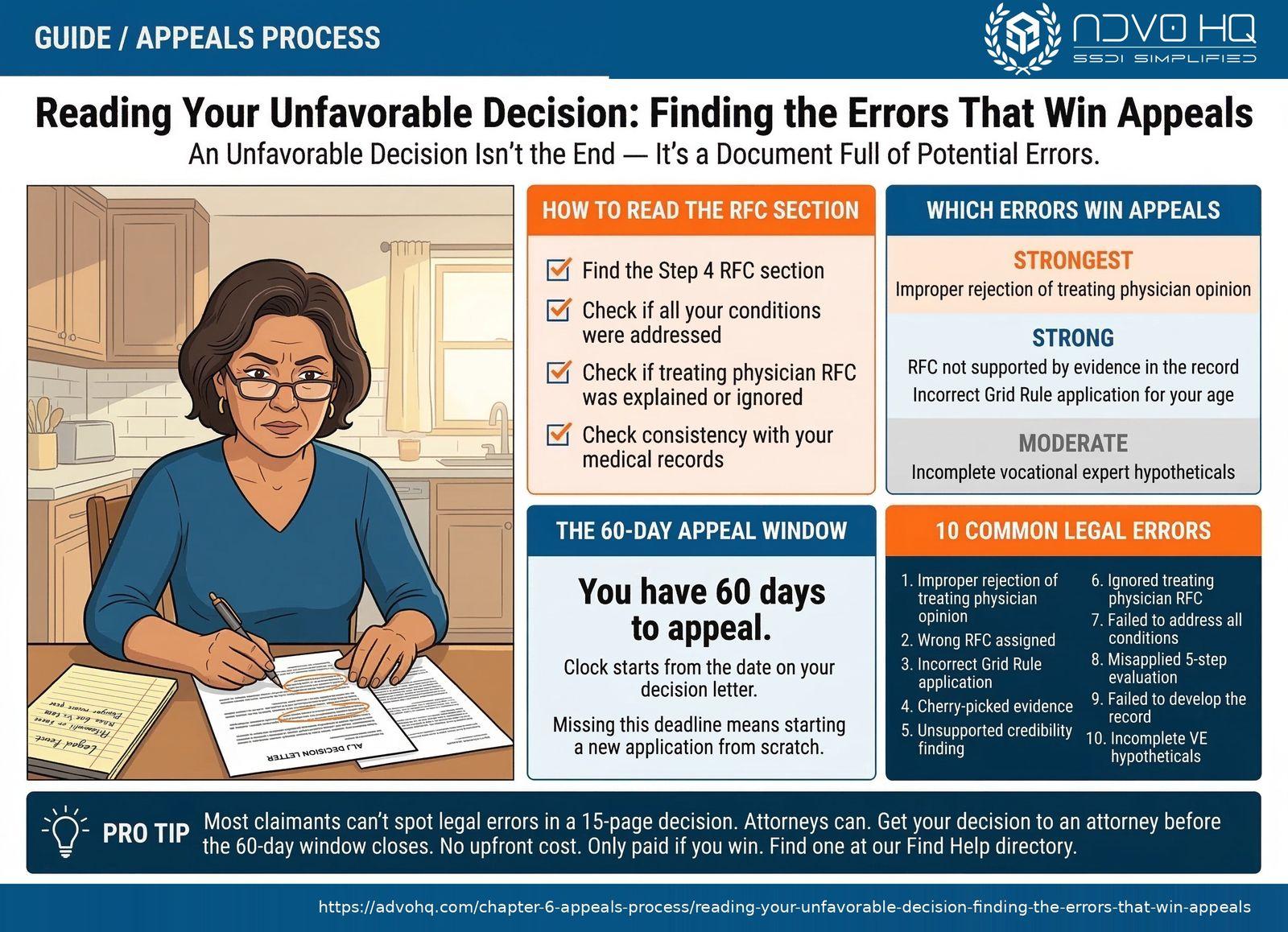
The Structure Of An ALJ Decision
Every ALJ decision follows SSA’s 5-step sequential evaluation. Understanding the structure helps you identify where errors occurred:
Rarely a source of error. The ALJ determines you haven’t worked above SGA levels. If you have worked, check whether the ALJ correctly evaluated unsuccessful work attempts.
Did the ALJ identify ALL your conditions as severe? If they dismissed a condition (especially mental health) as "non-severe," that may be an error if medical evidence supports it.
Did the ALJ properly analyze whether you meet or equal a listing? Did they consider the Medical Expert’s testimony? A conclusory statement like "does not meet any listing" without analysis is an error.
This is where most errors occur. Did the ALJ properly explain the RFC? Did they give valid reasons for rejecting your treating physician’s RFC? Did they account for all your limitations?
Did the ALJ rely on the Vocational Expert’s testimony correctly? Did the hypothetical include ALL your accepted limitations? Did the ALJ apply the Grid Rules correctly for your age?
The 10 Most Common Legal Errors In ALJ Decisions
- Improperly Rejecting Treating Physician Opinion — The ALJ dismissed your doctor’s RFC without giving "specific, legitimate reasons" supported by the record. Vague statements like "not supported by the evidence" without explanation are insufficient.
- Cherry-Picking Favorable Evidence — The ALJ cited records showing improvement while ignoring records showing ongoing limitations. The decision must consider the entire record, not just the parts that support denial.
- RFC Not Supported By Evidence — The ALJ assigned an RFC that doesn’t match any medical source’s opinion. If no doctor said you can do light work, the ALJ can’t simply invent that RFC.
- Failure To Consider Combined Effects — The ALJ evaluated each condition separately but didn’t assess how they interact. Chronic pain + depression + medication side effects may be more limiting in combination than individually.
- Improper Credibility Analysis — The ALJ rejected your testimony based on daily activities ("can do some household chores") without recognizing the difference between occasional activities and sustained full-time work performance.
- Incomplete Hypothetical To Vocational Expert — The ALJ’s hypothetical to the Vocational Expert didn’t include all the limitations the ALJ actually found credible, or ignored limitations documented in the RFC.
- Wrong Grid Rule Application — For claimants 50+, the ALJ applied the wrong Grid Rule or failed to explain why a directing Grid Rule didn’t apply. This is a pure legal error.
- Failure To Develop The Record — The ALJ had an incomplete medical record and didn’t take steps to obtain missing evidence. ALJs have a duty to develop a complete record, especially for unrepresented claimants.
- Boilerplate Credibility Language — The decision uses SSA’s standard credibility template ("not entirely consistent") without specific analysis of which statements are inconsistent and why. Federal courts in multiple circuits have remanded solely on this basis.
- Ignoring Favorable Expert Testimony — If the Medical Expert said your conditions were more severe than the ALJ found, or the Vocational Expert said no jobs exist under hypotheticals the evidence supports, the ALJ must explain why they rejected that testimony. Silence is a distinct, documentable legal error.
How To Read The RFC Section—The Most Important Pages
The RFC determination at Step 4 is where most cases are won or lost. Here’s what to examine:
Compare to your treating physician’s RFC.
Under current SSA rules, the ALJ must evaluate treating source opinions using specific factors: supportability, consistency, treatment relationship, specialization, and other factors.
If you have documented depression, anxiety, or cognitive issues, the RFC must include mental limitations.
If your evidence supports frequent absences or being off-task 15%+, the RFC should address this.
If the RFC doesn’t match any doctor’s opinion—not your treating physician, not the CE doctor, not the DDS reviewer—the ALJ may have improperly created their own medical opinion.
Frequently Asked Questions
60 days from the date you receive the decision. SSA assumes you received it 5 days after the date on the letter, so the practical deadline is about 65 days from the decision date. You request Appeals Council review by filing Form HA-520. Miss the deadline and you can lose your appeal rights, so mark the date immediately. The next article, Filing With The Appeals Council: Form HA-520 and the 60-Day Deadline, walks through the exact steps.
It typically appears mid-decision, right after the listings analysis. Focus on three sections: the RFC determination, the discussion of the medical opinions, and the symptom-consistency analysis (what older decisions called the 'credibility' analysis). Read those alongside your treating physician's forms and mark every discrepancy.
Direct reversals are rare — roughly 1–2% of cases. But another 10–15% get remanded back to an ALJ for a new decision, which is often the real win (for how the Appeals Council reviews and decides, see What The Appeals Council Actually Does With Your Case). If the Appeals Council doesn’t act, the next step is federal district court, where a large share of SSA cases are remanded rather than affirmed: per SSA’s official Appeals Council public data, court remands ran to about 69.9% of new court cases filed in FY 2023 — evidence of how frequently these decisions contain fixable legal errors.
The recurring ones are failure to properly evaluate medical opinions under the supportability/consistency factors (20 CFR 404.1520c), inadequate symptom-consistency assessments (SSR 16-3p), incomplete RFC determinations, and errors in the vocational analysis. If your decision has one of these, it may have real appeal potential.
Not on their own. For conditions like fibromyalgia or chronic pain, "normal" physical exams don't contradict your limitations — the disease doesn't always show up on a routine exam. If the ALJ leaned on selected "normal" findings while ignoring the rest of the record, that selective evaluation of the evidence is a challengeable error.
What They Don't Tell You
Insider knowledge that can make or break your application:
The decision contains the blueprint for your appeal
Every error the ALJ made is documented in the decision itself. The ALJ must explain their reasoning, and when that reasoning is flawed, the decision provides the evidence against itself.
Your real deadline is quietly earlier than "60 days from receipt."
The notice tells you that you have 60 days, but SSA does not count from the day you actually open the envelope — it presumes you received the decision 5 days after the date printed on the letter (20 CFR 404.901), unless you can show otherwise. In practice, mark the date on the letter, add 5 days, and count 60 from there; that presumed-receipt date, not the day it hit your mailbox, is what SSA uses to decide whether your appeal is on time.
Your attorney reads decisions differently than you do
You read for the outcome. Your attorney reads for the legal analysis. What feels like a thorough decision to you may contain specific legal errors that an experienced attorney spots immediately.
Some errors are more fixable than others
A wrong Grid Rule application can be corrected on paper. A disagreement about how much pain you're in requires a new hearing. The type of error determines both the appeal strategy and the likely outcome.
The decision tells you what the ALJ didn't credit
Read the symptom-consistency section carefully (older decisions label it "credibility"). If the ALJ found your testimony about sitting limitations inconsistent with the record, that tells your attorney exactly what evidence needs to be strengthened for a remand hearing or new application.
Read the decision hunting for a legal error
Don't read your decision to see whether the judge "believed you" — read it hunting for a specific legal error, because that is the only thing the Appeals Council can act on. The Council doesn't re-weigh your evidence or decide the case fresh; it reviews only for an error of law, an abuse of discretion, findings not supported by substantial evidence, or a broad policy issue (20 CFR 404.970(a)). So flag concrete mistakes: a medical opinion the ALJ never evaluated for supportability and consistency, a vocational expert answer that conflicts with the DOT with no explanation, or a listing the judge never addressed. Because the 60-day window is short, get your marked-up decision in front of an attorney quickly.
An unfavorable decision isn’t the end—it’s a document that either contains appealable errors or tells you exactly what to fix for your next attempt.
An unfavorable decision isn't the end — it's a document that either contains appealable errors or tells you exactly what to fix for your next attempt. Your attorney can identify legal errors that most claimants would never notice: improper rejection of treating physician opinions, wrong Grid Rule applications, incomplete VE hypotheticals, and cherry-picked evidence. The 60-day appeal window is short, so get the decision to your attorney quickly and let them tell you whether your case has appeal potential.
Up Next: Filing With The Appeals Council: Form HA-520 And The 60-Day Deadline—the exact steps to file your appeal, what to include, and how to submit new evidence.
An Attorney Finds The Errors You Can’t See
Experienced disability attorneys review unfavorable decisions every day. They know exactly which legal errors the Appeals Council acts on and which arguments win remands. Free consultation. No upfront cost.
→ Find A Disability Attorney In Your County
→ Get Your Unfavorable Decision Reviewed Free
Not affiliated with SSA or any government agency. For informational purposes only — not legal advice.
- Social Security Administration — Appeal a Decision We Made. ssa.gov
- 20 CFR § 404.1520 — Evaluation of disability in general (five-step sequential evaluation). ecfr.gov
- 20 CFR § 404.1520c — How we consider and articulate medical opinions and prior administrative medical findings for claims filed on or after March 27, 2017 (no controlling weight; supportability and consistency are the most important factors). ecfr.gov
- 20 CFR § 404.1545 — Your residual functional capacity (RFC). ecfr.gov
- 20 CFR Part 404, Subpart P, Appendix 2 — Medical-Vocational Guidelines (the "Grids"). ecfr.gov
- SSR 16-3p — Titles II and XVI: Evaluation of Symptoms in Disability Claims (evaluates the consistency of symptom statements; eliminated the term "credibility"; supersedes SSR 96-7p). ssa.gov
- 42 U.S.C. § 405(g) (Social Security Act § 205(g)) — Judicial review; findings supported by substantial evidence are conclusive. ssa.gov
- SSA Appeals Council Public Data Files — "Court Remands as a Percentage of New Court Cases Filed" (FY2023 ≈ 69.9%; 10,467 remands ÷ 14,984 new court cases filed). ssa.gov
- 20 CFR § 404.970(a) — Cases the Appeals Council will review (grounds for review: error of law, abuse of discretion, action/findings/conclusion not supported by substantial evidence, broad policy or procedural issue); read with 20 CFR § 404.1520c (evaluating medical opinions) and SSR 24-3p (use of occupational information / VE evidence; eff. Jan. 6, 2025, rescinding and replacing SSR 00-4p). ecfr.gov