
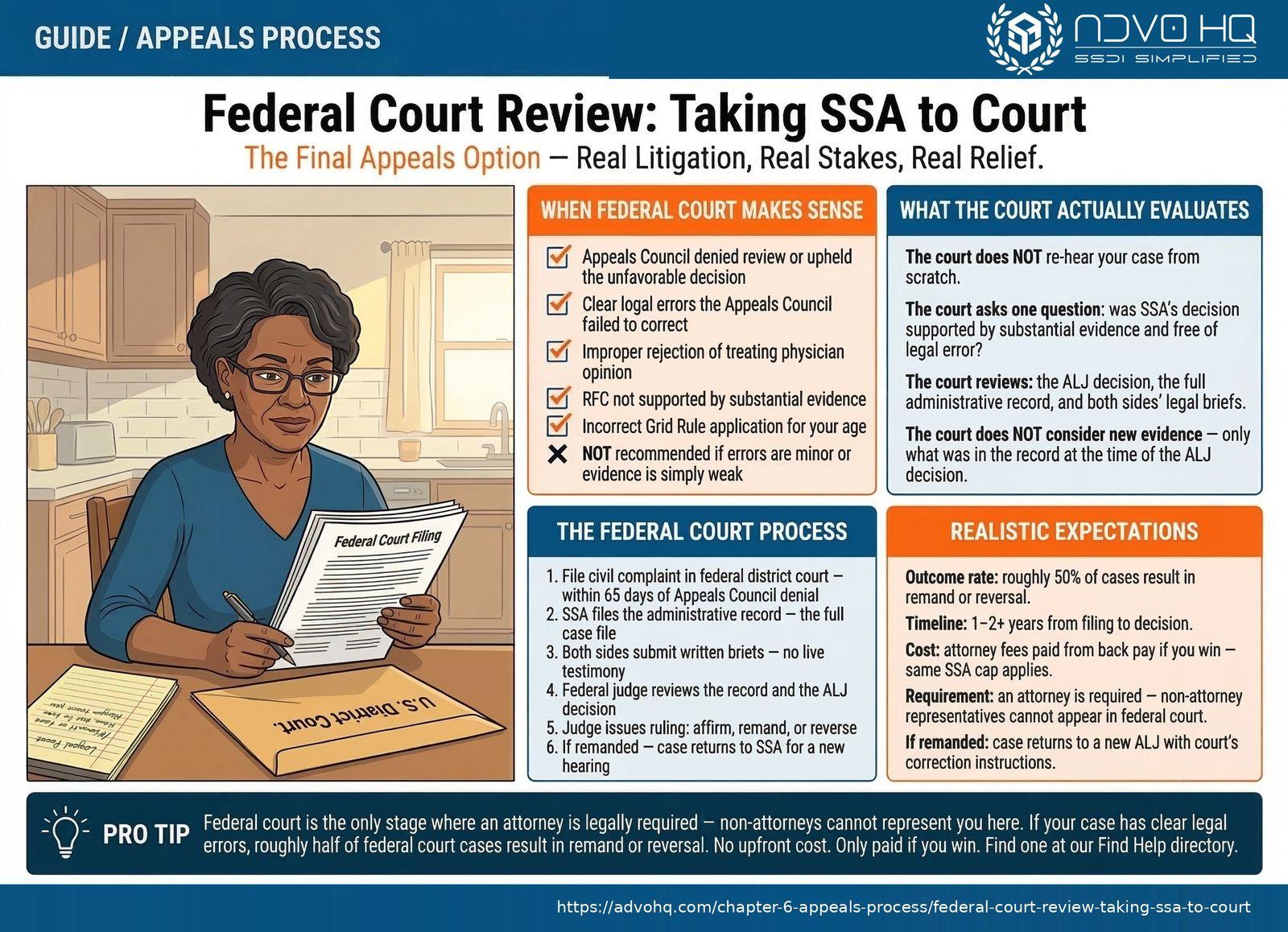
When Federal Court Makes Sense
- Clear legal errors the Appeals Council ignored — Strong. If the ALJ violated SSA regulations and the Appeals Council denied review without addressing it, a federal judge may find the error.
- Substantial evidence problem — Moderate. If the ALJ's decision is not supported by substantial evidence in the record, the court can reverse or remand.
- Constitutional or due process issues — Strong. Procedural errors, bias, or denial of a fair hearing are issues federal courts take seriously.
- Disagreement with how ALJ weighed evidence — Weak. Courts give deference to ALJ factual findings. Simple disagreement with the outcome isn't enough.
- Your condition has significantly worsened since the hearing — Weak for federal court (court reviews the record as it was). Better to file a new application with updated evidence.
How To File: The Basics
- Deadline — 60 days from the Appeals Council's denial or decision (plus 5 days for mailing). This deadline is strict.
- Where to file — U.S. District Court for the judicial district where you live, or where SSA has its principal office (Maryland), or where the final decision was made.
- Filing fee — Court filing fees apply (currently around $400), but you can request a fee waiver (in forma pauperis) if you can't afford it.
- Attorney required — Only licensed attorneys can represent you in federal court. Non-attorney representatives cannot. If you've been using an advocate, you need to retain an attorney for this stage.
- What you file — A complaint naming the Commissioner of Social Security as the defendant and requesting the court review SSA's decision.
The Federal Court Process: Step By Step
Your attorney files the initial complaint in federal court within the 60-day deadline.
SSA's attorneys file an answer and submit the certified administrative record—your complete file from the SSDI process.
Your attorney files an opening brief arguing why the ALJ's decision was legally wrong. SSA files a response. Your attorney may file a reply. This is entirely written—there's typically no oral argument.
In most districts, a magistrate judge reviews the briefs and issues a Report and Recommendation (R&R) to the district judge.
The district judge reviews the R&R and either adopts it, modifies it, or rejects it. The court issues a final decision.
Affirm SSA's decision (you lose), reverse and remand for a new hearing, or reverse with an award of benefits (rare).
The Standard Of Review: What The Court Actually Evaluates
The court asks: "Is the ALJ's decision supported by substantial evidence?"
The court asks: "Did the ALJ apply the correct legal rules?"
The court gives the ALJ's factual findings some deference—it doesn't re-decide the case.
Even if the ALJ made an error, the court may find it "harmless" if correcting it wouldn't change the outcome.
Federal court reviews what was in the administrative record. No new testimony, no new evidence (with very limited exceptions). That's why building the strongest possible record at the hearing level and Appeals Council stage is so critical.
Costs And Attorney Fees In Federal Court
If you eventually win, the 25%/$9,200 cap still applies to the SSA attorney fee — the same as at the hearing level.
Under the Equal Access to Justice Act, if the court finds SSA's position was not "substantially justified," SSA may be ordered to pay your attorney's federal court fees separately from the contingency fee.
Around $400 to file in federal district court.
Some attorneys charge separately for federal court work beyond the standard contingency fee.
Realistic Timeline And Outcomes
In many cases, SSA's attorneys review the record and agree that errors exist. Rather than fully litigating, both sides agree to remand the case for a new hearing. This saves time and typically results in a faster return to the hearing level.
Frequently Asked Questions
You have 60 days from the date of the Appeals Council's denial or decision, plus 5 days SSA allows for mailing. This deadline is strict—miss it and you generally lose your right to federal review. The civil action is filed under 42 U.S.C. § 405(g).
For practical purposes, yes. Only licensed attorneys can represent you in federal court—non-attorney representatives who helped at earlier stages cannot. Federal court means legal briefs, court procedures, and case-law arguments, so representation matters enormously here.
Only the existing administrative record, under the "substantial evidence" standard set by 42 U.S.C. § 405(g). The judge doesn't hold a new hearing or take new evidence—they decide whether the ALJ applied the correct legal standards and whether substantial evidence supports the decision.
A large share of cases that reach federal court end in remand for a new hearing. Direct reversals awarding benefits are rare (under 5%). Federal court's real value is fixing clear legal errors, not re-arguing the facts.
It's when SSA's own attorneys review the record, agree errors exist, and agree to send the case back for a new hearing rather than litigate. These are common and typically get you back to the hearing level faster than a fully litigated case.
What They Don't Tell You
Insider knowledge that can make or break your application:
Federal court is where attorneys make the biggest difference
This is real litigation with legal briefs, court procedures, and case-law arguments. Research on representation finds that skilled counsel is associated with better outcomes and faster resolution — not a guaranteed win, but a meaningful edge, and the quality of the briefing can strongly influence how the court rules. Find an attorney who handles Social Security federal court cases specifically.
EAJA fees can make federal court financially viable for attorneys
The possibility of SSA-paid attorney fees under the Equal Access to Justice Act makes some attorneys willing to take federal court cases they might otherwise decline. This is especially important for cases with lower potential back pay.
You can file a new application while federal court is pending
There's no rule against filing a new SSDI application while your federal court case is active. This protects your interests if the court case takes years.
Circuit law matters
Different federal circuits (geographic regions of the U.S.) have different case law on disability issues. Your attorney should know the relevant circuit's approach to treating-physician opinions, credibility analysis, and other key issues.
Win in federal court and SSA may pay your lawyer
If you win in federal court, you can make the government pay your lawyer. Under the Equal Access to Justice Act a court "shall award to a prevailing party" reasonable attorney fees — a statutory base of $125/hour, adjusted upward for cost of living — unless the government's position was "substantially justified," and this award is separate from, and can offset, the fee your attorney takes out of your back pay (28 USC 2412(d)). Watch two clocks: file the civil action within 60 days of the Appeals Council's final action, and the EAJA fee application within 30 days of final judgment. Because not every disability attorney handles federal court, ask a prospective one how many appeals they've filed and what your circuit's approach is to your key issue.
Federal court is the final appeals option within the system.
Federal court is the final appeals option within the system. It requires an attorney, takes 1–2+ years, and involves real litigation against SSA. But for cases with clear legal errors, federal court provides meaningful relief—a majority of cases that reach this stage (court remands equaled roughly 69.9% of new court cases filed in FY2023, per SSA's official Appeals Council public data) result in remand or reversal. If your attorney believes the ALJ's decision was legally flawed and the Appeals Council failed to correct it, federal court is a legitimate path forward.
Up Next: Filing A New Application vs. Continuing Your Appeal—the decision framework for choosing the best path forward based on your specific situation.
Federal Court Requires An Attorney Who Litigates
Not every disability attorney handles federal court cases. You need someone who writes legal briefs, knows your circuit's case law, and has experience litigating against SSA. Free consultation to evaluate your case.
→ Find A Disability Attorney In Your County
→ Get Your Federal Court Options Evaluated
Not affiliated with SSA or any government agency. For informational purposes only — not legal advice.
- Social Security Act § 205(g), Title II — 42 U.S.C. § 405(g). ssa.gov
- Appeals Council action and effect of the decision — 20 C.F.R. § 404.981; see also 20 C.F.R. § 404.982 and 20 C.F.R. § 404.983. ecfr.gov
- Equal Access to Justice Act — 28 U.S.C. § 2412(d) / § 406(a)(2) 25%/$9,200 representative-fee cap. law.cornell.edu
- Attorney fee cap — 42 U.S.C. § 406(a)(2). law.cornell.edu
- Federal-court remand rate — SSA, "Court Remands as a Percentage of New Court Cases Filed". Metric is remands as a percentage of new court cases filed. ssa.gov
- Social Security Administration — [Appeal a Decision](. ssa.gov
- Equal Access to Justice Act fee award — 28 U.S.C. § 2412(d); civil-action 60-day deadline and sentence-four vs. sentence-six remands under 42 U.S.C. § 405(g). law.cornell.edu