
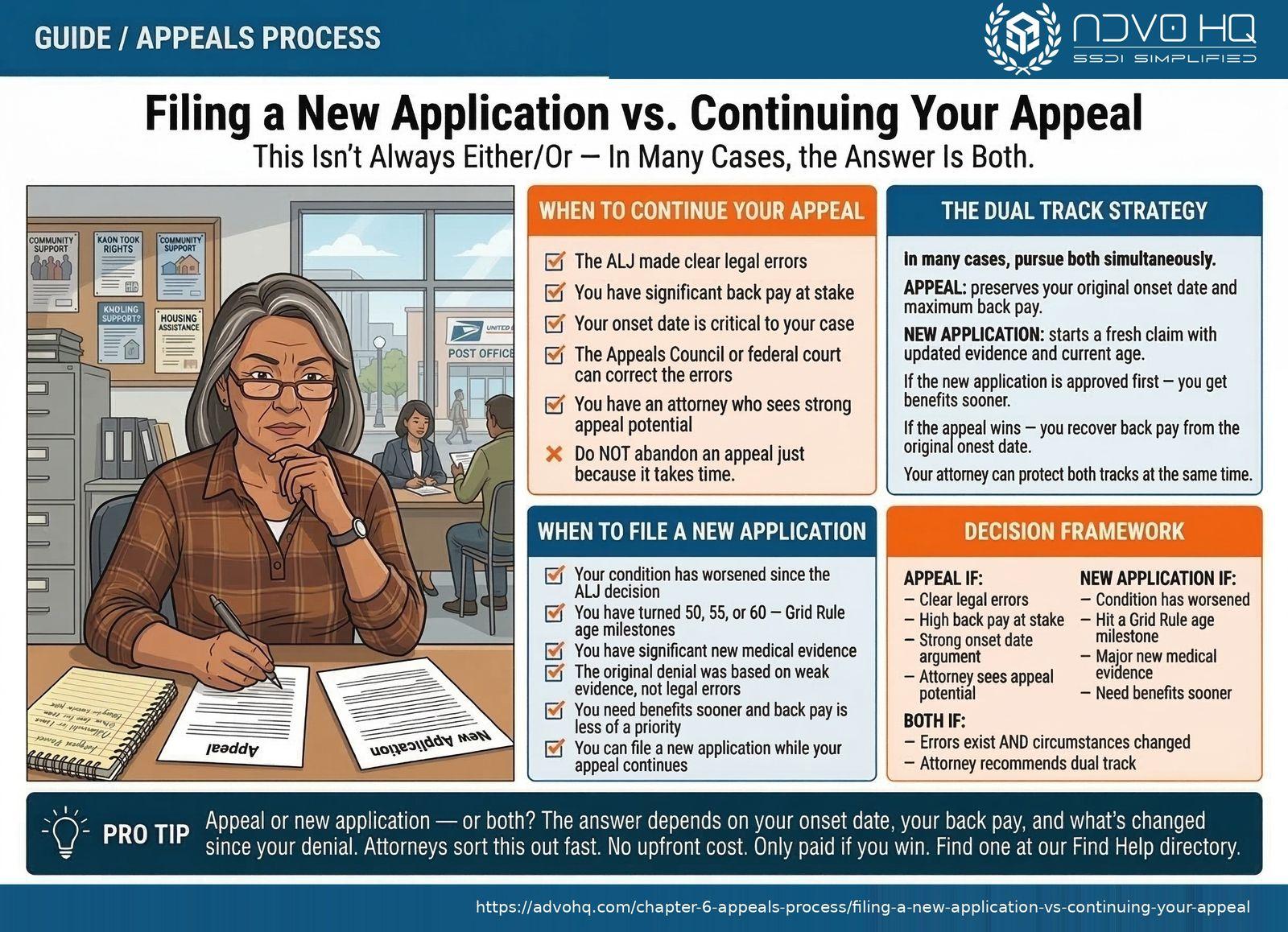
The Core Tradeoff: Speed vs. Back Pay
- Onset date preserved — all accumulated back pay stays on the table
- Timeline: Appeals Council 6–12+ months, federal court 12–24+ months, remand hearing additional 6–12 months — total potentially 2–4+ years
- Evidence: existing record, plus limited new evidence at Appeals Council only
- Chances: depends on whether the ALJ made clear legal errors — strong errors mean good odds
- New onset date — you lose back pay from the original application period
- Timeline: initial decision in 3–6 months, but if denied, reconsideration and hearing add 12–24+ more months
- Evidence: fresh record — submit everything that's changed since the hearing
- Chances: depends on whether conditions worsened, evidence is stronger, or you've aged into Grid Rule territory
When To Continue Your Appeal
Improper rejection of a treating physician RFC, wrong Grid Rule application, or an incomplete Vocational Expert hypothetical — these are winnable appeal issues.
If you've been waiting 2+ years, you could have $50,000+ in accumulated back pay. Filing a new application forfeits all of it.
If you had a solid case and the ALJ made a bad call, the appeals process is designed to correct that. Filing a new application with the same evidence may produce the same denial.
If you're approaching 50 or 55, preserving your original onset date may allow the Grid Rules to apply retroactively — potentially making your case automatically favorable.
An experienced disability attorney who sees clear reversible errors is the strongest indicator that appeal is worthwhile.
When To File A New Application
New diagnoses, worsened imaging, new symptoms — a fresh application lets you present this current evidence from the start rather than trying to add it mid-appeal.
If the ALJ followed proper procedures and the evidence simply wasn't strong enough, an appeal won't change the outcome — courts defer to ALJ findings supported by substantial evidence.
Aging into a new Grid Rule category fundamentally changes SSA's analysis. A new application with your current age may win where the old case couldn't.
If your first case lacked mental health evidence and you've since been diagnosed and treated, a new application captures this from the very start of the record.
If you've only accumulated a few months of back pay, the financial cost of starting over is minimal — and a new application may get you approved faster.
Doing Both: The Dual Track Strategy
In many cases, the smart move is to pursue both paths simultaneously:
File the Appeals Council request within 60 days to preserve your appeal rights. On the same day, file a new SSDI application. Both proceed in parallel — one doesn't cancel the other.
Your appeal preserves the original onset date and all accumulated back pay. Your new application starts a new onset date — typically the day after the ALJ's unfavorable decision.
SSA processes the new application independently of the appeal. Your attorney manages both — coordinating the onset date documentation to prevent res judicata issues.
Your original onset date and full back pay are preserved. The new application becomes unnecessary and can be withdrawn.
You receive benefits going forward and back pay from the new onset date. Your appeal may still produce additional back pay from the original period if it succeeds — res judicata only blocks re-deciding the already-decided period.
Your attorney may recommend filing both to protect all your options. Continuing the appeal preserves your original onset date and the accumulated back pay, while the new application addresses any evidence weaknesses going forward — but because of res judicata, the new application can't recover the period the ALJ already denied. If either path succeeds, you win. The only cost is the effort of pursuing both simultaneously.
Decision Framework: A Quick Reference
- ALJ made clear legal errors — wrong Grid Rule, rejected RFC without explanation, flawed Vocational Expert hypothetical
- Back pay exceeds $30,000 — onset date is worth protecting
- Evidence was strong at the hearing and the ALJ simply got it wrong
- You're approaching a Grid Rule age threshold (50 or 55)
- Your attorney identifies reversible errors in the decision
- Condition has significantly worsened with new diagnoses or imaging
- ALJ's decision was legally sound — evidence just wasn't strong enough
- You've turned 50 or 55 since the hearing — new Grid Rule category
- You now have mental health documentation that wasn't in the record
- Back pay is minimal — faster approval outweighs protecting onset date
Frequently Asked Questions
Yes. There's no waiting period and no rule against running both at once. You file the HA-520 to preserve your appeal within 60 days of the ALJ decision, and you can file a new SSDI application the same day. SSA processes the two independently.
Only if you abandon the appeal. The new application starts a fresh onset date (usually the day after the unfavorable decision), so on its own it can't recover the earlier period. Keeping the appeal alive is what preserves the original onset date and the back pay tied to it.
As a general matter, SSA applies res judicata so it won't re-decide a period it has already ruled on, and in practice a new application is treated as covering the time AFTER the prior unfavorable decision. Changed circumstances — new or worsened conditions, or aging into a new age category under the Grid Rules — are generally what let you move forward despite the earlier denial. The related path of asking SSA to reopen the earlier decision is governed by its own rules (20 C.F.R. §§ 404.987–404.989), with specific time limits and "good cause" conditions; confirm the exact mechanics and deadlines with an attorney or against SSA's regulations before relying on them.
It depends on how long you've waited. Extended appeals can run 3–4+ years, and at a typical benefit level that can mean roughly $45,000–$60,000+ in accumulated past-due benefits, including up to 12 months of retroactive benefits before your application. The longer the wait, the more an appeal protects.
The Medical-Vocational (Grid) Rules in 20 C.F.R. Part 404, Subpart P, Appendix 2 (§ 200.00; Tables 1 & 2) use age as one of several vocational factors, and they draw decisive lines at ages 50 ("closely approaching advanced age") and 55 ("advanced age") — these age bands are the key inflection points in how the Grids resolve a case. Crossing one of these thresholds can shift SSA's analysis — but only in combination with your RFC, education, and work experience; the Grids don't direct an approval on age alone. Where the other factors line up, moving into an older age category can change the outcome, which is one reason refiling can be worth considering.
What They Don't Tell You
Insider knowledge that can make or break your application:
You can file a new application at any time
There's no waiting period. You can literally file a new SSDI application the day after receiving an unfavorable decision. The only question is whether it's the right strategic move.
The new application won't re-decide the old period
Res judicata means SSA won't re-evaluate whether you were disabled during the period already decided. Your new application covers from the day after the unfavorable decision going forward.
Aging into Grid Rule territory is one of the strongest reasons to refile
Turning 50 or 55 can change the SSA analysis under the Medical-Vocational Guidelines (Appendix 2), because age combines with your RFC, education, and past work at step five. If you were 49 at your hearing and you're now 50, a new application can produce a different result — where your residual functional capacity and vocational profile support it. It is the age crossing plus the rest of the profile, not age by itself, that drives the change.
Your attorney can run both tracks simultaneously
An experienced disability attorney manages appeals and new applications at the same time routinely. They know how to coordinate the two paths and maximize your chances on both.
Appealing protects your onset date and back pay
Continuing your appeal preserves your original onset date and the back pay that has been building the whole time; filing a fresh application usually throws both away. Once a denial becomes final it is treated as res judicata for the period already decided, so a new claim generally can't reach back before that decision — you lose those months or years of retroactive benefits and may start a new onset date entirely (20 C.F.R. § 404.957(c)(1)). As a rule of thumb, keep appealing unless your appeal rights are truly gone or a genuinely new, later-onset condition changes the picture. Filing the HA-520 within 60 days keeps every option open while you decide.
The appeal vs.
The appeal vs. new application decision depends on three factors: whether the ALJ made legal errors, whether your evidence or circumstances have changed, and how much back pay is at stake. In many cases, the answer is both — pursue the appeal to preserve your back pay while filing a new application with updated evidence and your current age. Your attorney can evaluate which path (or combination) gives you the best chance at the benefits you've earned.
Up Next: Winning Strategies Across The Appeals Process—the errors that get reversed most often, how to build the strongest record, and how attorneys approach appeals differently than hearings.
Let An Attorney Help You Choose The Right Path
Appeal, new application, or both? An experienced disability attorney evaluates your unfavorable decision, your current evidence, and your circumstances to recommend the strategy that gives you the best chance. Free consultation. No upfront cost.
→ Find A Disability Attorney In Your County
→ Get A Free Strategy Evaluation
Not affiliated with SSA or any government agency. For informational purposes only — not legal advice.
- Retroactive / back pay — up to 12 months of benefits before the application month (net of the 5-month waiting period): 20 C.F.R. § 404.621(a)(1) — [eCFR](. ecfr.gov
- Five-month waiting period (limits retroactivity): 20 C.F.R. § 404.315(a)(4) — eCFR(2). ecfr.gov
- Reopening a prior determination or decision — conditions and time limits: 20 C.F.R. § 404.987 (reopening — general), § 404.988 (conditions/time limits) — [eCFR](. ecfr.gov
- Appeals Council review — Request for Review filed on Form HA-520 within 60 days: 20 C.F.R. § 404.968(a)(1); [Form HA-520](. ssa.gov
- Administrative review process (four appeal levels): 20 C.F.R. § 404.900 — [eCFR](. ecfr.gov
- Medical-Vocational Guidelines (Grid Rules) — age as a key vocational factor, with decisive thresholds at 50 ("closely approaching advanced age") and 55 ("advanced age"): 20 C.F.R. Part 404, Subpart P, Appendix 2 (§ 200.00; Tables 1 & 2) — [eCFR](. ecfr.gov
- Res judicata / reopening a prior determination — dismissal on res judicata where a prior final determination covers the same facts and issues: 20 C.F.R. § 404.957(c)(1); general rule, conditions and time limits, good cause: 20 C.F.R. §§ 404.987–404.989 — [eCFR](; SSA appeals guidance — [Appeal a Decision](. ecfr.gov
- Judicial review — civil action within 60 days: Social Security Act § 205(g), 42 U.S.C. § 405(g); mirrored at 20 C.F.R. § 404.981.
- Social Security Administration — [Appeal a Decision](. ssa.gov