
Where You Are In The Process
Here’s the complete SSDI appeals path with the Appeals Council and federal court in context:
DDS examiner reviews your medical records and makes the initial decision. Timeline: 3–6 months. Deadline to appeal: N/A (60 days to request reconsideration).
A new DDS examiner reviews the same record. Paper review only—no hearing. Timeline: 4–8 months. Deadline to appeal: 60 days.
You testify before an Administrative Law Judge. Vocational expert testimony. This is your best chance of approval. Timeline: 8–18 months. Deadline to appeal: 60 days.
Reviews the ALJ’s decision for legal errors. No new hearing. No testimony. Written record only. Timeline: 6–12+ months. Deadline to appeal: 60 days.
Federal judge reviews the case through written briefs. Last option—can approve directly or remand back to an ALJ for a new hearing. Timeline: 12–24 months. Deadline to file: 60 days.
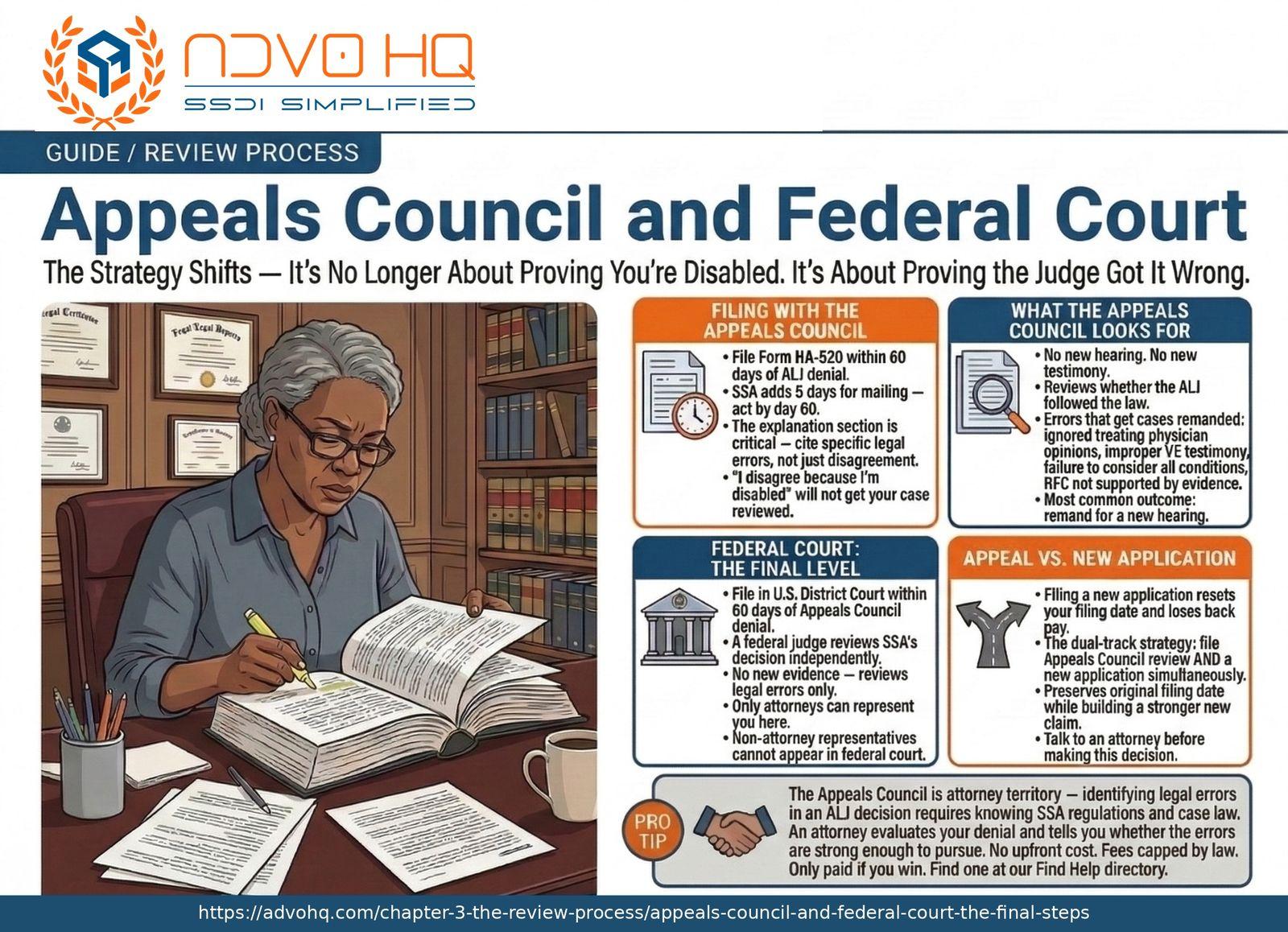
The ALJ hearing was your best shot at approval. The Appeals Council and federal court are about finding legal errors in the ALJ's decision—not getting a fresh look at your claim. The strategy shifts from "prove you're disabled" to "prove the judge got it wrong."
The Appeals Council: What It Is And What It Isn’t
The Appeals Council is part of SSA’s Office of Appellate Operations in Baltimore. It’s the last step within the Social Security Administration before your case would go to federal court.
What The Appeals Council IS
- A review of whether the ALJ followed the law and SSA procedures correctly
- A check for legal errors, procedural mistakes, or unsupported conclusions
- An office in Baltimore that reviews the written record
- The required step before you can go to federal court
- A body that can deny review, issue its own decision, or remand to the ALJ
What The Appeals Council IS NOT
- A new hearing where you testify again
- A fresh evaluation of your medical evidence from scratch
- A panel you meet with in person
- A stage where new evidence is easily accepted
- A guaranteed second chance at approval
How To File: Form HA-520
You have 60 days from the date you receive the ALJ’s unfavorable decision to request Appeals Council review. SSA assumes you received the decision 5 days after it was mailed—so you effectively have 65 days from the mail date.
Online (Preferred)
AC iAppeal through your my Social Security account at ssa.gov. SSA’s preferred filing method — fastest confirmation and no mail delay risk.
By Mail
Complete Form HA-520 and mail to: SSA Office of Appellate Operations, 6401 Security Blvd, Baltimore, MD 21235-6401. Use certified mail to document delivery.
By Fax
Fax completed Form HA-520 to 1-833-509-0817. Keep the fax confirmation page as proof of timely filing.
In Person / By Phone
Visit your local SSA office or call 1-800-772-1213. A representative will help you complete the request in person or over the phone.
What Form HA-520 Asks
The form is straightforward, but the most important section is where you explain why you disagree with the ALJ’s decision. This is where legal arguments matter:
Specific legal errors the ALJ made — not "I’m really disabled" but "The ALJ failed to properly weigh my treating physician’s RFC" or "The RFC finding is not supported by substantial evidence."
Only accepted if it is: (1) new, (2) material, (3) relates to the period on or before the ALJ’s decision, (4) would likely change the outcome, and (5) you have good cause for not submitting it earlier.
File the request now to stop the clock — don’t wait until you’ve gathered everything and risk missing the 60-day deadline entirely.
The HA-520 explanation section is where legal expertise matters most. An attorney identifies the specific legal errors in the ALJ's decision, cites the relevant regulations and rulings, and frames the argument in terms the Appeals Council responds to. Writing "I disagree because I'm disabled" will not get your case reviewed.
What The Appeals Council Can Do With Your Case
Deny Review
The ALJ’s decision stands as SSA’s final decision. Most common outcome — the AC looked at your request and decided it didn’t warrant full review.
Next: File in U.S. District Court within 60 days, or file a new application. These are not mutually exclusive.
Grant Review — Issue Own Decision
The AC reviews the full record and issues its own favorable or unfavorable decision. Rare — most granted reviews result in a remand instead.
Next: If favorable, claim approved. If unfavorable, file federal court within 60 days.
Grant Review — Remand
Errors found — case sent back to an ALJ for a new hearing with a specific correction order. Your best possible outcome at this level.
Next: New hearing with ~45–51% approval rates. The remand order tells the judge exactly what must be reconsidered.
Dismiss
Request dismissed for procedural reasons — filed too late, wrong form, or request was withdrawn.
Next: Limited options. You may be able to show good cause for a late filing, or file a new application.
What Counts As A "Reversible Error"
The Appeals Council doesn’t rehear your case. It looks for errors the ALJ made that could have changed the outcome. These are the types of errors that get cases reviewed or remanded:
Failed To Weigh Medical Opinions
ALJ rejected your treating physician’s RFC without adequate explanation, or cited a consultative examiner’s brief exam as more persuasive without justification.
RFC Not Supported By Evidence
ALJ assigned an RFC that doesn’t match the medical record — e.g., said you can do light work when multiple doctors documented sedentary limitations.
Failed To Consider All Impairments
ALJ evaluated physical conditions but ignored documented mental health conditions, or didn’t consider the combined effect of multiple impairments.
Improperly Evaluated Credibility
ALJ found your symptom testimony not credible but didn’t follow SSA’s required evaluation framework under SSR 16-3p.
VE Testimony Conflicts With DOT
ALJ relied on VE testimony that conflicted with the Dictionary of Occupational Titles without identifying and resolving the conflict on the record.
Procedural Errors
ALJ didn’t let you testify fully, cut off your attorney’s cross-examination of the VE, or failed to develop the record when evidence was lacking.
Misapplied Grid Rules
ALJ didn’t properly apply the Medical-Vocational Guidelines based on your age, education, past work, and RFC. Especially relevant for claimants 50+.
New And Material Evidence
Evidence that existed during the relevant period but wasn’t available before the hearing, and would likely change the outcome. Must meet the strict five-part test.
How Long The Appeals Council Takes
You’ll receive written confirmation that your request was received by the Appeals Council.
A staff attorney or analyst screens your case to determine if it warrants full review. Most cases are denied at this stage.
The Appeals Council reviews the complete record, your legal arguments, and any new evidence submitted. Additional briefing may be requested.
Written decision arrives by mail. The backlog has been growing — over 271,000 pending cases as of early 2025. Expect delays beyond published estimates.
Continue all medical treatment. Keep seeing your doctors. Document any changes in your condition. If your condition worsens significantly during this period, inform your attorney—this may support a new application filed concurrently with the Appeals Council review.
Federal Court: The Last Level Of Appeal
If the Appeals Council denies review or issues an unfavorable decision, you have 60 days to file a civil action in U.S. District Court. This is the final level of the SSDI appeals process — fundamentally different from everything that came before.
What’s Reviewed
Whether SSA’s decision is supported by "substantial evidence" and follows correct legal standards — using the same administrative record. No new evidence in most cases.
Who Reviews
A federal district court judge. No jury. The judge reviews written briefs from both attorneys — you do not testify or appear in court.
Where You File
The U.S. District Court for the judicial district where you live. Filing fee may be waivable for financial hardship (in forma pauperis).
Timeline
Typically 12–24 months from filing to decision — legal briefing, government response, and judicial review. Some districts run longer.
Most Common Outcome
Remand — over 50% of cases sent back to SSA for a new ALJ hearing. Only ~1% receive direct approval at this level. A remand puts you back at ~45–51% approval rates.
Attorney Fees
Regulated by SSA — 25% of back pay, capped at $9,200. Most attorneys work on contingency. Some charge additional court filing costs.
Procedural Rules
Federal Rules of Civil Procedure apply — stricter than ALJ hearings. Briefs must cite case law and regulations. Self-representation is not realistic at this level.
The Honest Assessment: Setting Realistic Expectations
The Hard Truth
- The Appeals Council denies review in the majority of cases.
- Federal court almost never approves claims directly (~1%).
- The total time from ALJ denial through federal court remand and new hearing can be 2–4 years.
- This stage requires specialized legal knowledge. Self-representation is extremely difficult.
- Your condition may change during the extended appeal period.
The Silver Lining
- Filing preserves your right to go to federal court and protects your original filing date and back pay.
- Over 50% of federal court cases are remanded—sent back for a new ALJ hearing where approval rates are ~45–51%.
- Each step in the appeal strengthens the legal record. Errors are documented. Evidence accumulates. Many people who are ultimately approved went through multiple rounds.
- Disability attorneys work on contingency—no upfront cost. You only pay if you win. The fee is regulated by SSA.
- Worsening conditions strengthen your case. Continue documenting. A new application filed concurrently can capture new evidence.
Frequently Asked Questions
You have 60 days from the date you receive the ALJ's unfavorable decision to file Form HA-520. SSA assumes you got the decision 5 days after it was mailed, so you effectively have about 65 days from the mail date. If you need more time, request an extension in writing before the deadline passes.
Continue Appealing
- Best when: The ALJ made clear legal errors, your evidence was strong but improperly evaluated, or the decision contradicts the record
- Back pay: Preserves your original filing date — all back pay from the original onset date is protected if you ultimately win
- Timeline: 6–12+ months for Appeals Council; 12–24 months for federal court; remand adds another 8–18 months for new hearing
- Risk: The Appeals Council rarely overturns; federal court is time-consuming. But a remand sends you back to the best stage (~45–51% approval)
- Can you do both? Yes — file a new application while the AC reviews the original. This is a common and often smart strategy
File New Application
- Best when: Your condition has worsened significantly, you have substantial new evidence, or the original application had fundamental weaknesses
- Back pay: Starts from the new filing date — you lose months or years of back pay from the original application
- Timeline: 3–6 months for initial decision; if denied, restart the entire appeals process from reconsideration
- Risk: Starting over means going through reconsideration (13–15% approval) before reaching another ALJ hearing
- Can you do both? Yes — a new application doesn’t affect a pending Appeals Council review. An attorney can manage both simultaneously
The dual-track strategy: Many experienced disability attorneys will file both—request Appeals Council review to preserve your original filing date and back pay, while simultaneously filing a new application with stronger evidence. This keeps all options open and gives you two paths to approval running at the same time.
Modest. Of the requests the Appeals Council acts on, it issues its own favorable (fully or partially reversing) decision in only roughly 1–2% of cases and remands roughly 10–15% back to an ALJ—these are outcomes measured against Appeals Council requests, not shares of all disability applicants (the SSA award "waterfall" in the Annual Statistical Report is a separate measure). The majority of requests are denied review, which lets the ALJ's decision stand. The most realistic favorable outcome is a remand, which puts you back in front of an ALJ where approval rates run ~45–51%.
Continue Appealing
- Best when: The ALJ made clear legal errors, your evidence was strong but improperly evaluated, or the decision contradicts the record
- Back pay: Preserves your original filing date — all back pay from the original onset date is protected if you ultimately win
- Timeline: 6–12+ months for Appeals Council; 12–24 months for federal court; remand adds another 8–18 months for new hearing
- Risk: The Appeals Council rarely overturns; federal court is time-consuming. But a remand sends you back to the best stage (~45–51% approval)
- Can you do both? Yes — file a new application while the AC reviews the original. This is a common and often smart strategy
File New Application
- Best when: Your condition has worsened significantly, you have substantial new evidence, or the original application had fundamental weaknesses
- Back pay: Starts from the new filing date — you lose months or years of back pay from the original application
- Timeline: 3–6 months for initial decision; if denied, restart the entire appeals process from reconsideration
- Risk: Starting over means going through reconsideration (13–15% approval) before reaching another ALJ hearing
- Can you do both? Yes — a new application doesn’t affect a pending Appeals Council review. An attorney can manage both simultaneously
The dual-track strategy: Many experienced disability attorneys will file both—request Appeals Council review to preserve your original filing date and back pay, while simultaneously filing a new application with stronger evidence. This keeps all options open and gives you two paths to approval running at the same time.
Rarely. The Appeals Council only accepts new evidence that meets a strict five-part test—it must be new, material, relate to the period on or before the ALJ's decision, likely change the outcome, and you must have good cause for not submitting it earlier. Federal court reviews the existing administrative record and generally accepts no new evidence at all.
Continue Appealing
- Best when: The ALJ made clear legal errors, your evidence was strong but improperly evaluated, or the decision contradicts the record
- Back pay: Preserves your original filing date — all back pay from the original onset date is protected if you ultimately win
- Timeline: 6–12+ months for Appeals Council; 12–24 months for federal court; remand adds another 8–18 months for new hearing
- Risk: The Appeals Council rarely overturns; federal court is time-consuming. But a remand sends you back to the best stage (~45–51% approval)
- Can you do both? Yes — file a new application while the AC reviews the original. This is a common and often smart strategy
File New Application
- Best when: Your condition has worsened significantly, you have substantial new evidence, or the original application had fundamental weaknesses
- Back pay: Starts from the new filing date — you lose months or years of back pay from the original application
- Timeline: 3–6 months for initial decision; if denied, restart the entire appeals process from reconsideration
- Risk: Starting over means going through reconsideration (13–15% approval) before reaching another ALJ hearing
- Can you do both? Yes — a new application doesn’t affect a pending Appeals Council review. An attorney can manage both simultaneously
The dual-track strategy: Many experienced disability attorneys will file both—request Appeals Council review to preserve your original filing date and back pay, while simultaneously filing a new application with stronger evidence. This keeps all options open and gives you two paths to approval running at the same time.
You file a civil action in U.S. District Court under 42 U.S.C. § 405(g). There's no trial, no testimony, and no jury—a federal judge reviews written briefs from your attorney and SSA's attorney against the administrative record. Only about 1% of cases are approved outright, but most are remanded back to SSA for a new hearing—court remands were roughly 70% of new court cases filed in FY2023 per SSA's official data. Cases typically take 12–24 months.
Continue Appealing
- Best when: The ALJ made clear legal errors, your evidence was strong but improperly evaluated, or the decision contradicts the record
- Back pay: Preserves your original filing date — all back pay from the original onset date is protected if you ultimately win
- Timeline: 6–12+ months for Appeals Council; 12–24 months for federal court; remand adds another 8–18 months for new hearing
- Risk: The Appeals Council rarely overturns; federal court is time-consuming. But a remand sends you back to the best stage (~45–51% approval)
- Can you do both? Yes — file a new application while the AC reviews the original. This is a common and often smart strategy
File New Application
- Best when: Your condition has worsened significantly, you have substantial new evidence, or the original application had fundamental weaknesses
- Back pay: Starts from the new filing date — you lose months or years of back pay from the original application
- Timeline: 3–6 months for initial decision; if denied, restart the entire appeals process from reconsideration
- Risk: Starting over means going through reconsideration (13–15% approval) before reaching another ALJ hearing
- Can you do both? Yes — a new application doesn’t affect a pending Appeals Council review. An attorney can manage both simultaneously
The dual-track strategy: Many experienced disability attorneys will file both—request Appeals Council review to preserve your original filing date and back pay, while simultaneously filing a new application with stronger evidence. This keeps all options open and gives you two paths to approval running at the same time.
It depends on why you were denied. If the ALJ made clear legal errors, appealing preserves your original filing date and back pay. If your condition has worsened or the original claim was weak, a new application may be stronger—but back pay resets to the new filing date. Many attorneys run both at once (the dual-track strategy). See Why Representation Matters Most At This Stage for how representation shapes this decision.
Continue Appealing
- Best when: The ALJ made clear legal errors, your evidence was strong but improperly evaluated, or the decision contradicts the record
- Back pay: Preserves your original filing date — all back pay from the original onset date is protected if you ultimately win
- Timeline: 6–12+ months for Appeals Council; 12–24 months for federal court; remand adds another 8–18 months for new hearing
- Risk: The Appeals Council rarely overturns; federal court is time-consuming. But a remand sends you back to the best stage (~45–51% approval)
- Can you do both? Yes — file a new application while the AC reviews the original. This is a common and often smart strategy
File New Application
- Best when: Your condition has worsened significantly, you have substantial new evidence, or the original application had fundamental weaknesses
- Back pay: Starts from the new filing date — you lose months or years of back pay from the original application
- Timeline: 3–6 months for initial decision; if denied, restart the entire appeals process from reconsideration
- Risk: Starting over means going through reconsideration (13–15% approval) before reaching another ALJ hearing
- Can you do both? Yes — a new application doesn’t affect a pending Appeals Council review. An attorney can manage both simultaneously
The dual-track strategy: Many experienced disability attorneys will file both—request Appeals Council review to preserve your original filing date and back pay, while simultaneously filing a new application with stronger evidence. This keeps all options open and gives you two paths to approval running at the same time.
What They Don't Tell You
Insider knowledge that can make or break your application:
The Appeals Council looks at every request—but only fully reviews a small percentage
It screens all requests but grants full review only when it identifies legal errors or procedural problems. Most requests are denied, meaning the ALJ's decision stands. That's not a broken system—it reflects deliberate deference to the judge who saw you, heard your testimony, and evaluated the evidence firsthand. The bar for overturning that judgment is intentionally high.
Many disability attorneys consider a remand the best realistic outcome at these levels
Getting your case sent back to an ALJ might sound like going backward, but it returns you to the appeal stage with the highest allowance rate. SSA hearing-level disposition data (Office of Hearings Operations) has historically shown roughly 45–50% of hearing decisions end in an allowance — that is the grant rate of decisions at that stage, not of all applicants, and it has trended lower in recent years. The remand order also tells the new judge what errors to fix, and you can submit new evidence and testify again. Many people who are ultimately approved went through a remand.
In some situations you can start a new application while an appeal is pending
Filing a new claim doesn't cancel a pending Appeals Council review or federal court case. But SSA limits filing a second disability claim for the same benefit while an earlier one is still pending at the Appeals Council or in federal court, so this "dual-track" approach isn't available in every case — whether it makes sense depends on your facts. Some attorneys recommend it when the rules allow, so you're already moving forward on a new claim rather than starting from scratch if the appeal fails. Ask a representative whether it fits your situation.
The ALJ's decision often contains the roadmap for winning on remand
When an ALJ denies your claim, the written decision explains exactly why. An experienced attorney reads it and identifies every weakness—thin reasoning, ignored evidence, misapplied law. Those weaknesses become the basis for the Appeals Council argument and, if remanded, the strategy for winning the new hearing.
Federal court isn't as scary as it sounds
You don't appear in court. You don't testify. There's no trial. Review of SSDI cases is done entirely through written briefs—your attorney argues the ALJ's errors, SSA's attorney responds, and the judge decides. It's expensive in time but not necessarily in money: your attorney still works on contingency in most cases.
The Appeals Council plays by different rules
Don't expect these final stages to work like the hearing. The Appeals Council rarely reverses and rarely accepts new evidence—it will only consider additional records that are new, material, relate to the period on or before the ALJ's decision, and show a reasonable probability of changing the outcome, and only if you had good cause for not submitting them earlier. If the Council denies review, your next stop is federal district court, where no new evidence is heard at all: the judge reviews only whether the ALJ made a legal error or lacked "substantial evidence." Even when you win there, the usual result is a remand sending your case back for a new hearing—not a check—which is exactly why an experienced disability attorney who can spot the ALJ's legal errors matters so much at this stage.
The Appeals Council and federal court are the final stages of a long process.
The Appeals Council and federal court are the final stages of a long process. They're not about proving you're disabled all over again—they're about proving the ALJ made legal errors that affected the outcome. The realistic path at these levels is a remand: getting your case sent back to an ALJ for a new hearing where the identified errors must be corrected. Filing the Appeals Council request preserves your rights, protects your back pay, and keeps the door to federal court open. An experienced disability attorney can evaluate your ALJ's decision and tell you whether the errors are strong enough to pursue—and, where SSA's rules allow, can weigh a dual-track approach of appealing while filing a new application.
Up Next: Why Representation Matters Most At This Stage—the final article in the Review Process series, covering the specific ways legal representation changes outcomes at every appeal level.
These Stages Require Legal Expertise
The Appeals Council and federal court involve legal arguments, regulatory citations, and written briefs—not testimony and medical records. An experienced disability attorney identifies the ALJ’s errors, files the proper arguments, and manages the dual-track strategy. Free consultations. No upfront cost.
→ Find An Attorney For Appeals Council Review
→ Request Free Help With Your Appeal
Estimate What Your Back Pay Could Be Worth
The longer your appeal takes, the more back pay accumulates from your original filing date. Use our Back Pay Calculator to see what your claim could be worth—and why preserving your filing date through the Appeals Council matters.
Not affiliated with SSA or any government agency. For informational purposes only — not legal advice.
- Appeals Council — right to request review: 20 C.F.R. § 404.967. ecfr.gov
- Appeals Council — 60-day deadline to request review: 20 C.F.R. § 404.968(a). ecfr.gov
- Appeals Council — standards of review (abuse of discretion, error of law, not supported by substantial evidence, broad policy/procedural issue, qualifying new and material evidence): 20 C.F.R. § 404.970. ecfr.gov
- "Date you receive notice" (5-day mailing presumption): 20 C.F.R. § 404.901. ecfr.gov
- Form HA-520, "Request for Review of Hearing Decision/Order," SSA. ssa.gov
- Evaluation of medical opinions (supportability and consistency; treating-physician rule eliminated for claims filed on/after 3/27/2017): 20 C.F.R. § 404.1520c. ecfr.gov
- Judicial review — civil action within 60 days; findings supported by substantial evidence are conclusive: Social Security Act § 205(g), 42 U.S.C. § 405(g) — (deadline mirrored at 20 C.F.R. § 404.981). ssa.gov
- Attorney fee cap (25% of past-due benefits, capped at $9,200, eff. Nov. 30, 2024): 42 U.S.C. § 406(a)(2); 20 C.F.R. § 404.1720; Fed. Reg. 2024-10248. federalregister.gov
- Approval/allowance rates and award "waterfall" (shares of all applicants by level; overall final award ~29%): SSA, Annual Statistical Report on the Social Security Disability Insurance Program, 2024, Sec. 4 (Table 60 & Chart 11). ssa.gov
- Federal-court remand rate — court remands as a percentage of new court cases filed (FY2023 ≈ 69.9%): SSA Appeals Council / OARO public data files, "Court Remands as a Percentage of New Court Cases Filed" — (landing:. ssa.gov
- SSA Office of Appellate Operations, Baltimore, MD. ssa.gov
- Appeals Council will consider additional evidence only if new, material, relating to the period on or before the ALJ decision, with a reasonable probability of changing the outcome, and shown good cause for late submission: 20 C.F.R. § 404.970(a)(5) and (b) — ; federal-court sentence-four remand authority: 42 U.S.C. § 405(g). ecfr.gov