
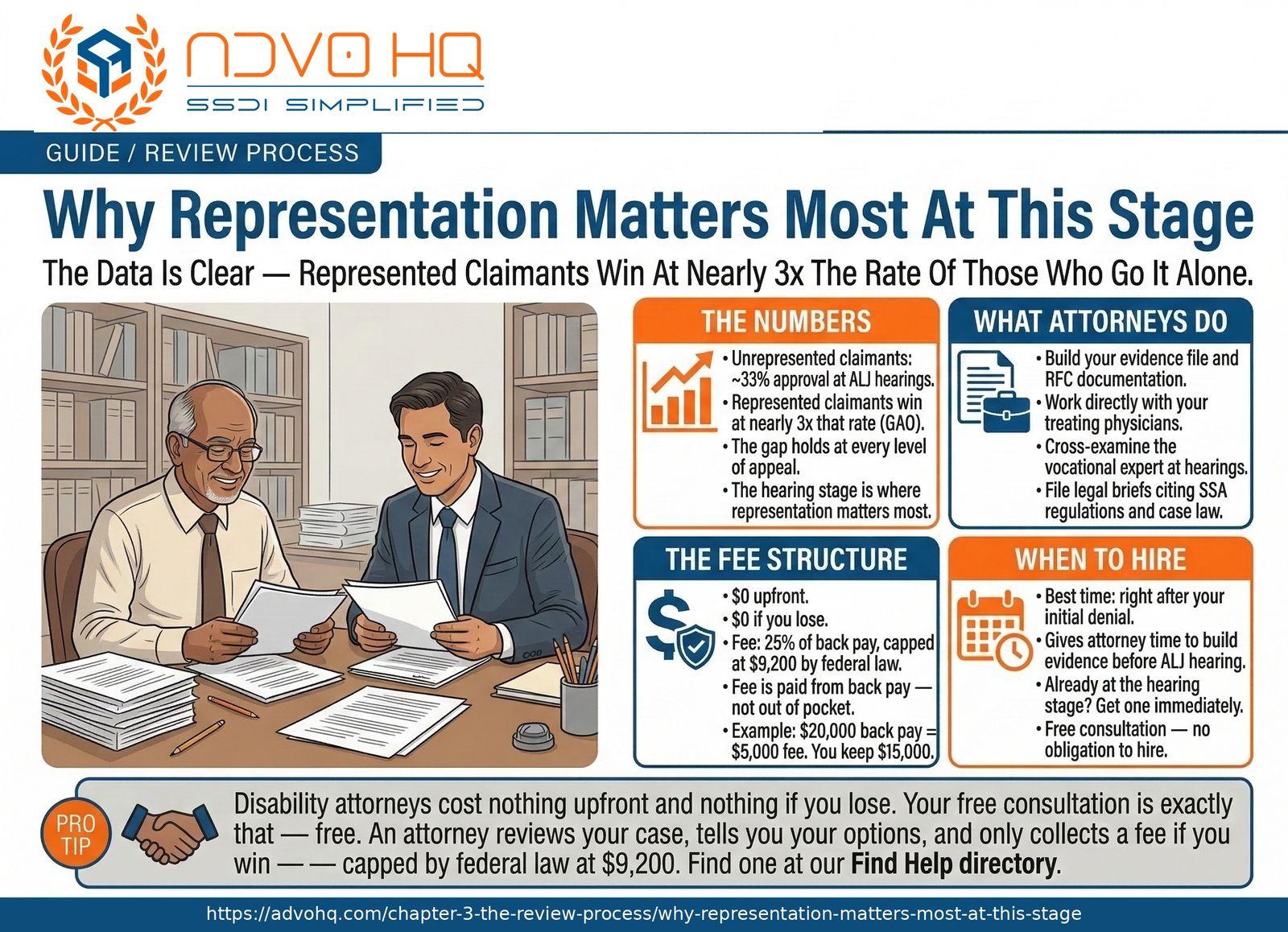
The Numbers: Represented vs. Unrepresented
Multiple studies and government reports consistently show the same thing: legal representation dramatically improves your chances of approval. Here’s what the data says:
Nearly 3× More Likely To Be Approved
Claimants with legal representation were nearly three times more likely to be awarded benefits than those who applied on their own.
Source: Government Accountability Office (GAO)
+23 Percentage Points At Initial Review
Legal representation increases the probability of initial approval by 23 points — from a baseline of ~32% to approximately 55%.
Source: NBER (National Bureau of Economic Research)
15–30% Higher Success Rates Across All Levels
Multiple academic studies found approval rates 15–30% higher for represented claimants across every stage of the appeal process.
Source: Kritzer, Maryland Action Plan, Popkin studies
37% Win Rate Without An Attorney At ALJ Hearings
Unrepresented claimants won 37.1% of ALJ hearing decisions. Represented claimants won at substantially higher rates at the same stage.
Source: Ortiz Law Firm analysis of local ALJ data
51% ALJ Approval Rate Overall (FY 2024)
The hearing level — where most claimants have attorneys — has by far the highest approval rate of any stage in the SSDI process.
Source: SSA Office of Decision Support, FY 2024
Represented claimants are allowed at a substantially higher rate than unrepresented claimants, and representation reliably gets you a decision faster and with fewer drawn-out appeals. What the best research does not support is a promise that hiring someone makes you more likely to ultimately win — the clearest causal evidence shows the biggest, most dependable benefits are speed and a smoother path, plus a better shot at an earlier (initial-stage) allowance. Your disability claim could be worth tens of thousands of dollars in back pay and years of monthly benefits, so it deserves that level of preparation regardless.
What A Disability Attorney Actually Does For Your Case
The approval rate gap isn’t magic. It’s the result of specific, skilled work that attorneys do at every stage of the process:
- Write a targeted rebuttal addressing every specific reason for denial with supporting evidence — not a vague disagreement
- Identify evidence gaps, obtain updated records, and secure RFC forms from your treating physicians
- Request and review the full DDS case file to understand exactly why you were denied and what needs to change
- Coach your Function Report to document your worst days with specific quantities, durations, and functional limits SSA recognizes
- Manage every deadline — file on time, request extensions when needed, and track the 60-day windows throughout
- Prepare your testimony — specific questions, coaching on how to describe limitations, and practice so you’re not caught off guard
- Write a pre-hearing brief that summarizes your case, cites medical evidence, argues the relevant Grid Rules, and tells the judge exactly why you qualify
- Cross-examine the vocational expert with targeted questions that add documented limitations, challenge job classifications, expose outdated DOT descriptions, and erode job numbers
- Apply the Grid Rules strategically — know which rule applies to your age, education, RFC, and work history, and argue for the RFC that puts you in the most favorable category
- Complete the evidence file months before the hearing — identify gaps, obtain missing records, and meet the 5-business-day submission deadline
- Ensure every impairment is documented — physical, mental, and combined — with specific functional limitations the judge must address
- Identify reversible errors in the ALJ’s written decision — improper weighing of evidence, overlooked impairments, credibility framework violations, VE/DOT conflicts, Grid Rule misapplication
- Write targeted legal arguments for the Appeals Council citing specific regulations and SSA rulings — not "I disagree because I’m disabled"
- File in federal district court if needed — legal briefs under Federal Rules of Civil Procedure, case law citations, argument for remand
- Run the dual-track strategy — file Appeals Council review while simultaneously filing a new application to protect your original filing date and back pay
How Disability Attorneys Get Paid: The No-Risk Model
One of the biggest reasons people don’t hire an attorney is cost. Here’s the reality: disability attorneys cost nothing upfront and nothing if you lose. The fee structure is regulated by the Social Security Administration:
The math: If your back pay is $20,000, the attorney fee would be $5,000 (25%). If your back pay is $40,000, the attorney fee is capped at $9,200—not $10,000. You keep $30,800. Without the attorney, your chances of receiving that back pay are significantly lower. The question isn’t whether you can afford an attorney. It’s whether you can afford not to have one.
The Back Pay Factor: Why Representation Protects Your Money
Back pay is the total amount of benefits you’re owed from your onset date (when you became disabled) to the date you’re approved. The longer your case takes, the more back pay accumulates. An attorney protects this money in ways most people don’t realize:
Preserve Your Original Filing Date
Every appeal level is managed so your original filing date stays intact. Miss a deadline and have to refile, and you lose all back pay accumulated from that date — potentially tens of thousands of dollars.
Argue For The Earliest Onset Date
Even claimants who win don’t always get the most favorable onset date. Attorneys argue for the date your medical evidence actually supports — the earlier the date, the more back pay you receive.
Challenge Partially Favorable Decisions
A partially favorable decision approves your claim but assigns a later onset date — reducing your back pay. Attorneys identify and challenge onset dates that don’t match the medical record.
Run The Dual-Track Strategy
File Appeals Council review while simultaneously filing a new application. Missing this strategy means potentially restarting the back pay clock if the appeal fails.
Verify The Back Pay Calculation
SSA occasionally makes errors in back pay calculations. Attorneys review the numbers and challenge any discrepancies before you accept a payment amount that may be incorrect.
- Monthly benefit: $1,800. Filed January 2024. Approved at ALJ hearing January 2026. - Back pay (24 months minus the 5-month waiting period): 19 months × $1,800 = $34,200- Attorney fee (25% of back pay): $8,550- You receive: $25,650 in back pay + ongoing monthly benefits of $1,800/month If you missed the appeal deadline and had to refile in January 2025, you'd lose 12 months of back pay — $21,600.
How To Find The Right Disability Attorney
Not all attorneys are the same. Here’s what to look for and why each criterion matters:
Specializes In Social Security Disability
Disability law is a specialty. A personal injury or general practice attorney won’t know the Grid Rules, VE cross-examination strategies, RFC standards, or SSA procedures. You want someone who does this every day.
Experience At The Hearing Level
The ALJ hearing is where most cases are won or lost. Ask how many hearings they’ve handled and their approximate win rate. Familiarity with your local hearing office and judges is a genuine advantage.
Handles Evidence Development
Good attorneys don’t just show up at the hearing. They build your case months in advance — getting RFC forms, ordering records, identifying specialists, and submitting comprehensive pre-hearing briefs.
Clear Fee Agreement
The standard is 25% of back pay capped at $9,200. Make sure you understand the fee structure before signing — and ask specifically about additional costs for records or court filing fees.
Responsive Communication
Your attorney should return calls and emails promptly and keep you informed about case status. If they’re hard to reach during the free consultation, that pattern won’t improve once they’ve signed you.
Licensed And In Good Standing
An SSA hearing is a federal administrative proceeding, not a state court case — so your attorney does not need to be licensed in the state where your hearing is held. Any attorney in good standing, with the right to practice before a court of any state or a federal court, can represent you. What matters far more is how many SSA hearings they have actually handled, and whether they know the ALJs at your local hearing office.
Questions To Ask During Your Free Consultation
- How many SSDI hearings have you handled in the past year?
- Do you personally attend hearings, or does a non-attorney representative handle them?
- Will you obtain my medical records and RFC forms, or is that my responsibility?
- Do you write pre-hearing briefs for every case?
- Are there any costs beyond the standard contingency fee?
- How will you communicate with me about my case status?
- Have you handled cases before the ALJ(s) at my local hearing office?
- What do you think about the strength of my case after reviewing my denial?
Common Objections And Honest Answers
What People Say
- "I can’t afford an attorney."
- "My case is straightforward—I don’t need help."
- "I don’t want to give up 25% of my back pay."
- "I’ve been researching online—I know the process."
- "Attorneys are just in it for the money."
- "I’ll just reapply if I lose."
The Reality
- You can’t afford not to. Disability attorneys charge nothing upfront and nothing if you lose. The fee comes from back pay you wouldn’t have received without them. It’s literally a no-risk arrangement.
- If it were straightforward, you’d have been approved already. The fact that you’ve been denied means the evidence needs to be presented differently, the gaps need to be filled, and someone needs to argue your case at the hearing.
- The alternative is a significantly lower chance of receiving any back pay at all. Unrepresented claimants win roughly 1 in 3 hearings. Even when they win, they often get later onset dates—which means less back pay. 75% of something is a lot more than 100% of nothing.
- Reading about the process and executing it under pressure at a hearing are very different things. Cross-examining a vocational expert, knowing which Grid Rule applies, writing a pre-hearing brief, and identifying errors in an ALJ’s decision require expertise that takes years to develop.
- Disability attorneys only get paid when you win. Their financial incentive is aligned with yours—they want the best possible outcome for your case because that’s how they make a living. The fee is regulated by SSA, not set by the attorney.
- Reapplying means losing your original filing date, losing accumulated back pay, going through reconsideration again (13–15% approval rate), and waiting months or years to reach another hearing. An attorney at your first hearing is far more efficient than starting over.
Frequently Asked Questions
As early as possible. Before filing, an attorney makes sure your initial application has the right medical evidence, the correct onset date, and a complete work history from day one. After an initial denial — the most common entry point — they review your denial letter, find the evidence gaps, and get RFC forms from your doctors. The most critical window is before the ALJ hearing, which is where cases are won. And after an ALJ denial, the Appeals Council and federal court stages require legal expertise you can't pick up online.
Why hire now: Attorney ensures your initial application includes proper medical evidence, the correct onset date, and a complete work history from day one.
Risk of waiting: A weak initial application leads to a denial that could have been avoided — and now you must appeal.
Why hire now: Attorney reviews your denial letter, identifies evidence gaps, obtains RFC forms from your doctors, and builds the full case for reconsideration and the hearing ahead.
Risk of waiting: Filing reconsideration without new evidence virtually guarantees another denial. Critical time wasted.
Why hire now: Attorney writes a pre-hearing brief, prepares your testimony, obtains updated medical evidence, and cross-examines the vocational expert. This is where cases are won.
Risk of waiting: No VE cross-examination, no pre-hearing brief, no prepared testimony — win rate drops from ~51% to ~37%.
Why hire now: Attorney identifies legal errors in the ALJ’s written decision, files with the Appeals Council, manages the dual-track strategy, and handles federal court if necessary.
Risk of waiting: These stages require specialized legal knowledge you cannot learn from the internet. Self-representation is extremely difficult.
The ideal time: After your initial denial. This gives the attorney time to build your evidence file, work with your doctors, and prepare thoroughly for the ALJ hearing — the stage with the highest approval rate. If you’re already at the hearing stage without an attorney, get one immediately.
Right after your initial denial. That gives the attorney time to build your evidence file, work with your doctors, and prepare thoroughly for the ALJ hearing — the stage with the highest approval rate. If you're already at the hearing stage without an attorney, get one immediately. If you're past the hearing, get one before filing with the Appeals Council.
Why hire now: Attorney ensures your initial application includes proper medical evidence, the correct onset date, and a complete work history from day one.
Risk of waiting: A weak initial application leads to a denial that could have been avoided — and now you must appeal.
Why hire now: Attorney reviews your denial letter, identifies evidence gaps, obtains RFC forms from your doctors, and builds the full case for reconsideration and the hearing ahead.
Risk of waiting: Filing reconsideration without new evidence virtually guarantees another denial. Critical time wasted.
Why hire now: Attorney writes a pre-hearing brief, prepares your testimony, obtains updated medical evidence, and cross-examines the vocational expert. This is where cases are won.
Risk of waiting: No VE cross-examination, no pre-hearing brief, no prepared testimony — win rate drops from ~51% to ~37%.
Why hire now: Attorney identifies legal errors in the ALJ’s written decision, files with the Appeals Council, manages the dual-track strategy, and handles federal court if necessary.
Risk of waiting: These stages require specialized legal knowledge you cannot learn from the internet. Self-representation is extremely difficult.
The ideal time: After your initial denial. This gives the attorney time to build your evidence file, work with your doctors, and prepare thoroughly for the ALJ hearing — the stage with the highest approval rate. If you’re already at the hearing stage without an attorney, get one immediately.
Nothing upfront, and nothing if you lose. Disability attorneys work on contingency: their fee is 25% of your back pay, capped at $9,200, and SSA deducts it directly so you never write a check. If your claim is denied, you owe no fee. Most attorneys also offer a free initial consultation.
Why hire now: Attorney ensures your initial application includes proper medical evidence, the correct onset date, and a complete work history from day one.
Risk of waiting: A weak initial application leads to a denial that could have been avoided — and now you must appeal.
Why hire now: Attorney reviews your denial letter, identifies evidence gaps, obtains RFC forms from your doctors, and builds the full case for reconsideration and the hearing ahead.
Risk of waiting: Filing reconsideration without new evidence virtually guarantees another denial. Critical time wasted.
Why hire now: Attorney writes a pre-hearing brief, prepares your testimony, obtains updated medical evidence, and cross-examines the vocational expert. This is where cases are won.
Risk of waiting: No VE cross-examination, no pre-hearing brief, no prepared testimony — win rate drops from ~51% to ~37%.
Why hire now: Attorney identifies legal errors in the ALJ’s written decision, files with the Appeals Council, manages the dual-track strategy, and handles federal court if necessary.
Risk of waiting: These stages require specialized legal knowledge you cannot learn from the internet. Self-representation is extremely difficult.
The ideal time: After your initial denial. This gives the attorney time to build your evidence file, work with your doctors, and prepare thoroughly for the ALJ hearing — the stage with the highest approval rate. If you’re already at the hearing stage without an attorney, get one immediately.
Represented claimants clearly do better on average — but it's worth being precise. The GAO (GAO-18-37, 2017) found represented claimants are allowed at nearly three times the rate of unrepresented claimants, though that's a correlation, not proof that representation alone causes the gap. The strongest causal study (NBER WP 29871, 2022) found representation mainly gets you a decision much faster and cuts drawn-out appeals, and improves your odds of an initial-stage allowance — but it did not detectably change the ultimate probability of an award. So the honest answer: representation reliably makes the process faster and smoother and is associated with higher allowance rates; it is not a guarantee that you will win.
Why hire now: Attorney ensures your initial application includes proper medical evidence, the correct onset date, and a complete work history from day one.
Risk of waiting: A weak initial application leads to a denial that could have been avoided — and now you must appeal.
Why hire now: Attorney reviews your denial letter, identifies evidence gaps, obtains RFC forms from your doctors, and builds the full case for reconsideration and the hearing ahead.
Risk of waiting: Filing reconsideration without new evidence virtually guarantees another denial. Critical time wasted.
Why hire now: Attorney writes a pre-hearing brief, prepares your testimony, obtains updated medical evidence, and cross-examines the vocational expert. This is where cases are won.
Risk of waiting: No VE cross-examination, no pre-hearing brief, no prepared testimony — win rate drops from ~51% to ~37%.
Why hire now: Attorney identifies legal errors in the ALJ’s written decision, files with the Appeals Council, manages the dual-track strategy, and handles federal court if necessary.
Risk of waiting: These stages require specialized legal knowledge you cannot learn from the internet. Self-representation is extremely difficult.
The ideal time: After your initial denial. This gives the attorney time to build your evidence file, work with your doctors, and prepare thoroughly for the ALJ hearing — the stage with the highest approval rate. If you’re already at the hearing stage without an attorney, get one immediately.
Yes. SSA allows both licensed attorneys and qualified non-attorney representatives, and both work under the same SSA-regulated contingency-fee rules. Ask who will actually attend your hearing, how many hearings they've handled, and whether they write a pre-hearing brief for every case.
Why hire now: Attorney ensures your initial application includes proper medical evidence, the correct onset date, and a complete work history from day one.
Risk of waiting: A weak initial application leads to a denial that could have been avoided — and now you must appeal.
Why hire now: Attorney reviews your denial letter, identifies evidence gaps, obtains RFC forms from your doctors, and builds the full case for reconsideration and the hearing ahead.
Risk of waiting: Filing reconsideration without new evidence virtually guarantees another denial. Critical time wasted.
Why hire now: Attorney writes a pre-hearing brief, prepares your testimony, obtains updated medical evidence, and cross-examines the vocational expert. This is where cases are won.
Risk of waiting: No VE cross-examination, no pre-hearing brief, no prepared testimony — win rate drops from ~51% to ~37%.
Why hire now: Attorney identifies legal errors in the ALJ’s written decision, files with the Appeals Council, manages the dual-track strategy, and handles federal court if necessary.
Risk of waiting: These stages require specialized legal knowledge you cannot learn from the internet. Self-representation is extremely difficult.
The ideal time: After your initial denial. This gives the attorney time to build your evidence file, work with your doctors, and prepare thoroughly for the ALJ hearing — the stage with the highest approval rate. If you’re already at the hearing stage without an attorney, get one immediately.
By preserving your original filing date through every appeal level, arguing for the earliest supportable onset date, challenging "partially favorable" decisions that push your onset date later, managing the dual-track strategy, and double-checking SSA's back pay math for errors.
Why hire now: Attorney ensures your initial application includes proper medical evidence, the correct onset date, and a complete work history from day one.
Risk of waiting: A weak initial application leads to a denial that could have been avoided — and now you must appeal.
Why hire now: Attorney reviews your denial letter, identifies evidence gaps, obtains RFC forms from your doctors, and builds the full case for reconsideration and the hearing ahead.
Risk of waiting: Filing reconsideration without new evidence virtually guarantees another denial. Critical time wasted.
Why hire now: Attorney writes a pre-hearing brief, prepares your testimony, obtains updated medical evidence, and cross-examines the vocational expert. This is where cases are won.
Risk of waiting: No VE cross-examination, no pre-hearing brief, no prepared testimony — win rate drops from ~51% to ~37%.
Why hire now: Attorney identifies legal errors in the ALJ’s written decision, files with the Appeals Council, manages the dual-track strategy, and handles federal court if necessary.
Risk of waiting: These stages require specialized legal knowledge you cannot learn from the internet. Self-representation is extremely difficult.
The ideal time: After your initial denial. This gives the attorney time to build your evidence file, work with your doctors, and prepare thoroughly for the ALJ hearing — the stage with the highest approval rate. If you’re already at the hearing stage without an attorney, get one immediately.
What They Don't Tell You
Insider knowledge that can make or break your application:
Many denied applicants never appeal — and that's often the biggest mistake
Studies of the SSDI process have long found that a large share of people who are denied never file an appeal; they give up after the initial denial or reconsideration. But the hearing level — the third stage — has historically had the highest allowance rate of any stage: SSA hearing-level disposition data (Office of Hearings Operations) has shown roughly 45–50% of hearing decisions end in an allowance (a grant rate of decisions at that stage, not of all applicants, and lower in recent years). Those are people who were denied twice before. The system is built so the most thorough review happens at the hearing. Giving up before you get there means walking away from your best chance.
Attorneys often spot problems you don't even know exist
An experienced attorney reviews your file and immediately sees the gaps. Maybe your doctor never completed an RFC form. Maybe your mental health conditions aren't documented. Maybe your past work was misclassified, or a specialist evaluation would change the analysis entirely. Most people don't know to look for these — but they're exactly what changes outcomes.
You can add — or switch — representation at any stage, not just at the start
Many claimants assume it's "too late" to get an attorney once they've been denied, or that they're stuck with a representative who isn't working out. Neither is true: you can bring in representation at the initial application, reconsideration, hearing, Appeals Council, or federal court, and you can change representatives along the way. The earlier one starts the more time they have to develop evidence, but there is no stage where it becomes too late to get help.
Your attorney works with your doctors, not against them
One of the most valuable things attorneys do is talk to your treating physicians. They explain what SSA needs, provide the right RFC forms, and help doctors document functional limitations in terms SSA recognizes. Most doctors want to help — they just don't know how the disability system works. Your attorney bridges that gap.
"Representation" is really a bundle of discrete tasks — and you can ask exactly which ones a rep will handle
Analyzing the denial letter, filing the right forms, building the evidence file, getting RFC forms, preparing for the hearing, questioning the VE, spotting legal errors, filing with the Appeals Council, and managing federal court are each separate pieces of skilled work. Because they're separable, it's fair to ask a prospective representative which of these they will personally do, who else in their office handles them, and how they keep your case moving — questions that tell you far more than a promise about outcomes.
The fee fear that keeps people unrepresented is misplaced
Fear of "lawyer bills" keeps many people unrepresented at the exact stage where representation helps most — and that fear is misplaced. A Social Security representative can't charge you anything up front and gets paid only if you win; the fee is set by statute at 25% of your past-due back benefits up to a hard cap (currently $9,200 under the fee-agreement process), and SSA must approve it and withholds it straight from your award. Because the fee comes out of back pay you'd never have received without winning — and it's capped by law — hiring a representative at this stage costs you nothing out of pocket and can't quietly balloon.
The data is clear.
The data is clear. Represented claimants are allowed at substantially higher rates, and representation reliably gets you a faster decision with fewer drawn-out appeals. Disability attorneys cost nothing upfront and nothing if you lose. The fee is regulated by SSA and comes from back pay you likely wouldn't receive without representation. Every stage of the appeal process — from reconsideration through federal court — involves tasks that require specialized knowledge and experience, and the hearing level, where most cases are decided, is where the gap between represented and unrepresented claimants is most dramatic. This is the final article in The Review Process series. If you've been denied and you're reading this, you have a decision to make: keep navigating this process alone, or get a free consultation with a disability attorney who handles cases like yours every day. The consultation costs nothing. If they take your case, the representation costs nothing upfront. And the data says represented claimants are allowed at higher rates and reach a decision faster. Use what you've learned, get help, and fight for the benefits you've earned.
This is the final article in the Review Process series. If you started from Article 1, you now have a complete understanding of every stage of the SSDI appeals process—from your denial letter through federal court. Use this knowledge. Get help. And fight for the benefits you’ve earned.
Get A Free Consultation Today
Disability attorneys offer free consultations, work on contingency (no upfront cost), and only get paid if you win. The fee is 25% of back pay, capped at $9,200, deducted directly by SSA. You never write a check. Find an experienced SSDI attorney in your area who can evaluate your case and start building the evidence you need to win.
→ Find A Disability Attorney In Your County
→ Request Free Help With Your SSDI Claim
→ Estimate Your Back Pay With Our Free Calculator
The Complete Review Process Series
1. You Got Denied — Now What?
2. Reconsideration: The First Appeal
3. Preparing For The ALJ Hearing
4. What Happens At The Hearing
5. Medical Evidence On Appeal: Strengthening Your Case
6. The Vocational Expert: Your Hidden Opponent
7. Appeals Council And Federal Court: The Final Steps
8. Why Representation Matters Most At This Stage ← You Are Here
Not affiliated with SSA or any government agency. For informational purposes only — not legal advice.
- 42 U.S.C. § 406(a)(2) — Representation of claimants; fee agreement process and maximum-dollar-limit authority. law.cornell.edu
- 20 C.F.R. § 404.1705 — Who may be your representative; an attorney need only be in good standing with the right to practice before a court of any State or a Federal court. There is no requirement to be licensed where the hearing is held. ecfr.gov
- 20 C.F.R. § 404.1720 — Fees for a representative's services. ecfr.gov
- Federal Register, "Maximum Dollar Limit in the Fee Agreement Process," 89 FR (May 10, 2024), doc. 2024-10248 — sets the $9,200 fee cap effective November 30, 2024. (See also the May 6, 2025 Partial Rescission, 90 FR doc. 2025-07813, which left the $9,200 cap unchanged.). federalregister.gov
- Social Security Administration — Appointed Representatives / Fee Agreements. and. ssa.gov
- Social Security Administration — Hearings and Appeals.. ssa.gov
- SSA, Annual Statistical Report on the SSDI Program, 2024 ed., Sec. 4 (Table 60 / Chart 11) — allowance/award outcomes by level, including the ~51% FY 2024 hearing-level allowance rate. ssa.gov
- GAO-18-37, "Social Security Disability: Additional Measures and Evaluation Needed to Enhance Accuracy and Consistency of Hearings Decisions" (Government Accountability Office, 2017) — documents that claimants with a representative were allowed at a rate nearly 3x higher than those without; a descriptive correlation, not a causal finding. gao.gov
- Hoynes, Maestas & Strand, "Legal Representation in Disability Claims," NBER Working Paper 29871 (2022) — causal (IV) evidence that representation raises the initial-stage allowance probability (~23pp off a ~32% base), speeds awards (~316 fewer days), and reduces appeals, but does not change the ultimate probability of an award. nber.org
- 42 U.S.C. § 406(a) (Social Security Act § 206) — fee-agreement/fee-petition authority; representative paid only from past-due benefits SSA withholds and approves. ; SSA, "Fee Agreements." ; 89 Fed. Reg. 40318 — maximum fee-agreement dollar limit set to $9,200. ssa.gov