
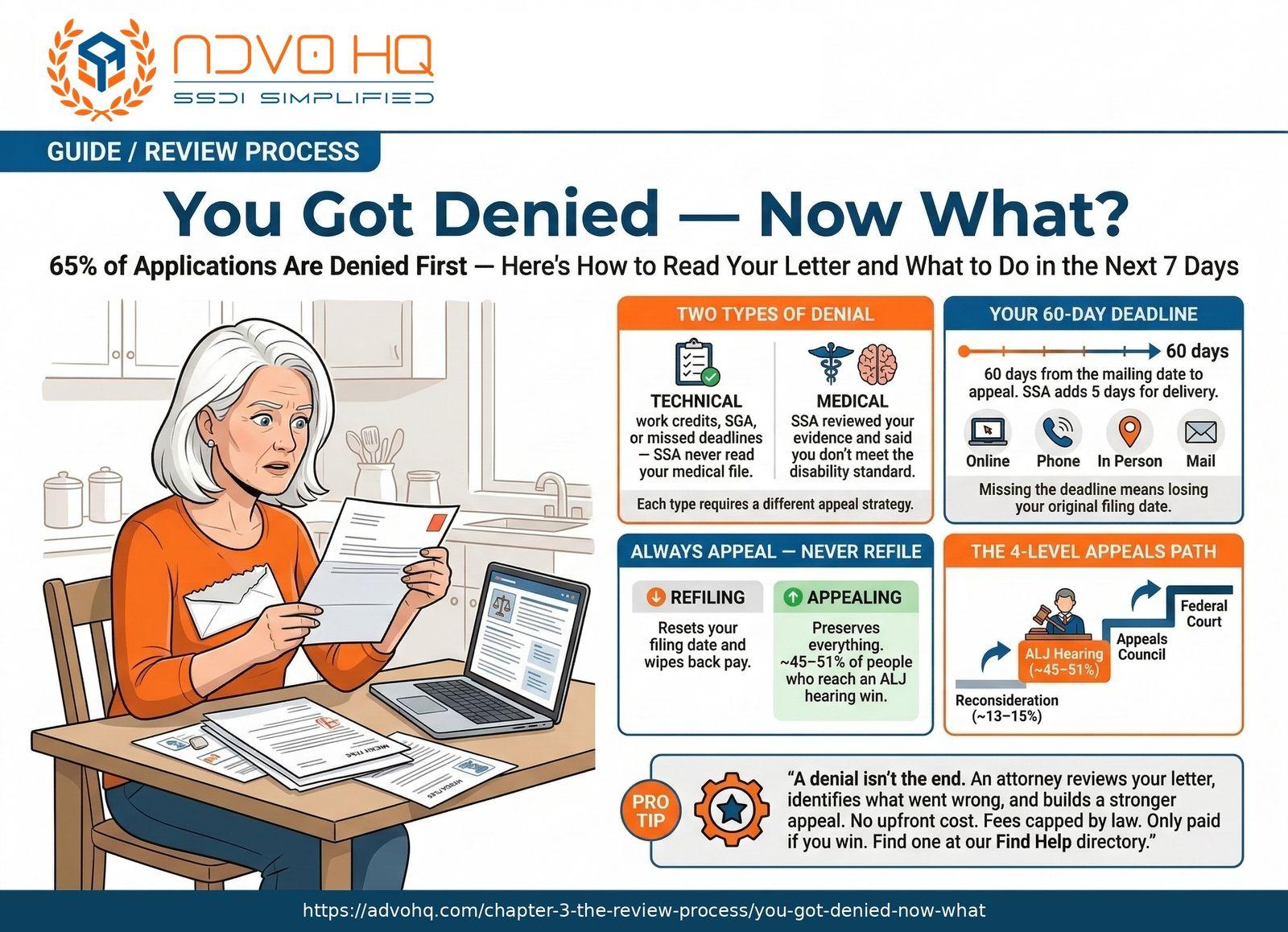
The Denial Letter Is A Roadmap, Not A Dead End
Your denial letter isn’t just bad news. It’s the most important document in your appeal because it tells you exactly why SSA said no. Every denial has a specific reason, and that reason tells you what needs to change for a different outcome. Here’s how to read it:
What The Letter Contains
- The decision. A clear statement that your claim has been denied.
- The specific reason for denial. This is the critical part. It tells you at which step of the evaluation process SSA stopped—and why.
- Your appeal rights. Instructions on how to appeal and the deadline for doing so.
- The date the letter was mailed. This starts your 60-day appeal clock (plus 5 days for mailing).
The Two Types Of Denials
Not all denials are the same. Understanding which type you received changes your entire appeal strategy.
Technical Denial
A technical denial means SSA didn’t even look at your medical evidence. You were denied because you didn’t meet the basic non-medical requirements. Common technical denial reasons:
- Insufficient work credits. You don’t have enough recent work history to qualify for SSDI. You need 20 credits in the last 10 years (roughly 5 years of work).
- Earning above SGA. You’re currently earning more than $1,690 per month (2026), which SSA considers substantial gainful activity.
- Failure to cooperate. You didn’t respond to SSA’s requests for information, missed a consultative exam, or didn’t return required forms.
- Past your Date Last Insured. Your SSDI coverage expired because too much time passed since you last worked. You must prove you were disabled before your coverage ended.
What this means for your appeal: Technical denials are about eligibility, not disability. Your appeal needs to address the specific technical issue—providing proof of additional work credits, showing you stopped working before you applied, or demonstrating that your onset date falls before your Date Last Insured.
Medical Denial
A medical denial means SSA reviewed your medical evidence and decided you don’t meet the disability standard. The denial letter will reference one of these specific findings:
- "Condition is not severe" — SSA found your impairment doesn’t significantly limit your ability to do basic work activities. Stopped at Step 2.
- "Does not meet a listing" — Your condition doesn’t match the severity criteria in SSA’s Blue Book. Moved past Step 3 to evaluate your work capacity.
- "Can perform past work" — SSA determined you can still do at least one of your previous jobs despite your condition. Denied at Step 4.
- "Can perform other work" — SSA says other jobs exist in the national economy that you could do given your RFC, age, education, and work history. Denied at Step 5.
- "Insufficient medical evidence" — SSA didn’t have enough medical documentation to make a determination. This is the #1 reason for medical denials.
- "Failure to follow treatment" — SSA found you’re not following your prescribed treatment plan without an acceptable reason.
What this means for your appeal: Medical denials require stronger evidence. You need to address the specific finding: more detailed records, an RFC from your treating physician, additional test results, or evidence that your condition has worsened since the initial review.
The 60-Day Clock: Your Most Important Deadline
From the date your denial letter is mailed, you have 60 days to file an appeal. SSA assumes you received the letter 5 days after it was mailed, so you effectively have about 65 days from the mail date. But don’t push it to the last day—things happen.
If You Appeal On Time
- Original filing date is preserved
- Back pay calculated from original onset date
- You can submit new evidence
- You move to the next level of review
If You Miss The Deadline
- Must start completely over with a new application
- Original filing date is lost
- Back pay only counts from new filing date
- New examiner sees you were previously denied
- You lose months or years of potential benefits
What counts as filing on time:
Online
At ssa.gov — fastest option.
By Phone
Call 1-800-772-1213.
In Person
At your local SSA field office.
By Mail
Form SSA-561 — postmark date counts.
If you missed the 60-day deadline, you can request an extension by showing "good cause" — serious illness, death in the family, misleading information from SSA, or never receiving the denial letter. SSA decides on a case-by-case basis, and it's not guaranteed.
The Full Appeals Path: Where Your Case Goes From Here
The SSDI appeals process has four levels. You must go through them in order—you can’t skip ahead. Here’s the overview:
Different DDS examiner reviews your full file plus any new evidence. Paper review only—no hearing.
You appear before an Administrative Law Judge. You testify, present evidence, and your attorney argues your case. This is where most cases are won.
Reviews whether the ALJ made legal or procedural errors. Can uphold, reverse, or remand back to ALJ.
Filed in federal district court. Judge reviews whether SSA followed its own rules. Requires an attorney.
The hearing is where most cases are truly decided — everything before it is mostly paperwork. At the ALJ hearing, a human being looks you in the eye, listens to your story, and makes a judgment call.
Why You Should Almost Always Appeal (Not Start Over)
After a denial, a lot of people think: "Maybe I should just file a new application." Almost always, that’s the wrong move. Here’s why:
If You Appeal
- Filing date preserved from original application
- Back pay calculated from original onset date
- Previous denial is part of the process—expected and normal
- Can add new records and testimony at each level
- Higher approval odds at ALJ hearing (~45–51%)
- Builds on work already done
If You Start Over
- Filing date resets to new application date
- Back pay starts over from new filing date
- New examiner sees you were denied before, creating uphill battle
- Must rebuild entire case from scratch
- Same low initial rate (~35%)
- All previous effort wasted
The only time starting over might make sense:
- Your condition has changed dramatically since the original application (new diagnosis, significant worsening)
- You missed the 60-day appeal deadline and can’t get a good cause extension
- Your technical denial was based on work credits that you’ve since earned
Even in those cases, talk to an attorney before making the decision. There may be a way to appeal and file simultaneously to protect your original filing date.
What To Do In The First 7 Days After A Denial
Don’t panic, but don’t wait either. Here’s your action plan:
The Numbers That Should Give You Hope
A denial feels final. It’s not. Here’s what the data actually says:
The takeaway: about half of the people who get denied at the initial level and give up would likely have been approved if they’d appealed. The system is designed with appeals as part of the process—not as an exception. Getting denied the first time is the rule, not the outlier.
Frequently Asked Questions
Possibly. You can ask SSA to accept a late appeal by showing "good cause" — a serious illness, a death in the family, misleading information from SSA, or never receiving the denial letter. SSA decides case by case, and it's not guaranteed. File on time whenever you possibly can.
A technical denial rejects your claim without ever reviewing your medical evidence — usually over work credits, earnings above SGA, or a failure to cooperate. A medical denial means SSA looked at your records and decided you don't meet the disability standard. Each one calls for a different appeal strategy, which is why reading your denial letter closely matters so much.
You're not required to have one, but the data strongly favors representation — especially at the ALJ hearing. Most disability attorneys work on contingency with no upfront cost, and their fee is capped at $9,200 (25% of your past-due benefits, whichever is less), a limit SSA set effective November 30, 2024. Free consultations are standard. See Do I Need a Lawyer or Advocate?.
You can, but it's almost always the wrong move. A new application resets your filing date and shrinks your back pay, and the next examiner sees you were denied before. Appealing preserves your original filing date and builds on the work you've already done. Starting over only makes sense if your condition has changed dramatically, you missed the deadline without good cause, or you've since earned the work credits you were missing.
As of the latest SSA figures (May 2026), reconsideration averages about 208 days (~7 months) and an ALJ hearing about 267 days (~9 months). The Appeals Council often takes a year or more — SSA doesn't publish a current average — and federal court adds 12+ months on top. End to end, a case that goes the distance can take 2–4 years from the initial denial to a final decision.
You can file a civil action in federal district court, where a judge reviews whether SSA followed its own rules. If you've exhausted every level, a new application would reset your filing date — so talk to an attorney first. They may spot new evidence or a legal error that strengthens a fresh claim. Don't give up without that conversation. For how the Appeals Council and federal court actually work, see Appeals Council And Federal Court: The Final Steps.
What They Don't Tell You
Insider knowledge that can make or break your application:
There is no secret policy to deny everyone the first time
It's a common belief that SSA automatically denies all initial applications. That's not true — a meaningful share of initial applications are approved outright, and many more are won on appeal. The high denial rate comes from incomplete evidence, technical issues, and the strict standard SSA applies, not from an intentional denial-first policy.
Your denial letter contains the blueprint for your appeal
Most people glance at the letter and feel defeated. But the specific findings tell you exactly what SSA found lacking. "Insufficient medical evidence" means get more records. "Can perform past work" means your job descriptions may have worked against you. "Can perform other work" means the Grid Rules didn't fall in your favor — something an attorney can challenge.
You can request your full case file — and you should
Most applicants never see the internal documents SSA used to deny them. But you have the legal right to your entire file, including the DDS examiner's worksheet, the RFC they assigned, consultative exam reports, and notes about what evidence was missing. This is critical information for building your appeal.
Back pay keeps growing while you appeal
Every month your appeal takes, your back pay increases — and if your claim is eventually approved, those months count. As an illustration only, a 12-month appeal could mean roughly $15,000–$25,000 or more in back pay depending on your benefit amount (your actual figure depends on your monthly benefit and onset date). Walking away from an appeal means walking away from that money.
A large share of denied applicants never appeal
Studies of the SSDI process have long found that a substantial portion of people who get denied simply accept a decision that might have been overturned. Many of them had legitimate disabilities and strong cases. They just didn't know the system, couldn't navigate the process, or assumed the denial was final. It's not.
Get your eFolder before you do anything else
Before you do anything else, get a copy of your complete claims file — SSA calls it the "eFolder" — along with its exhibit list. It shows the exact records SSA actually had, the state agency's written rationale (the Disability Determination Explanation), and, most tellingly, which of your own treating doctors SSA never contacted. If you have a representative they get instant online access to the eFolder; if you don't, you can request the file in writing (or start with a call to 1-800-772-1213). Nine times out of ten you'll find the denial rests on missing or misread records you can now fix — the difference between appealing blind and knowing exactly which gap to close.
A denial is a setback, not a stop sign.
A denial is a setback, not a stop sign. The appeals process exists because SSA knows the initial review isn't always right. Your job right now is simple: read the denial letter, mark your deadline, request your case file, and file your appeal. Everything else — stronger evidence, attorney involvement, hearing preparation — builds from there.
Up Next: Reconsideration: The First Appeal—what it is, how to file it, what new evidence to submit, and what to realistically expect at this stage.
Don’t Navigate Your Appeal Alone
A disability attorney can review your denial letter, identify exactly what went wrong, and build a strategy to get a different result. Free consultations. No upfront cost. They only get paid if you win.
→ Find An Attorney In Your County
→ Request Free Help With Your Appeal
New To SSDI?
If you haven’t applied yet, start with our Initial Application Series—a 10-article guide that walks you through every step of the SSDI process from start to finish.
Not affiliated with SSA or any government agency. For informational purposes only — not legal advice.
- SSA — The Appeals Process (overview). ssa.gov
- 20 CFR § 404.900 — Introduction: the four-step administrative review process (reconsideration → ALJ hearing → Appeals Council → Federal court). ecfr.gov
- 20 CFR § 404.909(a)(1) — Reconsideration must be requested in writing within 60 days of receiving notice of the initial determination. ecfr.gov
- 20 CFR § 404.901 — Definition of "date you receive notice": 5 days after the notice date unless rebutted (the "+5 days" for mailing). ecfr.gov
- SSA Form SSA-561 — Request for Reconsideration. ssa.gov
- 20 CFR § 404.933 — Request for a hearing before an ALJ must be filed within 60 days; SSA Form HA-501, Request for Hearing by Administrative Law Judge. ecfr.gov
- 20 CFR § 404.968 — Appeals Council review must be requested within 60 days (Form HA-520). ecfr.gov
- Social Security Act § 205(g), 42 U.S.C. § 405(g) — Judicial review by civil action within 60 days; findings supported by substantial evidence are conclusive. ssa.gov
- SSA, Annual Statistical Report on the Social Security Disability Insurance Program, 2024, Sec. 4 (Table 60 / Chart 11) — final award rate ~29% (2014–2023); allowance shares of all applicants ~20% initial / ~2% reconsideration / ~7% hearing-and-above. ssa.gov
- SSA — Social Security Performance: Disability claim processing time (reconsideration avg ~208 days) and Disability appeals time (ALJ hearing avg ~267 days), latest published month May 2026. ssa.gov
- 42 U.S.C. § 423(c)(1); 20 CFR § 404.130(b) — Insured-status "20/40" rule (20 credits in the last 10 years). ecfr.gov
- SSA — Substantial Gainful Activity: 2026 non-blind SGA = $1,690/mo. ssa.gov
- Attorney fee cap — 25% of past-due benefits, capped at $9,200, effective Nov. 30, 2024. Fed. Reg. "Maximum Dollar Limit in the Fee Agreement Process," 89 FR (May 10, 2024); 42 U.S.C. § 406(a)(2); 20 CFR § 404.1720; SSA Fee Agreements. federalregister.gov
- SSA — "Appointed Representative Services / Access to the Electronic Folder" (eFolder access to the claims file and exhibit list). ; HALLEX I-2-1-20 (Preparation of Exhibit List). ssa.gov