
What Reconsideration Actually Is
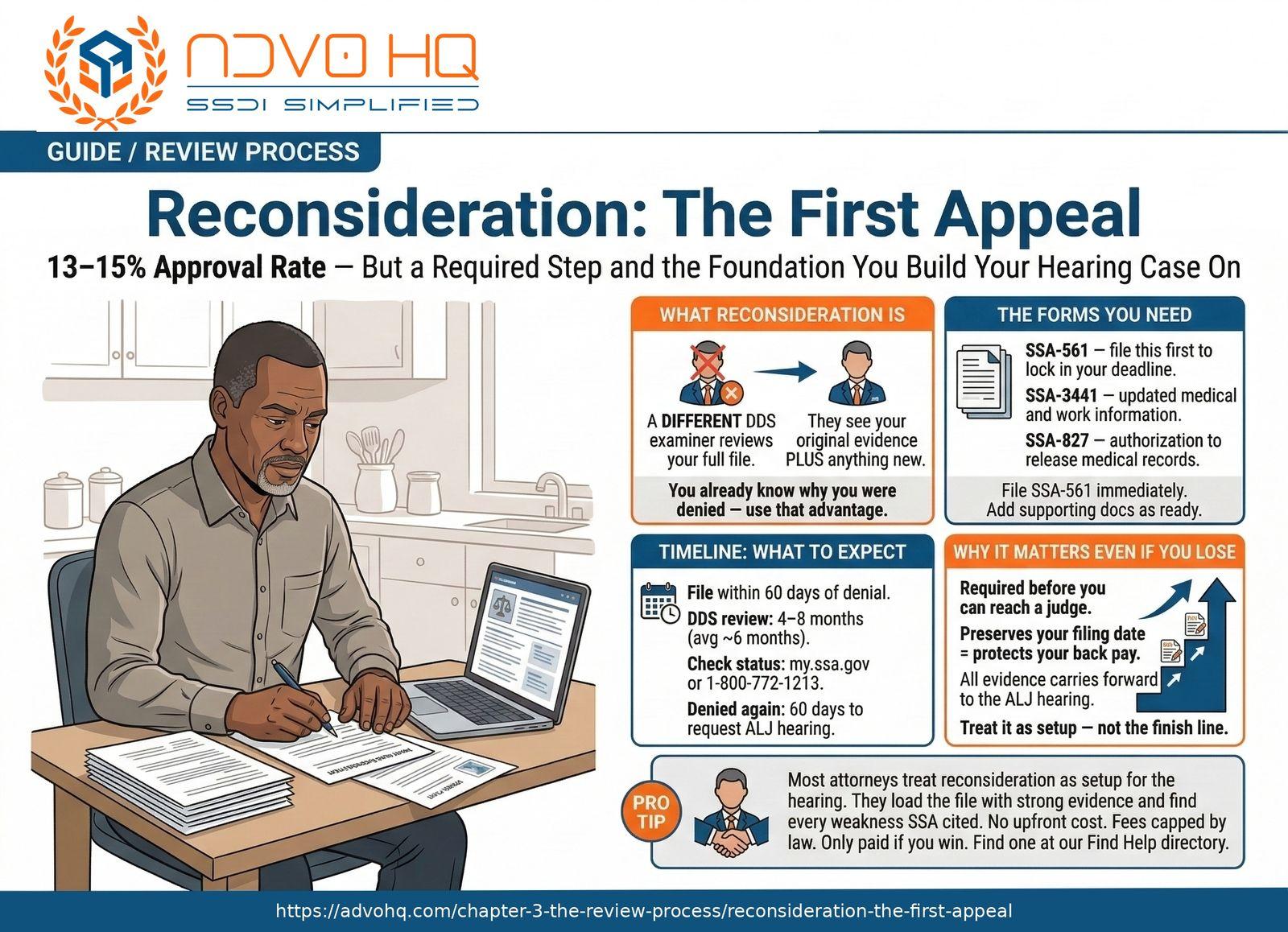
Reconsideration is a complete review of your claim by a different DDS examiner than the one who denied you initially. The new examiner looks at everything from your original application plus any new evidence you submit. Here’s what it is and what it’s not:
What It Is
- A fresh pair of eyes on your claim
- A chance to submit new medical evidence
- A mandatory step before an ALJ hearing
- A paper review (no face-to-face meeting)
- An opportunity to correct what was missing
What It’s Not
- A hearing or in-person meeting
- A chance to testify or explain in person
- A guaranteed path to approval
- Optional (you must do this before a hearing)
- A place where your attorney can argue your case
The new examiner uses the same five-step evaluation process as the first reviewer. They look at the same medical evidence, the same forms, the same work history—plus anything new you provide. The key difference is that it’s a different person making the call, and you now have the advantage of knowing exactly why you were denied.
The Forms You Need To File
Filing a reconsideration isn’t just one form. To give yourself the best chance, you need to submit a complete appeal package. Here’s what goes in it:
Filing strategy: File Form SSA-561 immediately to meet the 60-day deadline. Then submit the supporting forms and evidence as soon as they’re ready. You can submit additional evidence after the initial filing—just don’t wait months to do it.
How To File: Step By Step
You have four ways to file your reconsideration request:
Online
Go to ssa.gov, search "Appeal a Decision," select "Start disability request." Fastest — you get immediate confirmation.
By Phone
Call 1-800-772-1213 (TTY: 1-800-325-0778). Available Mon–Fri, 8 AM–7 PM. Call early morning or late afternoon to avoid long waits.
In Person
Visit your local SSA field office (ssa.gov/locator). Bring your denial letter and claim number. Staff can help complete forms on the spot.
By Mail/Fax
Download Form SSA-561 from ssa.gov/forms, complete it, and mail or fax to your local office. Postmark date counts — use certified mail and keep copies.
What To Write On The SSA-561
The form asks you to explain why you disagree with the denial. You don’t need to write a legal brief. Keep it clear and direct. Here’s a framework:
Too Vague
- "I disagree with this decision. I am disabled and cannot work. Please reconsider."
Specific & Actionable
- "I disagree with the determination that I can perform past work. Since my initial application, my condition has worsened. I am submitting updated medical records from Dr. Smith (orthopedic) and Dr. Jones (psychiatrist), including a Residual Functional Capacity evaluation that documents specific functional limitations preventing full-time work activity. I will submit additional evidence with Form SSA-3441."
Important: You won’t lose any arguments by keeping this section brief. The examiner decides based on evidence, not persuasive writing. But being specific about what’s changed and what new evidence you’re submitting gives the examiner a reason to look at your case differently than the first reviewer did.
The Evidence That Actually Changes Outcomes
Submitting the same evidence that got you denied won’t get you a different answer. The new examiner needs something different to reach a different conclusion. Here’s what moves the needle:
The Reconsideration Timeline: What To Expect
Once you file your reconsideration request, here’s what happens and roughly when:
SSA confirms they received your appeal. You’ll get a letter with your case number and the DDS office handling your review.
A new DDS examiner is assigned — a different person than the one who reviewed your initial application.
The examiner requests any new medical records from your providers. This is often the longest phase — doctor’s offices can be slow to respond.
The examiner and a medical consultant review all evidence (original + new) and apply the five-step evaluation.
You receive a written determination by mail. If denied, it includes appeal instructions and a new 60-day clock.
Total: 4–8 months in most cases. Some states are faster, some slower. Processing has averaged around 6 months in recent years due to backlogs and staffing shortages at DDS offices. You can check your status at my.ssa.gov or by calling 1-800-772-1213.
Setting Realistic Expectations
Here’s the hard truth about reconsideration:
Those numbers aren’t great. So why bother? Three reasons:
- It’s required. In most states, you must go through reconsideration before you can request an ALJ hearing. You can’t skip it.
- It preserves your filing date. Every month of appeal adds to your back pay. Walking away and starting over costs you thousands.
- The evidence you build here carries forward. Everything you submit at reconsideration becomes part of your file for the ALJ hearing. Think of this stage as building your hearing case, not just trying to win reconsideration.
The best disability attorneys treat reconsideration as a setup for the hearing. They use this stage to get all the evidence into the file, identify the weaknesses SSA found, and build the arguments they'll make to the judge. If reconsideration results in an approval, great — that's a bonus. If not, you're already prepared for the next step.
Common Mistakes That Guarantee Another Denial
The Mistake
- Submitting no new evidence
- Filing the SSA-561 with a one-sentence disagreement
- Not seeing your doctor during the appeal
- Copying the same Function Report
- Ignoring mental health conditions
- Waiting until day 58 to file
- Not requesting your case file
What To Do Instead
- Get updated records, new test results, and an RFC form from your doctor before or shortly after filing
- Reference the specific denial finding and explain what new evidence addresses it
- Continue regular treatment appointments—gaps in care signal improvement to SSA
- Submit a new, more detailed SSA-3373 that describes your worst days with specific examples
- Add psychiatrist or therapist records—SSA evaluates combined impairments
- File the SSA-561 within the first 2 weeks, then submit additional evidence as it’s ready
- Request your full DDS file to see exactly what the first examiner found—and what they missed
If Reconsideration Is Denied: Your Next Move
If you’re denied at reconsideration—and statistically, most people are—you have 60 days to request an ALJ hearing. This is where the game changes. At the hearing level:
- Approval rates jump to 45–51%
- You appear before a judge who hears your case directly
- You can testify about your condition, limitations, and daily life
- Your attorney can cross-examine vocational experts
- The judge makes an independent decision — not bound by the previous DDS reviews
To request a hearing, file Form HA-501 (Request for Hearing by Administrative Law Judge) within 60 days of your reconsideration denial. You can file online at ssa.gov, by phone, in person, or by mail—same options as reconsideration. Don’t miss this deadline.
Frequently Asked Questions
The new examiner reviews the same evidence as the first reviewer — and is likely to reach the same conclusion. Reconsideration isn't a re-argument of your original case; it's a fresh review that requires fresh evidence. An RFC from your doctor, updated treatment records, or new test results give the examiner something different to work with.
Yes. File the SSA-561 immediately to protect your deadline, then submit medical records, RFC forms, and updated reports as they become available. The examiner won't make a final decision the moment they receive your form — there's a window of several months. Just don't wait too long; eventually they'll close the record with whatever they have.
Not required, but reconsideration is actually the best time to get one involved. An attorney won't dramatically change your odds at this stage — the low approval rate is system-level, not attorney-driven. But they can start building your evidence file, work with your doctors to get an RFC, and develop your hearing strategy months in advance. The earlier they're involved, the stronger your hearing case. For how much representation changes outcomes at the appeal stages, see Why Representation Matters Most At This Stage.
Attend it. Missing a consultative exam without good cause can result in a denial based on failure to cooperate. The exam will be brief (15–30 minutes) and the doctor is chosen by SSA — not your own physician. The best way to reduce SSA's reliance on consultative exams is to submit comprehensive, recent records from your own treating doctors so they don't need to schedule one.
You have 60 days from the date you receive the denial (presumed 5 days after the date on the notice) to request an ALJ hearing by filing Form HA-501, per 20 CFR 404.933. This is the most important step — approval odds at the hearing level are substantially higher than at reconsideration (commonly cited around 45–51% versus roughly 10–16%, though neither is an SSA-published per-stage grant rate). Don't skip it. Every month you delay is back pay you may never recover. See Preparing For The ALJ Hearing for how to request it and use the wait.
What They Don't Tell You
Insider knowledge that can make or break your application:
Many disability attorneys treat reconsideration as mostly a formality — but a necessary one
The low approval rate tells you that the same DDS system reviewing the same types of evidence rarely reverses itself. The real opportunity is the ALJ hearing. But you can't get there without going through reconsideration first. Use this stage strategically: build your evidence file, address the specific denial findings, and prepare for the hearing.
The new examiner often has access to your original examiner's notes
While the reconsideration is a "fresh review," the new examiner can see the first examiner's findings and reasoning. This means if you submit the exact same evidence, they're likely to reach the same conclusion. New evidence is what makes the difference.
You can submit evidence after you file the SSA-561
Don't wait until you have everything perfectly assembled. File the form to meet the deadline, then submit additional medical records, RFC forms, and updated reports as they become available. Just don't drag it out for months — the examiner will eventually make a decision with whatever they have.
A consultative exam may be scheduled again
If DDS still doesn't have enough evidence, they'll schedule another consultative exam. The same rules apply: you must attend, it will be brief (15–30 minutes), and the doctor is chosen by SSA. The best way to avoid another CE is to submit comprehensive, recent records from your own doctors.
This is the best time to hire an attorney if you haven't already
If you handled the initial application on your own and got denied, reconsideration is the point where professional help makes the biggest difference going forward. An attorney's real value shows at the hearing level — but they need time to build your case. Getting them involved at reconsideration means they can start evidence development, work with your doctors, and plan your hearing strategy months in advance.
Reconsideration isn't a fresh, friendlier look
Here's what most people don't realize: reconsideration isn't a fresh look by a higher, more sympathetic office. It's a paper review by a different examiner inside the very same state DDS agency that just denied you — which is exactly why national approval rates at this step sit in the low double digits. A bare "please reconsider" changes nothing; the only thing that moves a paper review is new, updated medical evidence — new treatment, worsening, specialist records. So treat this step as your chance to build the record you'll ultimately need at the hearing, where a human being finally looks you in the eye. We walk through the next stage in Preparing for the ALJ Hearing.
Reconsideration is a low-probability step with high strategic value.
Reconsideration is a low-probability step with high strategic value. The approval odds are slim, but the process preserves your filing date, builds your evidence file, and positions you for the ALJ hearing where most cases are won. File quickly, submit strong new evidence, and start preparing for the next level.
Up Next: Preparing For The ALJ Hearing—how to request a hearing, what happens while you wait, and how to build the strongest possible case for the most important stage of the appeals process.
Denied? Don’t Go Through This Alone.
A disability attorney can review your denial, identify what evidence is missing, and start building your case for the hearing level—where approval rates are 3x higher than reconsideration. Free consultations. No upfront cost.
→ Find An Attorney In Your County
→ Request Free Help With Your Appeal
Estimate Your Back Pay
Every month your appeal takes, your back pay grows. Use our free SSDI Benefits Calculator to estimate what you could receive when your claim is approved.
Not affiliated with SSA or any government agency. For informational purposes only — not legal advice.
- 20 C.F.R. § 404.907 — Reconsideration (definition of the reconsideration step). ecfr.gov
- 20 C.F.R. § 404.909 — How to request reconsideration; must be filed in writing within 60 days after the date you receive notice of the initial determination. ecfr.gov
- 20 C.F.R. § 404.901 — Definition of "date you receive notice" (presumed 5 days after the date on the notice unless rebutted); supplies the +5-day mailing presumption for the 60-day deadlines. ecfr.gov
- 20 C.F.R. § 404.913 — The two forms of reconsideration (case review; formal/informal conference). ecfr.gov
- 20 C.F.R. § 404.933 — Request for an ALJ hearing; written request within 60 days after the date you receive notice of the reconsideration determination. ecfr.gov
- 20 C.F.R. § 404.1520 — Five-step sequential evaluation of disability. ecfr.gov
- Social Security Administration — Form SSA-561, "Request for Reconsideration.". ssa.gov
- Social Security Administration — Form HA-501, "Request for Hearing by Administrative Law Judge.". ssa.gov
- Social Security Administration — [Appeal a Decision We Made](. ssa.gov
- Social Security Administration — Annual Statistical Report on the Social Security Disability Insurance Program, 2024, Sec. 4 (Outcomes of Applications), Table 60 & Chart 11 (award-rate "waterfall" figures — shares of all applicants, not per-stage grant rates). ssa.gov
- Social Security Administration — Social Security Performance, "Disability Appeals Time" (average reconsideration processing time ~208 days as of May 2026). ssa.gov
- Social Security Act, Title II — 42 U.S.C. §§ 401–434. ssa.gov
- 20 C.F.R. §§ 404.909–404.913 (reconsideration procedure — different examiner, same DDS); SSA, Annual Statistical Report on the SSDI Program (Outcomes of Applications), showing low reconsideration allowance rates. ssa.gov