
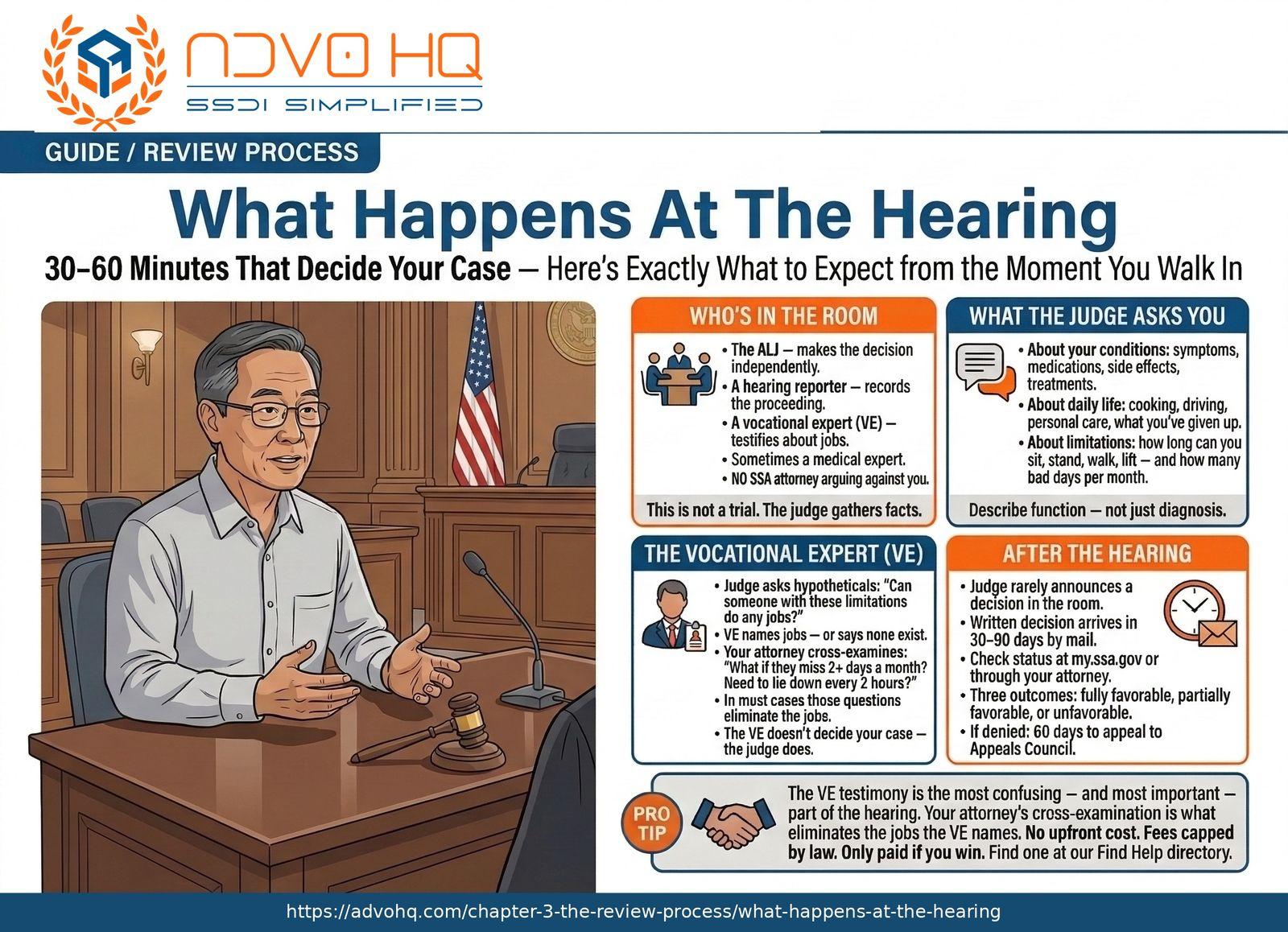
Who’s In The Room
The hearing is smaller and less intimidating than most people expect. Here’s who will be present:
Makes the decision on your claim. Asks most of the questions. Reviews all evidence.
Answer questions about your condition, daily life, work history, and limitations.
Presents your case, questions you, cross-examines experts, and makes legal arguments.
Testifies about jobs you might be able to do given various sets of limitations.
Reviews your medical records and gives opinions on severity and functional limitations.
Records the hearing for the official record.
Family members, caregivers, or others who can describe your daily limitations.
There's no SSA lawyer arguing against you. This isn't an adversarial proceeding like a trial. The judge's job is to gather facts and make a decision — not to prove you're wrong.
The Hearing Step By Step
Here’s what typically happens, in order:
The judge opens the record, states the case number, identifies everyone present, and explains the hearing process. You and any witnesses are placed under oath or affirmation.
The judge identifies the issues in your case—typically whether you meet the definition of disability under SSA rules and what your onset date is.
If you have an attorney, they may give a brief opening statement summarizing your case and key evidence. This is their chance to frame the case for the judge.
The judge (and your attorney) ask you questions about your medical conditions, daily activities, functional limitations, work history, and how your disability affects your life. This is the core of the hearing.
If you brought witnesses, they testify about what they’ve observed regarding your condition and limitations. The judge may ask them questions.
The ME reviews your medical records and gives opinions about diagnosis severity, whether your condition meets a Blue Book listing, and what functional limitations are supported by the evidence.
The judge asks the VE hypothetical questions about jobs someone with various sets of limitations could perform. Your attorney cross-examines the VE. (See detailed section below.)
Your attorney may make a closing argument summarizing why the evidence supports a finding of disability. The judge closes the record.
Usually 30–60 minutes. Complex cases can go longer. Some hearings are shorter — particularly if the judge has reviewed the evidence and already has a strong sense of the case. A short hearing is not necessarily a bad sign.
What The Judge Will Ask You
The judge isn’t trying to trick you. They’re trying to understand how your condition affects your ability to work a full-time job, 8 hours a day, 5 days a week, consistently. Here are the types of questions to expect:
- What are your medical conditions?
- What are your symptoms?
- What medications do you take and what are the side effects?
- What treatments have you tried? Have they helped?
- How has your condition changed since you stopped working?
- Describe a typical day from when you wake up to when you go to bed.
- Can you cook, clean, do laundry, shop for groceries?
- Do you drive? How far and how often?
- Do you need help with personal care (bathing, dressing)?
- What hobbies or activities have you had to give up?
- How long can you sit before you need to change position?
- How long can you stand or walk continuously?
- How much can you lift and carry?
- Do you need to lie down during the day? How often and for how long?
- How many days per month does your condition keep you from functioning?
- Do you have problems with concentration, memory, or following instructions?
- Describe your past jobs—what did you do physically and mentally?
- Why did you stop working?
- Have you tried to go back to work? What happened?
- Could you do any of your past jobs today? Why not?
How To Testify Effectively
Your testimony matters. Here’s how to present yourself honestly and effectively:
Do This
- Be specific about quantities and durations: "I can sit for about 15 minutes before I have to shift position."
- Describe your worst days: "About 3–4 days a week, my pain is bad enough that I can’t leave the house."
- Mention what you’ve given up: activities, hobbies, household tasks you used to do but can’t anymore.
- Explain medication side effects: drowsiness, nausea, brain fog, dizziness.
- Be honest. If you can do something, say so. If you can do it but poorly or with pain, explain that.
- Take your time answering. It’s okay to pause and think.
- Speak to the judge directly and make eye contact (even on video).
Avoid This
- Being vague: "I can’t sit for long." The judge needs numbers.
- Only describing your best days. The judge needs to know how your condition looks most of the time, including the bad days.
- Minimizing your limitations. Many people instinctively downplay their problems. This is the one place where you need to be completely honest about what you can’t do.
- Forgetting to mention side effects. The judge evaluates their impact on your ability to sustain work.
- Exaggerating. Judges are experienced at spotting inconsistencies. One exaggeration can undermine your entire testimony.
- Rushing through answers or giving one-word responses. Elaborate with details when you can.
- Looking to your attorney for answers. Your attorney can’t testify for you.
Describe function, not just diagnosis. The judge already knows your diagnoses from the medical records. What they need from you is a clear picture of how those conditions affect your ability to do work-related activities — sitting, standing, walking, lifting, concentrating, getting along with people — for a full 8-hour workday, 5 days a week.
The Vocational Expert: Understanding The Hypotheticals
The vocational expert (VE) portion of the hearing is often the most confusing—and the most important. Here’s how it works:
The judge describes a hypothetical person with a specific set of limitations—lifting capacity, sitting/standing tolerances, concentration limits, etc.—and asks the VE: "Can this person do the claimant’s past work?" and "Are there other jobs this person could do?" The limitations in the hypotheticals are often based on your medical records, your testimony, and what the judge is considering for your RFC.
For each hypothetical, the VE either names jobs the hypothetical person could do (with DOT codes and job numbers in the national economy) or says no jobs exist for that set of limitations.
Judges typically ask 3–5 hypotheticals, each with different limitation levels—from least restrictive to most restrictive. This isn’t because they’ve already decided which one applies to you. They’re exploring the range. The limitations that the judge ultimately assigns to your RFC will determine the outcome.
This is where your attorney earns their fee. They ask the VE targeted questions designed to show that jobs the VE named don’t actually exist in significant numbers, require abilities you don’t have, or wouldn’t accommodate your limitations. Common attorney questions include: "What if this person needed to miss more than 2 days per month?" or "What if they needed to lie down for 30 minutes every 2 hours?" In most cases, the VE will testify that someone with those limitations couldn’t sustain employment.
- Don't react when the VE names jobs you think you can't do. Those are hypothetical answers — not a ruling. - Don't argue with the VE. Your attorney handles cross-examination. - The judge — not the VE — makes the final decision. The judge can disagree with the VE. - If the VE says "no jobs exist" for a hypothetical that matches your limitations, that's a strong sign. - If the judge asks only one hypothetical and the VE says no jobs, that's an even stronger sign.
Reading The Room: What Hearing Clues Mean
Judges rarely announce their decision at the hearing. But experienced attorneys can often read clues:
Potentially Positive Signs
- Judge cuts the hearing short after reviewing your evidence, saying they have "a good understanding of the case"
- VE testifies no jobs exist for the main hypothetical
- Judge comments positively on evidence strength or physician opinions
- Judge asks only 1–2 hypotheticals of the VE
- Medical expert confirms your condition meets or equals a listing
Potentially Concerning Signs
- Judge spends significant time questioning gaps in your medical treatment
- VE names several jobs for even the most restrictive hypothetical
- Judge questions inconsistencies between your testimony and medical records
- Judge asks 4–5 hypotheticals with different restriction levels
- Medical expert says your records don’t support the severity you described
Important caveat: These are tendencies, not guarantees. The decision isn’t final until you receive the written decision by mail, usually within 30–90 days after the hearing. Don’t celebrate or despair based on hearing-day impressions alone.
After The Hearing: Waiting For The Decision
In most cases, the judge does not issue a decision at the hearing. Here’s what happens next:
Bench Decision (Rare)
The judge announces a favorable decision at the hearing. This is uncommon but does happen when the evidence is overwhelming. You’ll still receive a written decision.
Written Decision: Fully Favorable
You’re approved. The decision includes your disability onset date, your benefit amount, and details about back pay. Benefits typically begin within 60 days.
Written Decision: Partially Favorable
You’re approved, but with a different onset date than you requested. This affects your back pay amount. Your attorney can advise whether to accept or appeal.
Written Decision: Unfavorable
You’re denied. The decision explains why. You have 60 days to appeal to the Appeals Council.
Timeline for receiving the decision: Typically 30–90 days after the hearing. In some cases, it can take longer depending on the judge’s caseload. You can check the status of your hearing on my.ssa.gov or through your attorney.
Frequently Asked Questions
Most hearings run 30 to 60 minutes, and some finish in under 30 minutes. Complex cases can go longer, but length isn't a verdict — a judge who has already reviewed strong evidence may not need much testimony. A short hearing is not a bad sign.
Yes. At the opening, the judge places you — and any witnesses — under oath or affirmation before questioning begins. Everything is recorded for the official record, so answer honestly and speak clearly.
The ALJ, you, and (if you have one) your representative are always present, along with a hearing reporter. A vocational expert appears in the large majority of disability hearings, and a medical expert may testify when there's a question about whether your condition meets a Blue Book listing. There is no SSA attorney arguing against you.
The VE answers the judge's hypothetical questions about whether someone with a given set of limitations could perform your past work or other jobs in the national economy. The VE's answers are not a ruling — the judge makes the final decision and can disagree with the VE. Your attorney can cross-examine the VE. The VE's role — and how your attorney challenges it — is covered in depth in The Vocational Expert: Your Hidden Opponent.
Judges rarely decide at the hearing. You'll usually receive a written decision by mail within several weeks to a few months, though it can take longer depending on caseload. You have 60 days to appeal an unfavorable decision to the Appeals Council. See What If I Get Denied? for the next steps.
What They Don't Tell You
Insider knowledge that can make or break your application:
There's no SSA attorney arguing against you
Unlike what you see on TV legal dramas, there's no opposing attorney at your hearing. The judge is an impartial decision-maker, not a prosecutor. They ask questions to understand your case, not to trip you up. This is an investigative process, not an adversarial one.
The judge has already read your file
They're not learning about your case for the first time at the hearing. They've reviewed your medical records, your forms, the DDS findings, and your attorney's pre-hearing brief. The hearing is about filling in gaps and clarifying details — not starting from scratch.
A short hearing can be a good sign
If the judge cuts the hearing short after 15–20 minutes, it often means the evidence is clear and they don't need more testimony. Don't panic if it feels rushed — judges who have already made up their mind based on strong evidence don't need to belabor the point.
What you wear and how you behave matters
Dress neatly but don't overdress — business casual is fine. More importantly: don't carry heavy bags, bound up stairs, or do anything physically inconsistent with your claimed limitations. The judge observes everything. For video hearings, choose a quiet, well-lit room with a neutral background.
Unrepresented claimants are at a significant disadvantage
Without an attorney, the VE often goes unquestioned, no pre-hearing brief gets submitted, and the legal arguments about the Grid Rules or the DDS examiner's findings often don't get made. Represented claimants are approved at higher rates at hearings — a GAO analysis found represented claimants were awarded benefits at roughly three times the rate of unrepresented ones (GAO-18-37) — but that gap is correlational, not proof that representation by itself causes an award. Research from the NBER (Working Paper 29871) finds representation mainly speeds awards and reduces appeals rather than guaranteeing a win. Even so, this is the stage where representation tends to make the most measurable difference.
The hearing isn't a courtroom fight
Walk in braced for a courtroom fight and you'll misread the whole hearing. An SSDI hearing is non-adversarial — there's no government lawyer across the table to cross-examine or oppose your claim, and the judge has an affirmative legal duty to develop your record fully and fairly, even for unrepresented claimants. Because it isn't a courtroom battle, you also don't have to "preserve" issues the way you would in court to raise them later — so politely ask the judge to obtain any missing records or clarify any gaps, because building the file is legally the ALJ's job too, not only yours. A representative helps you use that to full effect: see Do I Need a Lawyer or Advocate?.
The ALJ hearing is a formal but not hostile proceeding.
The ALJ hearing is a formal but not hostile proceeding. The judge is there to listen, not to prosecute. Be honest, be specific about your limitations, describe your worst days, and let your attorney handle the legal strategy. The VE testimony can be confusing — don't react to it. The judge makes the final call, not the VE. Everything you've done over the past months — gathering records, getting RFC forms, continuing treatment, keeping a journal — comes together in this room. The preparation is what wins hearings.
Up Next: Medical Evidence On Appeal: Strengthening Your Case—how to build the evidence file that gives the judge what they need to rule in your favor.
Your Hearing Is Coming. Are You Ready?
An experienced disability attorney prepares you for testimony, submits a pre-hearing brief, cross-examines the vocational expert, and makes legal arguments the judge needs to hear. The hearing is where representation makes the biggest difference. Free consultations. No upfront cost.
→ Find A Hearing Attorney In Your County
→ Request Free Help Before Your Hearing
Calculate Your Potential Back Pay
By the time you reach a hearing, your back pay may be substantial. Use our free SSDI Benefits Calculator to estimate your potential lump sum payment when your claim is approved.
Not affiliated with SSA or any government agency. For informational purposes only — not legal advice.
- 20 C.F.R. § 404.929 — Hearing before an administrative law judge, general (the ALJ conducts a de novo review, "looks at all the issues," and "may consider evidence in your case record that was not before the state agency"). ecfr.gov
- 20 C.F.R. § 404.936 — Time and place for a hearing before an administrative law judge (hearing procedures, in-person, video, and telephone appearances). ecfr.gov
- 20 C.F.R. § 404.950 — Presenting written and oral evidence at the hearing (right to appear and testify, witnesses examined under oath or affirmation, cross-examination, and the ALJ's authority to receive expert testimony). ecfr.gov
- 20 C.F.R. § 404.938 — Notice of a hearing before an administrative law judge (notice mailed or served at least 75 days before the hearing date). ecfr.gov
- 20 C.F.R. § 404.968 — Request for Appeals Council review (60-day deadline to appeal an unfavorable decision). ecfr.gov
- Social Security Administration — [The Appeals Process](. ssa.gov
- Biestek v. Berryhill, 587 U.S. 97 (2019) — vocational expert testimony and the substantial-evidence standard.
- Sims v. Apfel, 530 U.S. 103 (2000) — SSDI proceedings are inquisitorial (non-adversarial); the ALJ has a duty to develop the record and issue-exhaustion is not required. ; HALLEX I-2-6-1 (Hearing Procedures — General). supreme.justia.com