
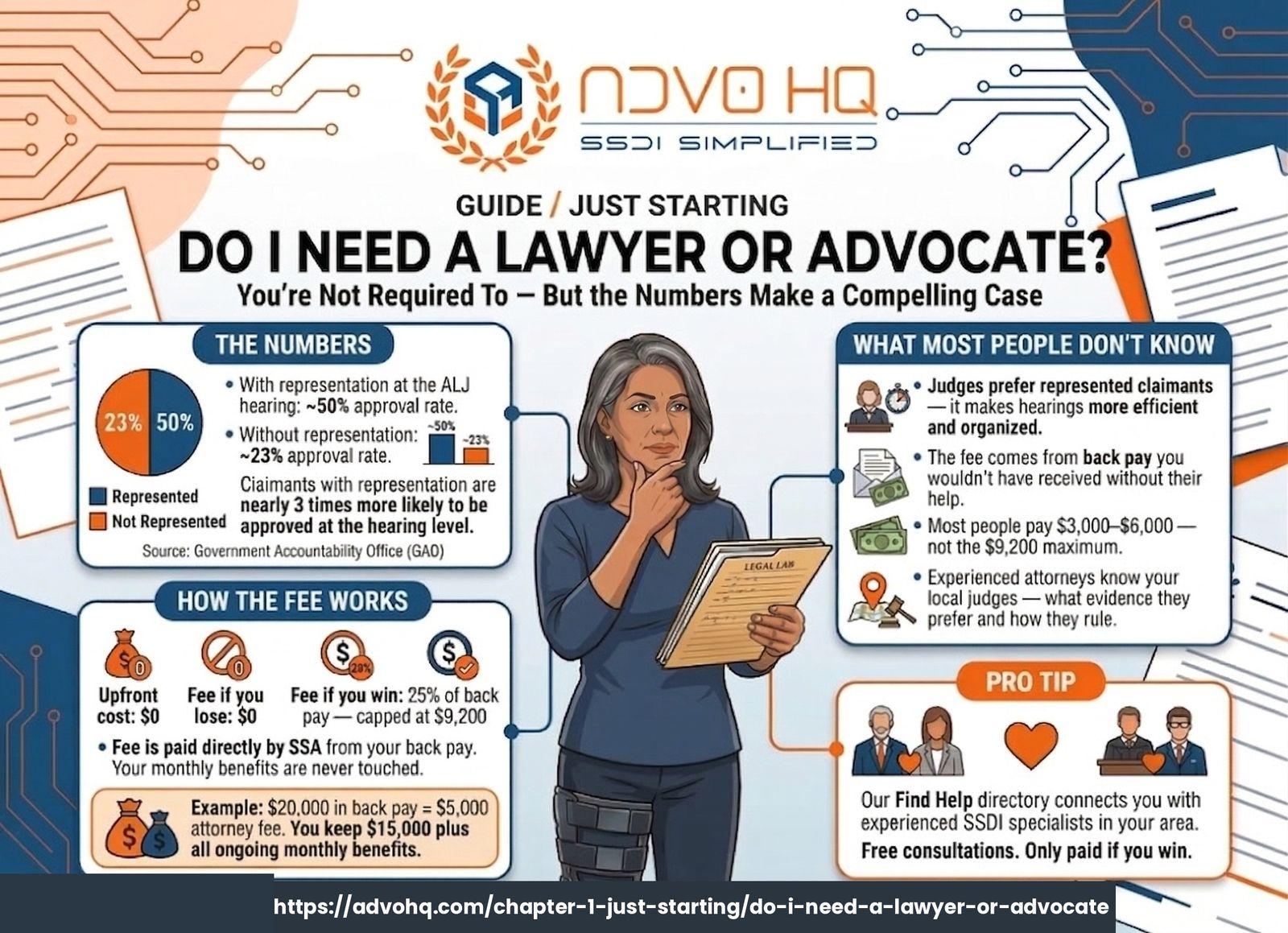
What the Numbers Show
A Government Accountability Office (GAO) study found that claimants with representation were nearly 3 times more likely to be approved at the hearing level. The gap is stark.
The ALJ hearing is where representation matters most. You're no longer submitting paperwork — you're testifying before a judge, questioning vocational experts, and making a live case for why you can't work. That's a different skill set than filling out forms.
What a Disability Attorney Does
A disability attorney or advocate helps at every stage — not just the hearing.
Gathers and organizes medical evidence
They know exactly what SSA looks for and work with your doctors to document limitations in work-relevant terms — not just diagnosis names.
Obtains RFC opinions from your doctors
They request detailed Residual Functional Capacity statements addressing specific work limitations — sitting, standing, concentration, stress tolerance — the exact factors SSA uses to evaluate your case.
Prepares you for the hearing
They help you understand what questions the judge will ask and coach you to describe your worst days — not your best. SSA evaluates your limitations at their most severe, not when you're managing well.
Cross-examines vocational experts
At hearings, a vocational expert testifies about jobs you could theoretically perform. An experienced attorney knows how to challenge that testimony — and a successful cross-examination can win the case.
Handles every deadline and filing
Missing the 60-day appeal deadline ends your case. Attorneys track every deadline, file every form, and manage all SSA communication — so you don't miss something that can't be undone.
How Attorney Fees Work (No Upfront Cost)
Disability attorneys work on contingency — regulated by federal law. The fee structure is identical across virtually all SSDI attorneys.
- How it's paid — SSA withholds the fee directly from your back pay lump sum and pays your attorney. You never write a check.
- Your monthly benefits — Not affected. The fee comes only from back pay, never from your ongoing monthly payments.
The $9,200 ceiling took effect November 30, 2024. SSA sets this dollar limit and updates it from time to time by official notice; it is not adjusted automatically every year. Some attorneys may charge small out-of-pocket costs for medical record copies — this should be disclosed upfront before you sign anything.
Attorney vs. Non-Attorney Advocate
Both types are regulated by SSA and charge the same fees. Either can represent you at ALJ hearings, access your file, submit evidence, and communicate with SSA on your behalf. The differences come down to credentials and what happens if your case goes further.
Attorney
- Holds a J.D. and is licensed to practice law
- Can represent you in federal court if needed
- Broader legal training across procedures and appeals
- Same 25% fee cap ($9,200 max) as advocates
Non-Attorney Advocate
- Must pass an SSA-approved exam and register with SSA
- Cannot represent you in federal court
- Often specializes exclusively in SSDI claims
- Same 25% fee cap ($9,200 max) as attorneys
How to Find a Disability Attorney
Look for representation that specializes — not general practitioners who handle SSDI on the side.
Not general practice. Not workers' comp. SSDI specifically — ideally with a track record of ALJ hearings in your area.
Every legitimate disability attorney offers this. If they charge for a consultation, move on.
No upfront fees. If they ask for a retainer or hourly rate, that's a red flag in SSDI cases.
Local experience matters. Approval rates vary significantly by hearing office and by judge — attorneys familiar with your local ALJ tend to know what evidence is persuasive there.
You should understand exactly what they'll do, what you need to provide, and how they'll communicate with you. Vagueness is a warning sign.
Frequently Asked Questions
You can hire representation at any stage, but the earlier the better. Some people hire help at the initial application to make it as strong as possible and prevent a denial. Many others seek help after an initial denial, when an attorney can pinpoint why you were denied and build the appeal. The most critical moment is before the ALJ hearing — that's where cases are won or lost. If you're approaching a hearing without representation, get help now.
Nothing. Disability attorneys and advocates work on contingency: no retainer, no hourly fees. They only get paid if you win, and the fee is deducted by SSA from your back pay — never from your ongoing monthly benefits. If you lose, you owe no fee.
By federal rule the representative's fee is 25% of your past-due benefits (back pay), capped at $9,200 (the dollar limit SSA set effective November 30, 2024). Because most cases settle well below the cap, typical fees land in the low thousands. A few attorneys also charge small out-of-pocket costs (for example, copying medical records) — these should be disclosed before you sign.
Both are regulated by SSA, charge the same capped fee, and can represent you at hearings. Attorneys hold a law license and can take your case into federal court if it goes that far; non-attorney advocates must pass an SSA exam and register, and often focus exclusively on SSDI. For most claims, either is effective — experience with disability cases matters more than the title.
Yes. You can switch attorneys or advocates if you're unhappy. Any fee arrangement must be approved by SSA, which protects you from being overcharged even if more than one representative is involved.
What They Don't Tell You
Insider knowledge that can make or break your decision:
Judges prefer represented claimants
Many disability attorneys report that ALJs prefer working with represented claimants because attorneys organize the evidence, ask proper questions, and make hearings more efficient.
The fee comes only from your back pay, never your ongoing checks
An attorney's 25% is taken from past-due benefits, and your monthly benefits are never touched. Research finds representation tends to speed awards and reduce appeals (NBER Working Paper 29871) — not that it guarantees a win — so weigh it as improving your odds and timeline, not a sure thing.
Most people don't pay the maximum fee
The dollar cap is a ceiling, not the norm. Because back pay varies and quick approvals mean smaller fees, most cases involve only a few thousand dollars in fees.
Attorneys know your local judges
Experienced local attorneys know which ALJs are strict, what evidence they favor, and how to frame your case for them. That insider knowledge is hard to replicate on your own.
You can fire your attorney if it's not working
If you're unhappy with your representation, you can change attorneys. SSA must approve any fee arrangement, so you're protected from being overcharged.
The fee is capped: 25% or $9,200, whichever's less
The real cost of a representative isn't open-ended, and that changes the math. Under a standard fee agreement the fee is capped at 25% of your back pay or $9,200 (2026) — whichever is less — and it's paid only if you win, never out of your ongoing monthly checks. So the question isn't "can I afford it." It's whether representation lifts your odds enough to be worth 25% of past-due benefits you might not collect at all on your own — and at the ALJ hearing level, the evidence says it generally does. If you're weighing it, our "Find Help" directory connects you with professionals who specialize in Social Security disability, offer free consultations, and only get paid if you win.
You're not required to have an attorney — but the numbers don't lie.
You're not required to have an attorney — but representation has real, documented benefits. The best evidence suggests it won't magically change whether you ultimately qualify, but it does tend to get you a decision faster, with fewer appeals, and it's associated with stronger initial allowances. And because disability attorneys work on contingency with fees capped by federal law, there's no upfront cost and no financial risk to you. Whether you're just applying, fighting a denial, or heading into a hearing, professional help can smooth a process that's built to be difficult to navigate alone.
Next Steps: Can you still work while your claim is pending or after you're approved? The answer is yes — but the rules are strict. Read Can I Work While Applying or Receiving SSDI? before you make a costly mistake.
- 42 U.S.C. § 406(a)(2) — representative fees / fee-agreement dollar cap. [law.cornell.edu/uscode/text/42/406](. law.cornell.edu
- 20 C.F.R. § 404.1720 — fees for representation before SSA. [ecfr.gov/current/title-20/.../section-404.1720](. ecfr.gov
- SSA, "Maximum Dollar Limit in the Fee Agreement Process," Fed. Reg. 2024-10248 ($9,200 cap eff. Nov. 30, 2024). [federalregister.gov/documents/2024/05/10/2024-10248](. federalregister.gov
- SSA, "Maximum Dollar Limit in the Fee Agreement Process — Partial Rescission," Fed. Reg. 2025-07813 (May 6, 2025; cap unchanged). [federalregister.gov/documents/2025/05/06/2025-07813](. federalregister.gov
- SSA — Fee Agreements (fee = 25% of past-due benefits or the dollar cap, whichever is less; $9,200 cap effective Nov. 30, 2024). [ssa.gov/representation/fee_agreements.htm](. ssa.gov
- SSA — Representing Social Security Claimants. [ssa.gov/representation](. ssa.gov
- 20 C.F.R. § 404.900 — administrative review process (four appeal levels, incl. Federal court). [ecfr.gov/current/title-20/.../section-404.900](. ecfr.gov
- 20 C.F.R. § 404.933 — request for ALJ hearing / 60-day deadline. [ecfr.gov/current/title-20/.../section-404.933](. ecfr.gov
- 20 C.F.R. § 404.1545 — residual functional capacity (RFC). [ecfr.gov/current/title-20/.../section-404.1545](. ecfr.gov
- Social Security Act, Title II — 42 U.S.C. §§ 401–434. [law.cornell.edu/uscode/text/42/chapter-7/subchapter-II](. law.cornell.edu
- SSA — Disability Benefits. [ssa.gov/benefits/disability](. ssa.gov
- SSA, Annual Statistical Report on the SSDI Program, 2024, Sec. 4 (application outcomes). [ssa.gov/policy/docs/statcomps/di_asr/2024/sect04.html](. ssa.gov
- U.S. Government Accountability Office, GAO-18-37, Social Security Disability: Additional Measures and Evaluation Needed to Enhance Accuracy and Consistency of Hearings Decisions (2017) — represented claimants at ALJ hearings allowed at a rate nearly 3× higher than unrepresented (descriptive correlation, not causal). [gao.gov/products/gao-18-37](. gao.gov
- Hoynes, Maestas & Strand, Legal Representation in Disability Claims, NBER Working Paper 29871 (2022) — representation speeds awards and reduces appeals but does not change the ultimate probability of an award. [nber.org/papers/w29871](. nber.org
- DisabilitySecrets — survey data on hearing-level representation (~71% of hearing claimants) (secondary).