
The Earnings Limit: Substantial Gainful Activity (SGA)
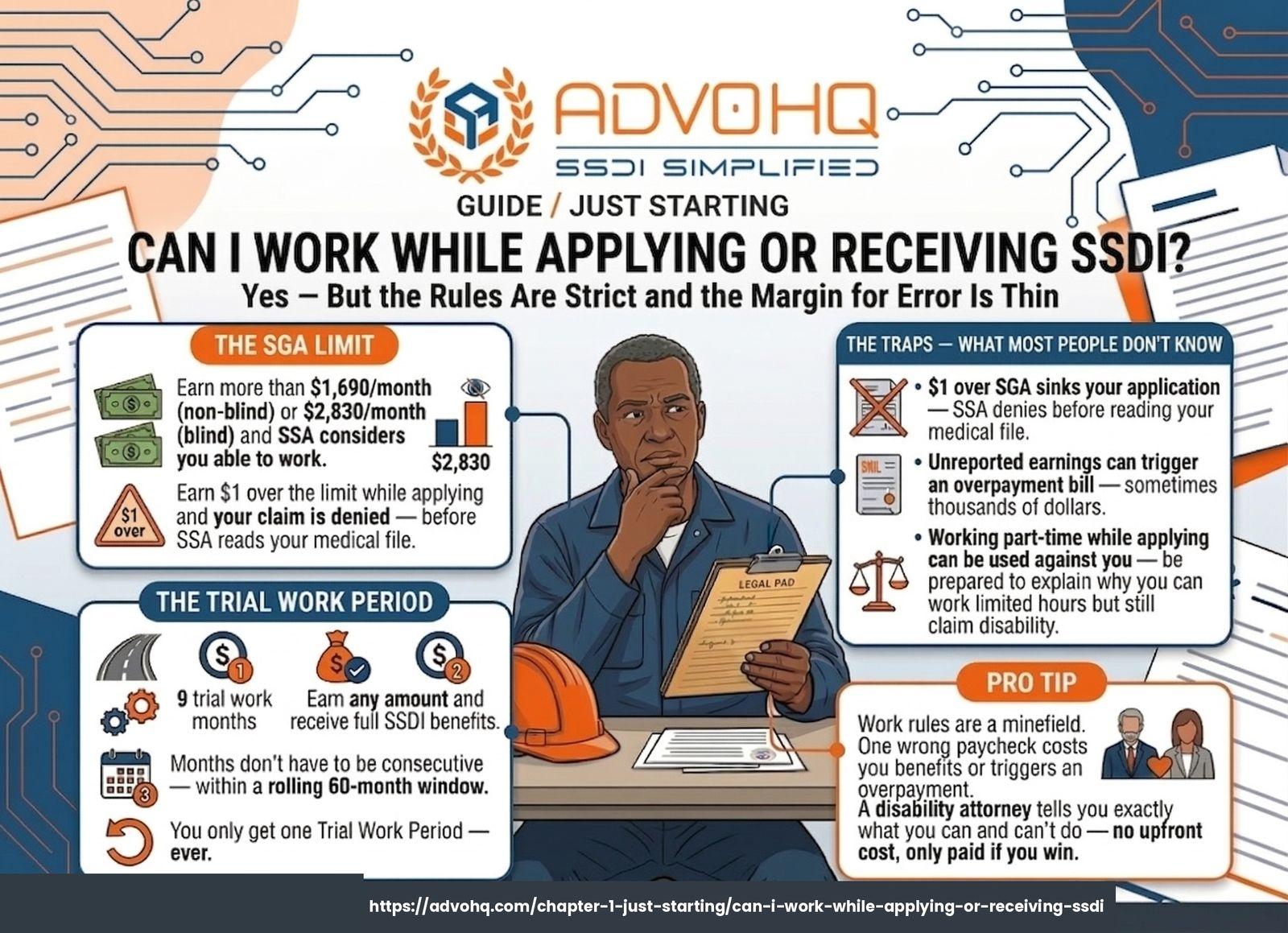
SGA is the amount Social Security considers "full-time work." If you earn more than the SGA limit, SSA generally concludes you’re not disabled.
Working While Your Application Is Pending
If you’re applying for SSDI and earning above SGA, your claim will likely be denied at Step 1 of the evaluation process—before SSA even looks at your medical condition.
Can you work at all while applying? Yes, as long as your monthly earnings stay below $1,690 (or $2,830 if blind). Some people work part-time while waiting for a decision. Just be careful—earning even one dollar over the limit in any month can be used against you.
If you tried to work but had to stop or reduce hours within 6 months because of your disability, SSA may exclude those earnings. Document why you couldn't continue.
The Trial Work Period (After You’re Approved)
Once you’re receiving SSDI, Social Security actually encourages you to try working through the Trial Work Period (TWP). During the TWP, you can earn any amount—even well above SGA—and still receive your full SSDI benefits.
You only get one Trial Work Period. Once you use all 9 months, they're gone. SSA tracks your trial months automatically based on reported earnings, but self-monitoring is advised.
You only get one Trial Work Period. Once you use all 9 months, they're gone permanently. SSA tracks your trial months automatically based on reported earnings — but you should track them yourself too.
Extended Period of Eligibility (After Trial Work)
After your 9 trial work months are complete, you enter a 36-month Extended Period of Eligibility (EPE). During this time:
Months below SGA ($1,690)
You receive your full SSDI benefit. Benefits are reinstated automatically for any sub-SGA month — no reapplication needed.
Months above SGA — benefits suspended
Benefits stop for that month but are not terminated. Drop below SGA the next month and they come back automatically.
Grace period — first month above SGA
The first time you exceed SGA during the EPE, you receive a 3-month grace period where full benefits continue. After that, suspension rules apply.
After the 36-month EPE ends
If you're still working above SGA, your SSDI benefits will be terminated — not just suspended. This is the hard cutoff.
Work Incentives That Can Reduce Countable Earnings
SSA allows certain deductions that can bring your "countable earnings" below SGA, even if your gross pay is above the limit:
Impairment-Related Work Expenses (IRWEs): Out-of-pocket costs for items or services you need to work because of your disability (medications, transportation, assistive devices, attendant care). These are deducted from your gross earnings before SSA calculates SGA.
Subsidies: If your employer pays you more than the value of work you actually perform (reduced productivity, extra supervision, lighter duties), SSA can reduce your countable earnings accordingly.
The Ticket to Work Program
Return-to-work support with benefit protection. SSA connects you with career counseling, job placement, vocational rehabilitation, and benefits counseling — all while protecting you from medical reviews during participation.
- Free career counseling and job placement
- Benefits counseling on how work affects payments
- Vocational rehabilitation services
- Protection from medical reviews while participating
Learn more at choosework.ssa.gov — Helpline: 1-866-968-7842
Frequently Asked Questions
Yes, but it's evaluated differently. SSA looks at your net self-employment earnings (after business expenses) against SGA, and it also looks at your hours — more than 80 hours a month of self-employment counts as a trial work month even if you earn less than $1,210. Gig work (Uber, DoorDash, Upwork) is treated as self-employment. IRWEs remain deductible.
Not immediately. After your Trial Work Period, the 36-month Extended Period of Eligibility protects you: benefits are suspended during over-SGA months and reinstate automatically when you drop below. Termination only happens if your earnings remain above SGA when the EPE ends — or through a separate medical improvement finding.
If your benefits terminate because of work and, within 5 years, you become unable to work again due to the same or a related condition, you can request Expedited Reinstatement instead of filing a brand-new application. SSA provides up to 6 months of provisional cash and Medicare benefits while it reviews your request.
Earning below SGA doesn't disqualify you, but SSA may view part-time work as evidence of functional capacity. If you're working while applying, make sure your medical records document the significant difficulty, accommodations, or limitations you face despite working limited hours.
Yes. You're required to report any work activity and all earnings to SSA promptly — even if you think they're below the limit. Failure to report causes overpayments that SSA recovers from future benefits, sometimes thousands of dollars. Report monthly via the online portal, by phone, or through the SSA mobile app.
What They Don't Tell You
Insider knowledge that can make or break your application:
One dollar over SGA can sink your claim
If you're applying and earn even $1 over the 2026 SGA limit of $1,690 in any month, SSA can deny your entire claim without ever looking at your medical records. Track your earnings carefully.
Self-employment has different rules
SSA looks at both your earnings AND your hours. More than 80 hours a month of self-employment counts as a trial work month, even if you earn less than the 2026 trial-work-period threshold of $1,210.
"Substantial" doesn't mean "full-time."
You could work just 10 hours a week and still exceed SGA if your hourly rate is high enough. It's about earnings, not hours.
Unreported work can trigger an overpayment you have to repay
Even wages you assume are below the limit can create an overpayment — sometimes thousands of dollars SSA later claws back — if you don't report them. Report all work activity, whatever you think it counts for.
Working part-time while applying can hurt your case
Many disability attorneys find that even when you're under SGA, SSA may question why you can work part-time but claim you're disabled. Be prepared to explain how your condition limits you despite working limited hours.
Use IRWEs to keep countable earnings under SGA
You can keep working while your claim is pending as long as you stay under the 2026 SGA line ($1,690/month; $2,830 if blind) — but here's the lever most people never pull: Impairment-Related Work Expenses. Out-of-pocket costs you have to pay because of your disability in order to work — special transportation, certain medications, assistive devices, even a job coach — get subtracted from your countable earnings before SSA measures you against SGA. That deduction can pull you back under the limit even when your gross paycheck is over it. The rules are unforgiving, so if you're near the line, Do I Need a Lawyer or Advocate? is worth a read.
Yes, you can work while applying for or receiving SSDI — but the rules are strict and the margin for error is thin.
Yes, you can work while applying for or receiving SSDI — but the rules are strict and the margin for error is thin. While applying, your earnings must stay below the SGA limit ($1,690/month in 2026). After approval, the Trial Work Period gives you 9 months to test your ability to work without losing benefits. Work incentives like IRWEs can help keep your countable earnings below the threshold. And no matter what — report all work activity to SSA. An unreported paycheck now can turn into an overpayment bill later.
Next Steps: Already approved? Read What Happens After Approval? to understand when payments start, how back pay works, when Medicare kicks in, and what to expect going forward.
- 20 C.F.R. § 404.1592 — Trial Work Period (incl. § 404.1592(b) self-employment trigger: >80 hours/month OR net earnings over the TWP amount). ecfr.gov
- 20 C.F.R. § 404.1592a — Extended Period of Eligibility (Reentitlement Period; § 404.1592a(a) 3-month grace period = cessation month + 2). ecfr.gov
- 20 C.F.R. § 404.1574(c) — Unsuccessful Work Attempt (employees; ≤6 months). ecfr.gov
- 20 C.F.R. § 404.1575(d) — Unsuccessful Work Attempt (self-employed). ecfr.gov
- 20 C.F.R. § 404.1592b — Expedited Reinstatement. ecfr.gov
- 20 C.F.R. § 404.1576 — Impairment-Related Work Expenses. ecfr.gov
- SSA, POMS DI 10520.001 & DI 10520.030 — Impairment-Related Work Expenses (what counts and how it is deducted from countable earnings). secure.ssa.gov
- SSA Red Book — "What's New in 2026" (2026 SGA / TWP amounts). ssa.gov
- 20 C.F.R. § 404.1590 — Continuing Disability Reviews (when and how often). ecfr.gov
- 20 C.F.R. Part 411 — Ticket to Work and Self-Sufficiency Program. ecfr.gov
- SSA — Substantial Gainful Activity (SGA amounts). ssa.gov
- SSA — Trial Work Period (TWP amount). ssa.gov
- SSA — 2026 Social Security Changes / COLA Fact Sheet. ssa.gov
- SSA — Working While Disabled: How We Can Help. ssa.gov
- SSA Red Book — A Guide to Work Incentives. ssa.gov
- SSA — Ticket to Work. choosework.ssa.gov
- Social Security Act, Title II — 42 U.S.C. §§ 401–434.