
The Blue Book: Social Security's Medical Guide
The Blue Book — officially titled Disability Evaluation Under Social Security — lists medical conditions SSA considers potentially disabling, organized into 14 categories for adults. If your condition matches the specific criteria in a listing, you may be approved faster without going through the full 5-step evaluation.
Matching a listing exactly is difficult. Most approvals happen through the functional capacity analysis at Steps 4 and 5 — but knowing which category your condition falls under can help you build a stronger case.
- Musculoskeletal Disorders — Back injuries, arthritis, joint dysfunction
- Special Senses and Speech — Vision loss, hearing loss, speech disorders
- Respiratory Disorders — COPD, asthma, pulmonary fibrosis
- Cardiovascular System — Heart failure, coronary artery disease
- Digestive System — Liver disease, Crohn's, IBD
- Genitourinary Disorders — Chronic kidney disease
- Hematological Disorders — Sickle cell disease, hemophilia
- Skin Disorders — Severe burns, chronic skin infections
- Endocrine Disorders — Diabetes (with complications), thyroid disorders
- Neurological Disorders — Epilepsy, MS, Parkinson's, ALS
- Mental Disorders — Depression, anxiety, bipolar, schizophrenia, PTSD
- Cancer (Malignant Neoplasms) — Various cancers depending on type and stage
- Immune System Disorders — Lupus, HIV/AIDS, rheumatoid arthritis
- Congenital Disorders — Down syndrome, cerebral palsy
If your impairment doesn't match a Blue Book listing exactly, SSA evaluates whether your functional limitations prevent any substantial work — which is how the majority of approved claims are actually won.
Most Commonly Approved Conditions
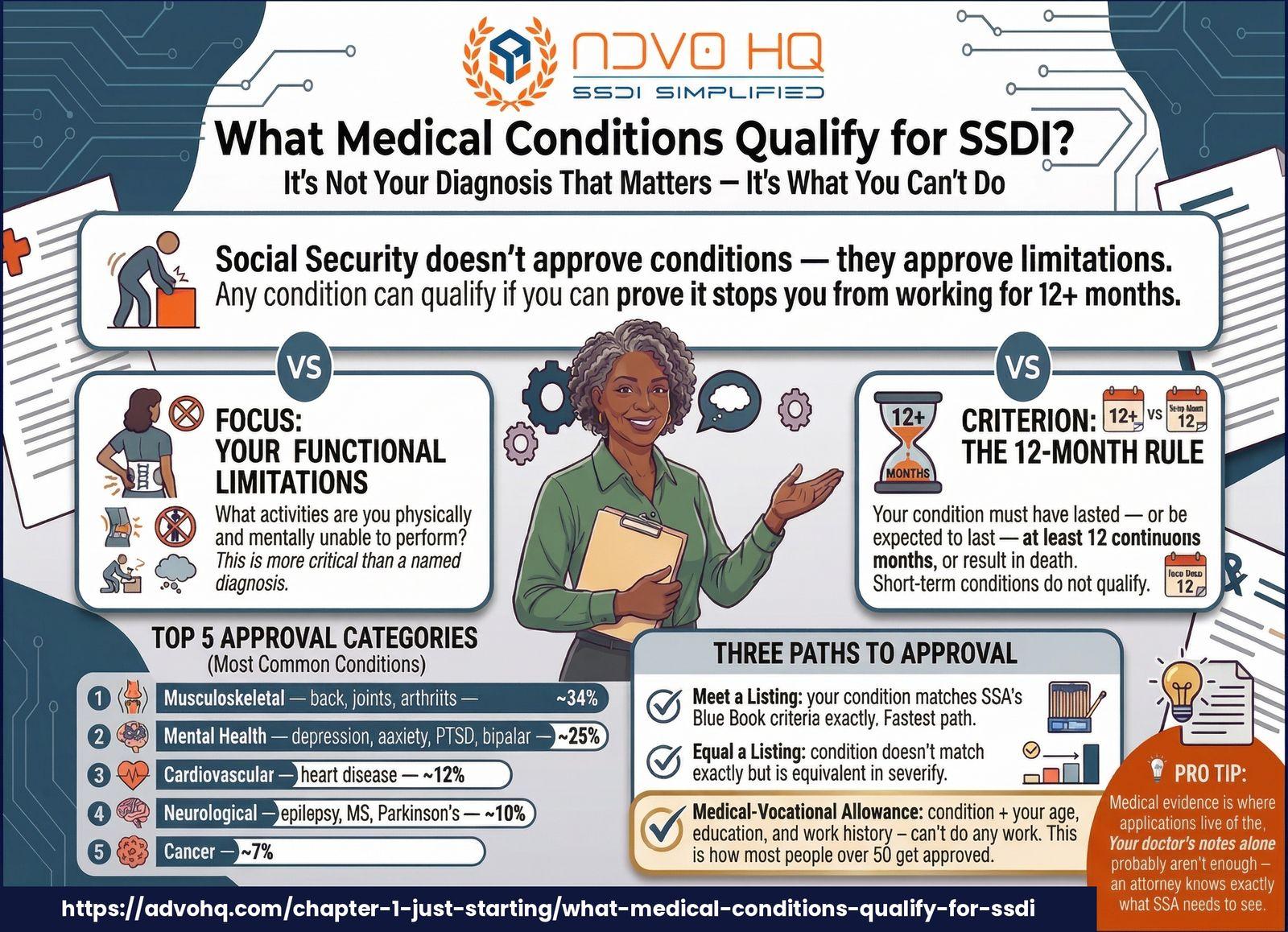
Based on SSA annual statistics, these condition categories account for the majority of SSDI approvals. Note that frequency of approval doesn't mean ease of approval — musculoskeletal conditions top the list partly because they're the most common applications filed.
Fast-Track: Compassionate Allowances
Some conditions are so severe that SSA fast-tracks them through a program called Compassionate Allowances. Over 200 conditions qualify — and instead of waiting months for a decision, these claims can be approved in weeks.
Social Security automatically flags applications that may qualify. Filing promptly with complete medical documentation is all you need to do.
The 12-Month Rule
Regardless of condition, SSA applies a strict duration requirement to every claim.
Frequently Asked Questions
Most approvals don't come from matching a listing exactly. SSA evaluates whether your condition — alone or combined with others — prevents you from doing any substantial work given your age, education, and experience. An unlisted condition can absolutely qualify through medical equivalence or a medical-vocational allowance.
Meeting a listing means your evidence satisfies every criterion SSA spells out for that condition. Equaling a listing means you fall short of one or more criteria, but your impairment (or combination of impairments) is at least equal in severity and duration to a listed one. Both are decided at Step 3 and both result in approval without a vocational analysis.
Yes. SSA considers the combined effect of all your impairments together. Three moderate conditions that collectively prevent you from working can qualify you even if none of them individually meets a Blue Book listing.
Yes — mental disorders account for roughly a quarter of SSDI awards to disabled workers. Depression, anxiety, PTSD, bipolar disorder, and schizophrenia all have Blue Book listings (the Mental Disorders body system, 12.00 — for example depression and bipolar under 12.04, anxiety and OCD under 12.06). The key is documentation showing how your condition limits four areas: understanding and memory, concentration and pace, interacting with others, and adapting or managing yourself.
SSA reviews records from your treating providers, lab results, imaging, and clinical notes. Only "acceptable medical sources" can establish that a condition exists. If your records are incomplete, SSA may order a Consultative Examination at its own expense. Your description of symptoms adds context, but objective medical evidence is what drives the decision.
What They Don't Tell You
What the approval statistics and Blue Book don't make obvious:
It's about function, not diagnosis
Social Security cares less about what your condition is called and more about what you can't do. A documented diagnosis with no evidence of functional limitation will likely be denied. Document your limitations in detail.
Multiple conditions can add up
If you have several conditions that aren't individually disabling, their combined effect may still qualify you — either by medically equaling a listing or by lowering your work capacity below any full-time job. List everything.
Mental health counts as much as physical
Mental disorders account for roughly a quarter of SSDI awards to disabled workers (SSA Annual Statistical Report, award distribution by diagnostic group, 2023). But a diagnosis alone won't do it — SSA looks for evidence tied to the four work-function areas, and a treating psychiatrist's statement on those limitations is often decisive.
Your doctor's opinion matters — a lot
Since 2017, SSA no longer gives automatic "controlling weight" to your treating doctor; it weighs every opinion on supportability and consistency. A detailed, well-supported statement of your limitations from a treating physician can still make or break your case. Ask for one.
Age works in your favor after 50
Social Security uses "grid" rules that make it easier to be approved as you get older. If you're over 50 with limited education or a physically demanding work history, the standard for approval is more lenient than it is for younger applicants.
It's about function, not your diagnosis
SSA approves based on how your condition limits function, not on the diagnosis label — so for ordinary claims there's no "automatic" qualifying disease. But there is a fast lane: if your exact diagnosis is on SSA's Compassionate Allowances list (now 300+ conditions), say so in your application and attach the pathology or imaging that proves it. SSA's software doesn't always catch a CAL match on its own, and flagging it yourself can cut months off the wait. Check the current list at ssa.gov/compassionateallowances.
It's not about your diagnosis — it's about what you can't do.
There's no magic list of conditions that guarantees approval. What matters is proving — with solid medical evidence — that your condition prevents you from working for at least 12 months. The Blue Book is a useful starting point, but even conditions that aren't listed can qualify. It's not about the diagnosis. It's about how well you document what it does to you.
Next Steps: Wondering what your benefits would actually be? Read How Much Will I Get Paid? to understand how Social Security calculates your monthly payment and back pay.
- 20 C.F.R. Part 404, Subpart P, Appendix 1 — Listing of Impairments ("Blue Book"). ecfr.gov
- 20 C.F.R. § 404.1525 — Listing of Impairments in appendix 1. ecfr.gov
- 20 C.F.R. § 404.1520 — Evaluation of disability in general (five-step sequential evaluation). ecfr.gov
- 20 C.F.R. § 404.1526 — Medical equivalence for adults and children. ecfr.gov
- SSR 17-2p — Evidence Needed to Make Findings About Medical Equivalence. ssa.gov
- 20 C.F.R. § 404.1520c — How we consider and articulate medical opinions (treating-physician rule eliminated for claims filed on/after March 27, 2017). ecfr.gov
- 20 C.F.R. § 404.1509 — Duration requirement (12-month rule). ecfr.gov
- SSR 12-2p — Titles II and XVI: Evaluation of Fibromyalgia (fibromyalgia has no listing). ssa.gov
- 42 U.S.C. § 423(d)(1)(A) — Statutory definition of disability. law.cornell.edu
- SSA — Disability Evaluation Under Social Security (Blue Book). ssa.gov
- SSA — Compassionate Allowances. ssa.gov
- SSA, Compassionate Allowances — complete list of conditions; POMS DI 23022.080 (CAL conditions). ssa.gov
- SSA — Annual Statistical Report on the SSDI Program, Sec. 3b, Table 37 (awarded disabled workers, distribution by diagnostic group/body system — NOT allowance rates by condition). ssa.gov