
How You Earn Credits
Every time you work and pay Social Security taxes — that's the "FICA" line on your pay stub — you're earning credits toward future SSDI eligibility. The math is straightforward:
If you earn $7,560 in January, you've already locked in all 4 credits for the year — no need to spread earnings across quarters.
The Two Tests You Must Pass
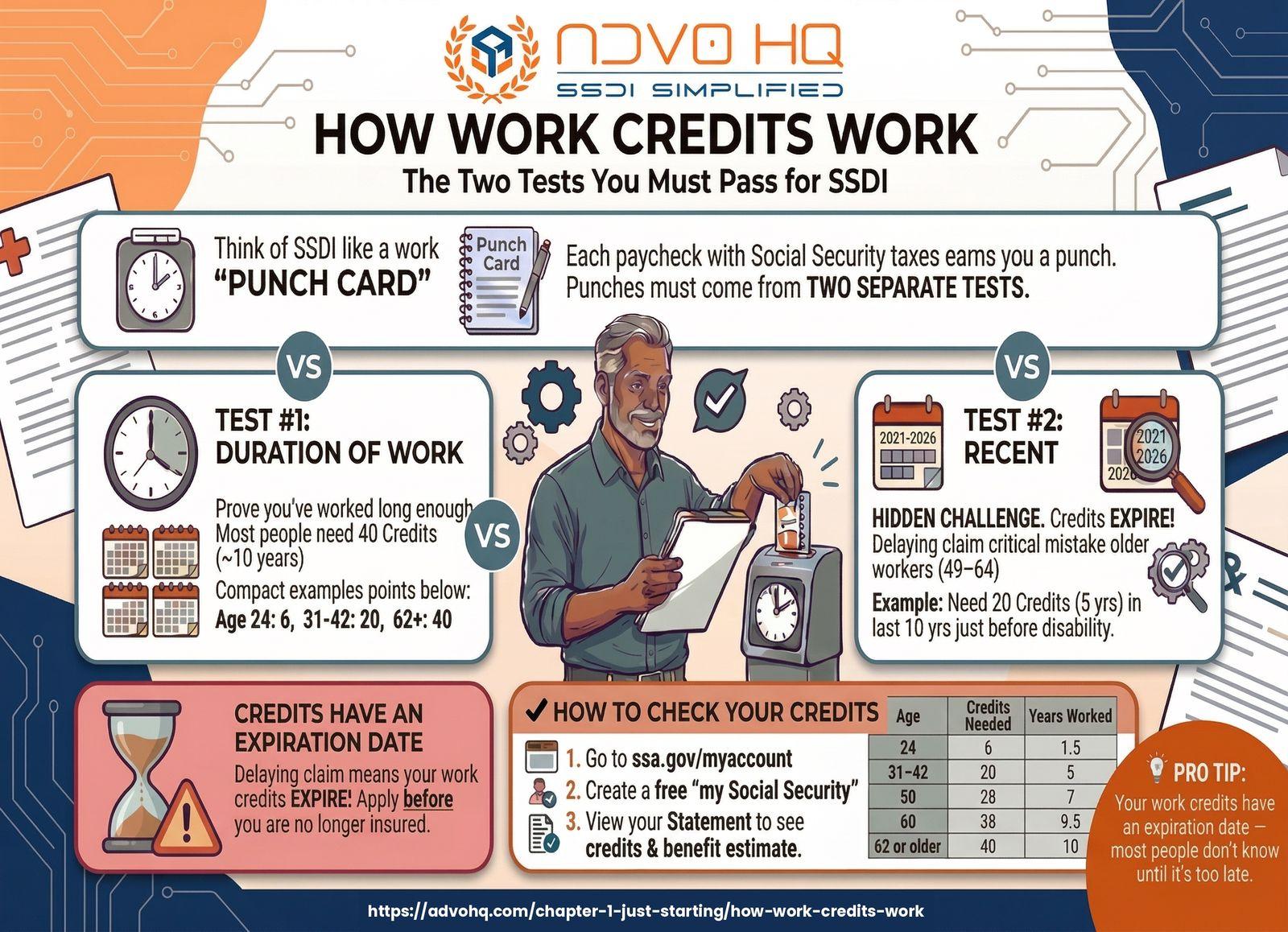
Most people don't realize that SSDI has two separate credit tests — and you have to pass both. Having plenty of total credits isn't enough if your recent work history is thin.
Duration Test
- Measures your overall work history
- Credits required scales with your age at disability — younger workers need fewer
- Ranges from 6 to 40 credits
Recent Work Test
- Checks whether your credits are current
- Old credits from decades ago don't count — SSA wants recent FICA contributions
- 20 credits in last 10 years (age 31+)
Test #1: The Duration Test (Total Credits)
Your required credit count scales with age — the assumption being that younger workers haven't had as long to build up credits.
Test #2: The Recent Work Test
This is the test that catches people off guard. For most applicants age 31 and older, you need:
This is why someone who worked for 20 years but stopped 15 years ago might NOT qualify — their credits are too old. The recent work test doesn't care how much you worked in total, only whether you worked recently enough.
How to Check Your Credits (Free)
You can see your exact credit count and full earnings history right now — it takes about 5 minutes and costs nothing.
Visit ssa.gov/myaccount directly. No third-party sites needed.
You'll need your SSN, a US mailing address, and a valid email. The process takes a few minutes and requires identity verification.
Once logged in, your statement is available as a downloadable PDF. It's updated annually.
Your estimated benefits section shows your current disability benefit estimate. Your earnings record shows every year of reported income — and where credits may be missing.
What Your Statement Shows
- Your total lifetime work credits
- Year-by-year earnings history
- Estimated monthly disability benefit if you became disabled today
- Any years where earnings weren't reported (gaps to investigate)
Frequently Asked Questions
Self-employment counts. As long as you pay self-employment taxes (the 15.3% on your Schedule SE), you earn credits just like a W-2 employee — net earnings above $400 for the year generate credits. The catch: you have to actually report the income and pay the tax. Unreported cash or gig income won't count, which is a common problem for cash-based businesses.
Your total lifetime credits don't disappear, but their usefulness can. The recent work test requires credits earned within a specific window before your disability. If you stop working for many years, you can eventually lose "insured status" for SSDI even with 40+ lifetime credits.
You still have options. SSI (Supplemental Security Income) has no work-credit requirement — it's need-based, with strict income and asset limits ($2,000 for individuals). You can apply for SSDI and SSI at the same time and, if you qualify for both, receive "concurrent benefits."
Not for SSDI — only your own record counts toward disability insured status. Spousal and survivor benefits are a separate program with different rules, and in some situations (such as disabled widow/widower benefits) you may be able to claim on a spouse's or ex-spouse's record.
Contact your local SSA office with documentation — W-2s, pay stubs, or tax returns from the affected years. SSA can correct errors, but it's easier the sooner you address them; records more than 3 years old can be harder to fix.
What They Don't Tell You
The things even well-informed applicants miss:
Your "insured status" can expire
If you stop working, your recent credits start aging out. After enough time passes, you may no longer be "insured" for SSDI — even if you have decades of work history behind you.
Your earnings record can have errors
Employers sometimes report wages incorrectly. Check your Social Security Statement for missing years or wrong amounts — especially if you changed jobs frequently.
Military service counts
Active-duty military service earns work credits, and you may also receive additional wage credits for service during certain periods.
The credit amount changes every year
In 2025, one credit was $1,810. In 2026, it's $1,890. SSA adjusts this annually based on average wages — it typically goes up.
Statutory blindness skips the recent work test
If you meet SSA's definition of statutory blindness, the 20/40 recent-work rule doesn't apply. You only need to be "fully insured" — lifetime credits, whenever they were earned.
Read your earnings record before you apply
Don't guess whether you have enough credits — open a free my Social Security account at ssa.gov/myaccount and read your earnings record before you apply. The trap most people miss is the recent-work test: for most adults, 20 of your 40 credits must have been earned in the last 10 years, so credits from a long-ago career can leave you technically uninsured today even with decades of work behind you. Checking early tells you whether you're still insured — and, just as important, by what date you'd need to be found disabled.
Two tests. Both matter. Check yours now.
Work credits are your ticket into SSDI — no credits, no eligibility. You need enough total credits based on your age AND enough recent credits earned in the last 10 years. You can check your status for free at ssa.gov in about five minutes. If you're short, SSI may be a backup option — but it comes with much stricter financial limits.
Next Steps: Got enough credits? Now the question is whether your condition qualifies. Read What Medical Conditions Qualify for SSDI?
- 42 U.S.C. § 423(c)(1) — disability insured status; 20-credits-in-40-quarters recency rule and statutory-blindness exception. law.cornell.edu
- 20 C.F.R. § 404.130 — how disability insured status is determined (Rules I–IV, credits needed by age). ecfr.gov
- 20 C.F.R. § 404.131 — insured status in the quarter of onset / Date Last Insured. ecfr.gov
- 42 U.S.C. § 416(i)(1) — statutory definition of blindness. law.cornell.edu
- SSA, "How You Earn Credits" (Pub. No. EN-05-10072). ssa.gov
- SSA, "my Social Security" (check your earnings record and credits online before applying). ssa.gov
- SSA, "Social Security Credits" (retirement/disability planner). ssa.gov
- SSA, "Quarter of Coverage" (2026 amount = $1,890 per credit; $7,560 for 4 credits). ssa.gov
- SSA, "2026 Social Security Changes" Fact Sheet (2026 COLA). ssa.gov
- SSA, "Disability Benefits — How You Qualify". ssa.gov
- Social Security Act, Title II — 42 U.S.C. §§ 401–434.