
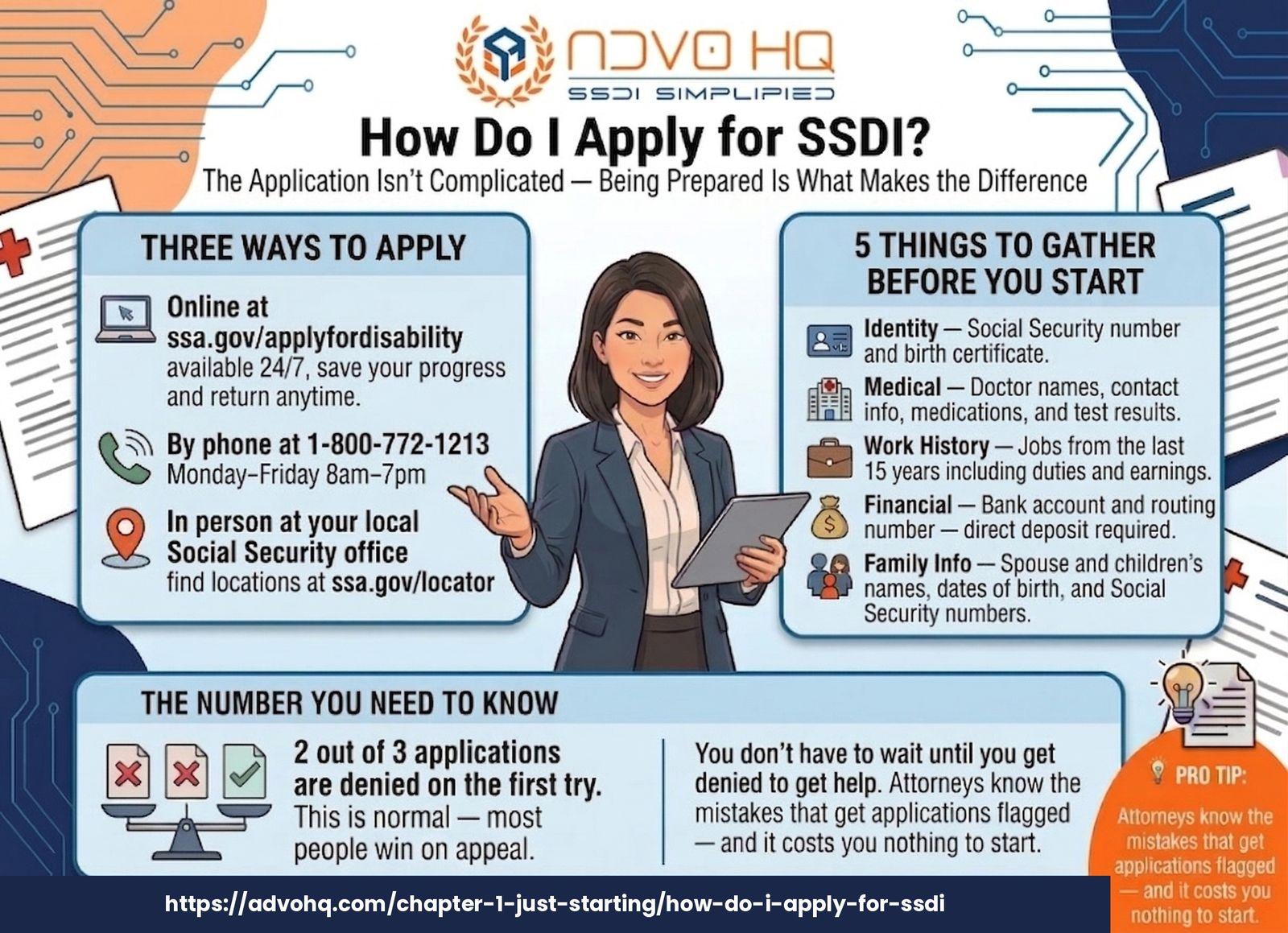
Three Ways to Apply
SSA accepts applications through three channels. All three reach the same system — the difference is convenience and speed.
Online
Recommended. Visit ssa.gov/applyfordisability. You'll need a "my Social Security" account first (via login.gov or ID.me). Available 24/7, save progress, and get confirmation on submit.
By Phone
Call 1-800-772-1213 (TTY 1-800-325-0778), Monday–Friday, 8 a.m.–7 p.m. A representative walks you through the application. Best if you have complex circumstances or were recently denied.
In Person
Visit your local SSA office — find locations at ssa.gov/locator. Make an appointment to avoid long wait times. Best for situations requiring original documents.
However, if you've been denied in the last 60 days or have a complex situation, you may need to complete part of the application by phone or in person.
What You’ll Need to Apply
Gather everything before you start. Stopping mid-application to find a document creates gaps — and gaps lead to delays.
Download the SSA's free "Adult Disability Starter Kit" at ssa.gov before you begin. It includes worksheets to help you organize everything.
What the Application Asks
The main form is SSA-16 (Application for Disability Insurance Benefits). It's comprehensive — plan for 1-2 hours if you're completing it in one sitting.
- Personal Information — name, address, SSN, date of birth, citizenship status
- Work History — jobs held in the last 5 years, duties, physical demands, earnings
- Medical Information — conditions, providers, hospitalizations, medications, test results
- Daily Activities — how your condition affects your ability to function and care for yourself
- Education and training — highest grade completed, vocational training, certifications
- SSA-827 authorization — medical release form permitting SSA to request your records directly
The SSA-3368 is submitted alongside SSA-16 and goes deeper on your medical history and functional limitations. This is where detail matters most — the more specific, the better.
What Happens After You Apply
Submitting the application starts a chain of events across multiple agencies. Here's what's happening while you wait.
SSA verifies you have enough work credits to qualify for SSDI (not SSI). If you do, your case moves forward. If not, they'll notify you about SSI options instead.
A state examiner and medical consultant review your medical evidence and apply SSA's 5-step evaluation to determine if you're disabled.
If your records are incomplete or outdated, DDS may contact your doctors directly or schedule you for a medical exam — at no cost to you — with one of their contracted physicians.
Typically 3-6 months after application, though complex cases can take longer. You can check status anytime at ssa.gov/myaccount.
Typical Timeline
Most people don't get approved on the first try. That's not failure — it's how the system works. Understanding the full timeline helps you prepare financially and emotionally.
About 2/3 of initial applications are denied. This is normal — many people win on appeal. See What If I Get Denied? for more.
Frequently Asked Questions
For most people, online at ssa.gov/applyfordisability. It's open 24/7, you can save your progress and finish later, and you get a confirmation when you submit. Phone (1-800-772-1213) and in-person options exist too — and are the better route if you were denied in the last 60 days or have a complicated case.
The core application is the SSA-16 (Application for Disability Insurance Benefits). Alongside it you'll complete the SSA-3368 (Adult Disability Report), which details your conditions, providers, and job history, and you'll sign the SSA-827 (Authorization to Disclose Information) so SSA can request your medical records directly.
Your Social Security number and birth certificate, contact details and visit dates for every doctor and hospital, a full medication list, your last 5 years of work history, bank details for direct deposit, and family information. Direct deposit is required for new applicants as of September 2025 — SSA no longer mails paper checks.
As of May 2026, SSA's published average for an initial decision is about 184 days (roughly 6 months). If you're denied and appeal, reconsideration averages about 208 days (~7 months) and a hearing before a judge averages about 267 days (~9 months). These are approximate agency averages that shift month to month and vary by state. About two-thirds of initial claims are denied, so a first "no" is common — not the end of the road. See What If I Get Denied? for what to do next.
Often, yes. If you know you'll have to stop soon because of your condition, many advocates suggest you can begin your application before your last day of work rather than waiting. Some sources cite a window of roughly 90 days ahead, but SSA does not publish a fixed "90-day" filing rule, so treat that number as a rule of thumb rather than a hard deadline and confirm timing with SSA for your situation. You can also track everything through your my Social Security account once you've submitted.
What They Don't Tell You
Insider knowledge that can make or break your application:
Your onset date matters more than you think
This is when you claim your disability began. It affects your back pay. Pick the date you actually stopped being able to work — not when you were diagnosed or when you stopped working for other reasons.
Specialist opinions can help
For claims filed on or after March 27, 2017, SSA no longer gives automatic or "controlling" weight to any doctor — it judges each opinion mainly by supportability (the medical explanation behind it) and consistency with the rest of your record. A specialist's relationship to your condition is one factor SSA may consider, so a cardiologist's well-documented notes about a heart condition can still add weight — but it is the strength and consistency of the evidence, not the title, that carries the day.
The work history section is a trap
If you describe your past jobs as easy or light-duty, SSA may decide you can still do that work. Be accurate about the physical and mental demands of each job.
"Consultative exams" are not on your side
Many disability practitioners caution that when SSA schedules you to see their doctor, that exam is typically brief (15-30 minutes) and can produce findings that hurt your case. Your own doctor's detailed records are more valuable.
You can apply before you stop working
If you know you'll have to stop soon due to your condition, you generally don't have to wait until your last day to start your application. You may hear a "90 days before your last day of work" figure, but SSA doesn't publish that as a formal rule — treat it as guidance, not a guaranteed window, and confirm with SSA.
Lock in your filing date before the paperwork's done
Your filing date drives your back pay — and you can lock it before the paperwork is finished. The moment you give SSA a signed written statement (or an online "intent to file") saying you plan to apply, that date becomes your protective filing date, even if you submit the full application weeks later. You then have up to 6 months to complete the Title II application without losing that earlier date, so stake your claim the day you decide to file — a few protected weeks can mean an extra month of back pay. A representative can lock this in for you on day one; see Do I Need a Lawyer or Advocate?.
Applying for SSDI isn't the hard part — you can do it online, by phone, or in person.
Applying for SSDI isn't the hard part — you can do it online, by phone, or in person. The hard part is applying well. That means thorough medical documentation, honest descriptions of your worst days, and realistic expectations about the timeline. As of May 2026, SSA's average for an initial decision is about 184 days (roughly 6 months), and roughly two-thirds get denied on the first try. That's normal — and it's not the end.
Next Steps: Filed your application? Read What Happens After I Apply? to understand the 5-step evaluation process and what Social Security is looking for.
- SSA, "Apply for Disability Benefits". ssa.gov
- SSA, "Adult Disability Starter Kit". ssa.gov
- Form SSA-16, "Application for Disability Insurance Benefits". ssa.gov
- Form SSA-3368, "Adult Disability Report". ssa.gov
- Form SSA-827, "Authorization to Disclose Information to SSA". ssa.gov
- 20 C.F.R. § 404.1520 — evaluation of disability in general (five-step sequential evaluation). ecfr.gov
- 20 C.F.R. §§ 404.1560, 404.1565 — past relevant work (5-year look-back). ecfr.gov
- SSR 24-2p — evaluation of past work; 89 Fed. Reg. 27653 (Apr. 18, 2024), eff. June 8, 2024. ssa.gov
- 20 C.F.R. § 404.1520c — how SSA considers medical opinions (claims filed on/after Mar. 27, 2017). ecfr.gov
- 20 C.F.R. § 404.621 — retroactive benefits / back pay. ecfr.gov
- 20 C.F.R. § 404.630 — use of the date of a written statement as your filing date (protective filing date). ecfr.gov
- SSA, POMS GN 00204.010 — protective filing / protective writings. secure.ssa.gov
- SSA, "Social Security performance — Disability claim processing time" (initial ~184 days, reconsideration ~208 days; latest month May 2026). ssa.gov
- SSA, "Social Security performance — Disability appeals time" (ALJ hearing ~267 days; latest month May 2026). ssa.gov
- SSA, "Contact Social Security" (1-800-772-1213; TTY 1-800-325-0778). ssa.gov
- SSA, Office/field-office locator. ssa.gov