
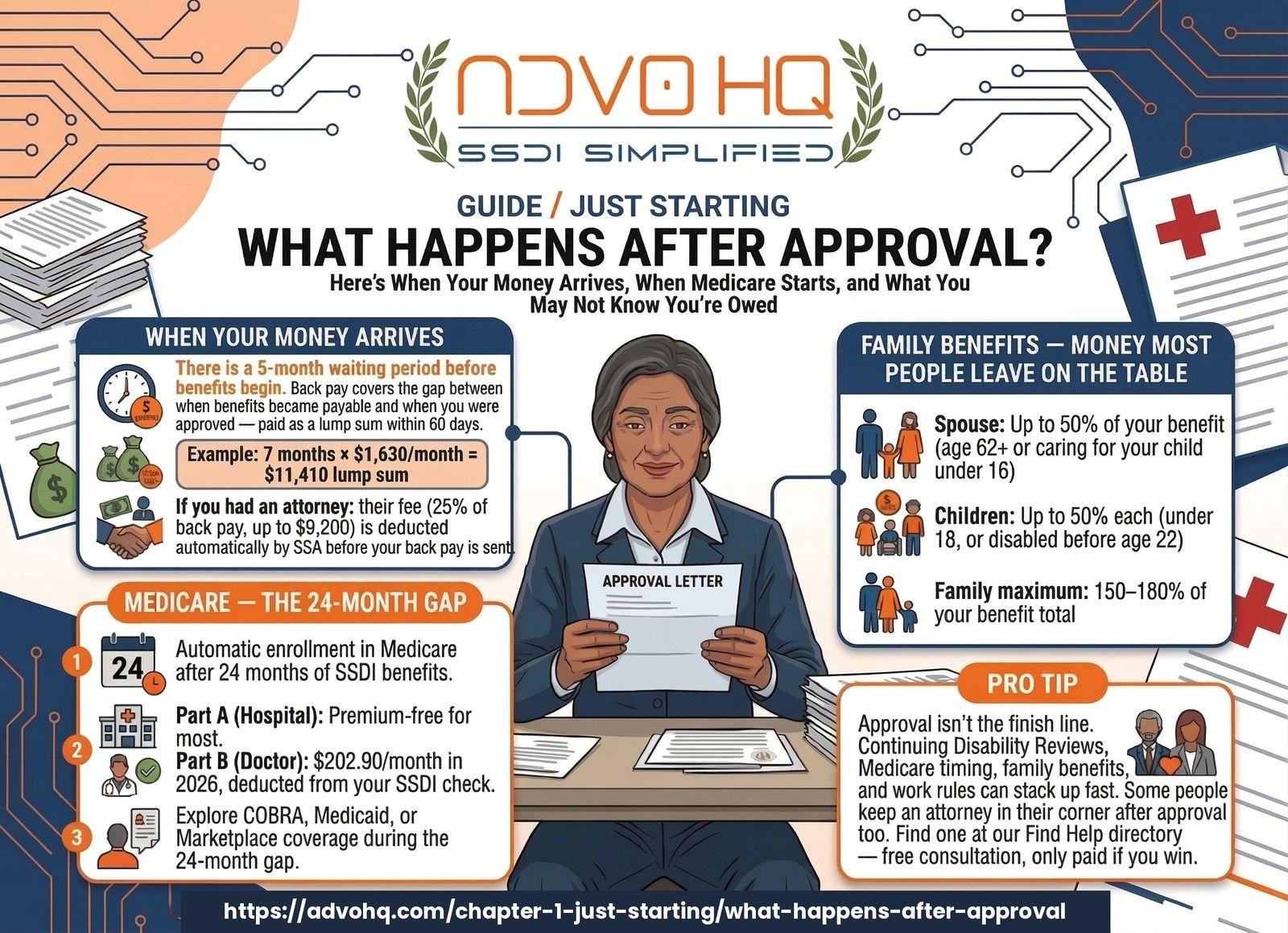
Your Notice of Award Letter
The Notice of Award is the official document confirming your approval. It contains everything you need to know about your benefits — keep it somewhere safe.
What your letter tells you
- Your monthly benefit amount
- Your established onset date (when SSA determined disability began)
- When your first payment will arrive
- How much back pay you'll receive
- Information about Medicare enrollment
Keep this letter in a safe place — you may need it for other benefits, housing applications, or tax purposes.
Your Payment Schedule
Monthly SSDI payments arrive on a Wednesday determined by your birthday. Payments are made by direct deposit — as of September 2025, paper checks are no longer issued to new beneficiaries.
Your Back Pay (Retroactive Benefits)
Back pay covers the gap between when your benefits became payable and when you were actually approved. Most people receive it as a lump sum within 60 days of approval.
Medicare Coverage
SSDI recipients are automatically enrolled in Medicare after 24 months of receiving benefits. This wait period runs separately from the 5-month SSDI waiting period.
During the 24-month Medicare gap, you'll need other coverage. Options:
- COBRA — continuation of your former employer's plan
- Spouse's plan — if covered under a family plan
- Medicaid — if you qualify based on income and resources
- Marketplace plan — ACA plans; may qualify for subsidies
If you have ALS, Medicare begins immediately when your SSDI benefits start — no 24-month wait.
Benefits for Your Family
Approval may also trigger benefits for eligible family members — paid in addition to your own benefit.
Continuing Disability Reviews (CDRs)
SSA periodically reviews your case to confirm you're still disabled. Frequency depends on whether your condition is expected to improve:
During a CDR, SSA reviews your medical records to see if your condition has improved. If they determine you're no longer disabled, your benefits may stop — but you have the right to appeal, and benefits can continue during the appeal if you request it within 10 days of the cessation notice. In practice, more than 90% of adults who go through a CDR keep their benefits.
Annual Cost-of-Living Adjustments
Your benefit automatically increases each year based on inflation through the Cost-of-Living Adjustment (COLA).
You don't need to do anything — increases are automatic. SSA sends a notice each December showing your new amount for the coming year.
When SSDI Converts to Retirement
Automatic conversion at Full Retirement Age: When you reach Full Retirement Age (66–67 depending on birth year), SSDI automatically converts to Social Security retirement benefits. The amount stays the same — only the program label changes. No action required.
Frequently Asked Questions
Contact SSA if your back pay hasn't arrived within 60 days of your approval letter — call 1-800-772-1213 or check your my Social Security account for payment status. Delays sometimes happen when attorney fees need to be processed or when family benefit calculations are involved.
Possibly. If your combined income (other income + 50% of your SSDI) exceeds $25,000 for single filers or $32,000 for married filing jointly, up to 50–85% of your benefit may be taxable. Many SSDI recipients fall below these thresholds and owe nothing. SSA doesn't withhold taxes automatically, but you can request voluntary withholding with Form W-4V, and it sends Form SSA-1099 each January.
Yes — a CDR can end benefits if SSA finds medical improvement. But benefits continue during your appeal if you request continuation within 10 days of the cessation notice. If you appeal and lose, SSA may ask you to repay benefits paid during the appeal, though you can request a waiver based on financial hardship.
No. Part A and Part B are automatic once you're enrolled. Part D (prescriptions) and Medicare Advantage plans have an annual Open Enrollment period (October 15 – December 7) where you can make changes. Review your Part D plan each year — formularies and premiums change.
Under SSA's work-incentive rules, Medicare generally continues for at least 93 months (about 7.75 years) after your Trial Work Period ends — this is often called Extended Medicare. After that, you can buy into Medicare at the premium rate. This protection exists specifically so the Medicare gap doesn't discourage people from attempting to work. Can I Work While Applying or Receiving SSDI? explains the Trial Work Period and other work incentives.
What They Don't Tell You
Insider knowledge that can make or break your application:
The 24-month Medicare wait is brutal
Plan for this gap. If you have a serious condition requiring ongoing care, 24 months without Medicare can be financially devastating. Explore Medicaid, COBRA, or Marketplace options.
Medicare Part B premiums eat into your COLA
In 2026, the standard Part B premium is $202.90/month (up $17.90 from $185.00 in 2025). If your COLA raise was $44/month but Part B went up about $18, your net increase is only about $26.
Keep seeing your doctors
Continuing Disability Reviews check your medical records. If you stop treatment, SSA may conclude you've improved. Keep documentation of ongoing limitations.
Unreported changes can become an overpayment you must repay
Changes like starting work, moving, marriage or divorce, or medical improvement affect your benefit — and if you don't report them, SSA can later demand back every dollar it overpaid. Report changes to SSA right away.
You may qualify for other benefits
SSDI approval may make you eligible for SNAP (food assistance), housing assistance, utility programs, and state-specific benefits. Don't leave money on the table.
Plan for the ~29-month Medicare coverage gap
Approval doesn't switch on your health coverage. Medicare for SSDI beneficiaries starts only after 24 months of entitlement — and because entitlement itself doesn't begin until after the 5-month waiting period, most people don't reach Medicare until roughly 29 months after their disability began. Line up a bridge for that gap now: COBRA, an ACA marketplace plan, Medicaid, or a spouse's plan. Two conditions skip the wait entirely — ALS (Medicare from the first month of entitlement) and end-stage renal disease.
After approval, expect your first payment within 1 to 2 months, with back pay arriving around the same time as a lump sum.
After approval, expect your first payment within 1 to 2 months, with back pay arriving around the same time as a lump sum. Medicare kicks in after 24 months on SSDI — plan for that gap. Your benefits increase every year with COLA and automatically convert to retirement benefits when you reach full retirement age. In the meantime, keep seeing your doctors (your records matter during Continuing Disability Reviews), report any changes to SSA, and look into other benefits you may now qualify for like SNAP, Medicaid, or state programs.
Next Steps: That completes the SSDI overview. If you or someone you're helping is still working toward approval, Chapter 2 goes deeper — start with Before You Apply: Are You Ready? for a step-by-step walk-through of doing the application right.
- 20 C.F.R. § 404.315 — five-month waiting period (entitlement to disability benefits). ecfr.gov
- 42 U.S.C. § 423(c)(2) — statutory five-month waiting period; ALS exemption. law.cornell.edu
- 20 C.F.R. § 404.621 — retroactive (back pay) benefits, up to 12 months before filing. ecfr.gov
- 42 U.S.C. § 426(b), (h) — Medicare 24-month qualifying period; ALS immediate entitlement. law.cornell.edu
- 42 U.S.C. § 426-1 — ESRD Medicare eligibility. law.cornell.edu
- 20 C.F.R. § 404.403 — family maximum (disability family maximum = 85% of AIME, floor PIA, ceiling 150% PIA). ecfr.gov
- 20 C.F.R. § 404.1590 — when and how often SSA conducts Continuing Disability Reviews (MIE 6–18 mo / MIP 3 yr / MINE 5–7 yr). ecfr.gov
- 20 C.F.R. § 404.1594 — Medical Improvement Review Standard (whether disability continues). ecfr.gov
- 42 U.S.C. § 406(a)(2); 20 C.F.R. § 404.1720 — representative fee cap (25% of past-due benefits, capped at $9,200 eff. Nov. 30, 2024). law.cornell.edu
- 26 U.S.C. § 86 — taxation of Social Security benefits (base amounts $25,000 single / $32,000 MFJ). law.cornell.edu
- Social Security Act, Title II — 42 U.S.C. §§ 401–434. ssa.gov
- Social Security Administration — 2026 COLA Fact Sheet. ssa.gov
- Social Security Administration — [Disability Benefits](. ssa.gov
- Social Security Administration — Approval Process / Medicare coverage timing. ssa.gov
- Social Security Administration — [What You Need to Know When You Get Disability Benefits (Pub. EN-05-10153)](. ssa.gov
- Social Security Administration — [Maximum Benefit for a Disabled-Worker Family](. ssa.gov
- Centers for Medicare & Medicaid Services — 2026 Medicare Parts A & B Premiums and Deductibles (Part B premium $202.90/mo; Part B deductible $283, CY 2026). cms.gov