
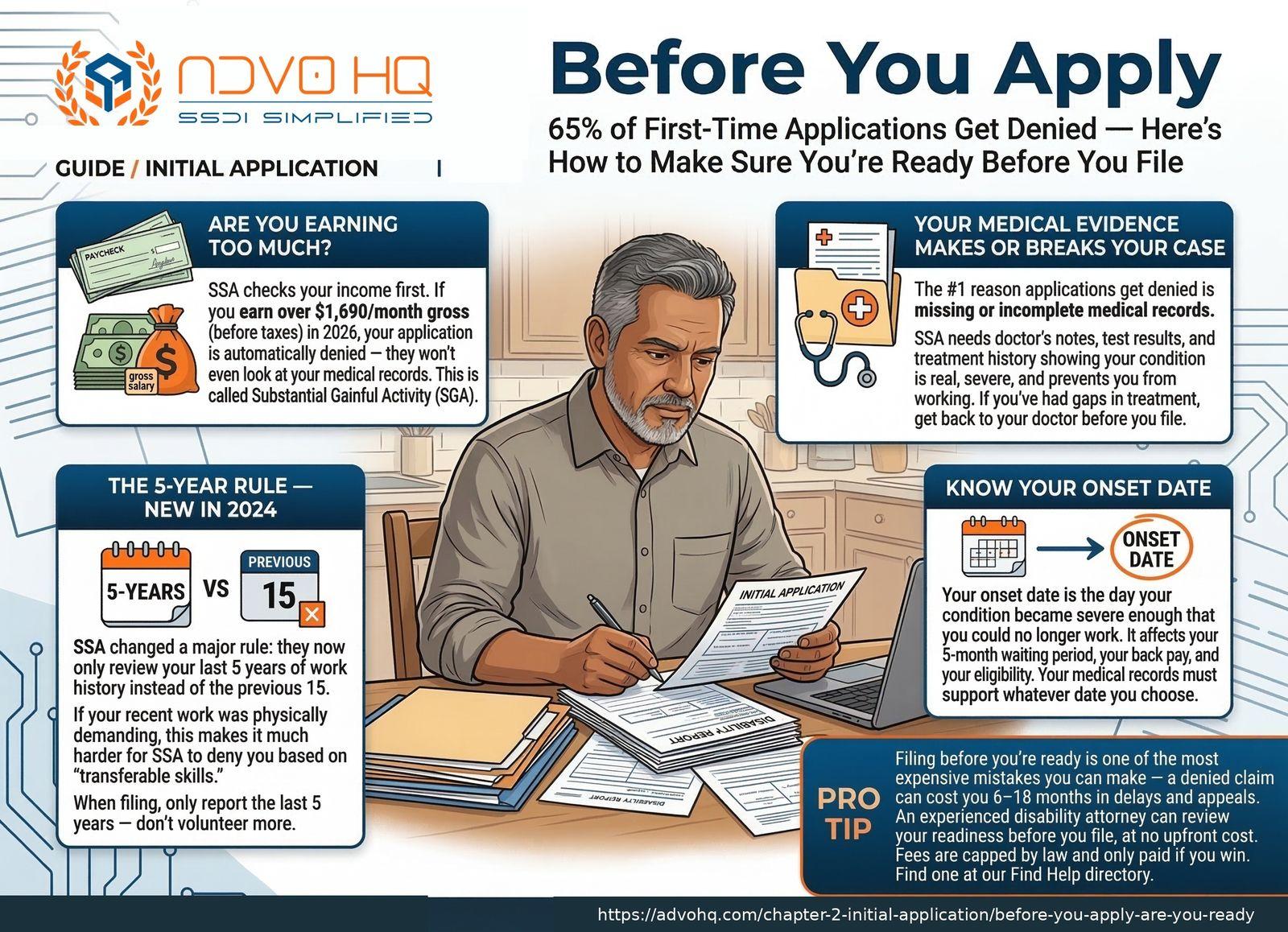
The Work History Rule Just Changed
Before you do anything else, know this: SSA quietly changed a major rule in late 2024 that likely works in your favor.
Your Readiness Checklist
Run through this before you start your application. If you can't check most of these boxes, take a week or two to get organized. There's no penalty for waiting — but there's a real cost to filing before you're ready.
Frequently Asked Questions
SSA uses the Substantial Gainful Activity (SGA) threshold. In 2026 it's $1,690/month for non-blind individuals and $2,830/month if you're statutorily blind. SSA counts gross pay — before taxes, insurance, and retirement deductions — so check your pay stub, not your bank deposit. Earn above the limit and your claim is denied at Step 1 before anyone reviews your medical records.
In 2026, the limit is $1,690 per month in gross income (that’s before taxes) for non-blind individuals, or $2,830 per month if you’re blind. This is called Substantial Gainful Activity (SGA).
Important: SSA looks at your gross pay—the amount on your paycheck before taxes, insurance, or any other deductions. If your bank deposit is $1,500 but your gross pay was $1,750, you’re over the limit.
If you’re working part-time, check your pay stubs carefully. You can still work and apply for SSDI—just stay under the limit.
Yes, as long as your earnings stay under the SGA limit. Part-time work below $1,690/month (gross) won't automatically disqualify you, but it can invite scrutiny about whether you're really unable to work, so keep your pay stubs and be ready to explain your hours and duties. For the full rules on working while a claim is pending or after approval, see Can I Work While Applying or Receiving SSDI?.
In 2026, the limit is $1,690 per month in gross income (that’s before taxes) for non-blind individuals, or $2,830 per month if you’re blind. This is called Substantial Gainful Activity (SGA).
Important: SSA looks at your gross pay—the amount on your paycheck before taxes, insurance, or any other deductions. If your bank deposit is $1,500 but your gross pay was $1,750, you’re over the limit.
If you’re working part-time, check your pay stubs carefully. You can still work and apply for SSDI—just stay under the limit.
Most people age 31 and older need 40 credits total, with 20 earned in the last 10 years before their disability began. In 2026 you earn one credit per $1,890 in covered wages, up to four per year ($7,560). Younger workers need fewer. Check your exact count at ssa.gov/myaccount.
In 2026, the limit is $1,690 per month in gross income (that’s before taxes) for non-blind individuals, or $2,830 per month if you’re blind. This is called Substantial Gainful Activity (SGA).
Important: SSA looks at your gross pay—the amount on your paycheck before taxes, insurance, or any other deductions. If your bank deposit is $1,500 but your gross pay was $1,750, you’re over the limit.
If you’re working part-time, check your pay stubs carefully. You can still work and apply for SSDI—just stay under the limit.
You may still qualify for SSI (Supplemental Security Income), which is based on financial need rather than work history. You can apply for SSDI and SSI at the same time — see Documents You'll Need for what to gather either way.
In 2026, the limit is $1,690 per month in gross income (that’s before taxes) for non-blind individuals, or $2,830 per month if you’re blind. This is called Substantial Gainful Activity (SGA).
Important: SSA looks at your gross pay—the amount on your paycheck before taxes, insurance, or any other deductions. If your bank deposit is $1,500 but your gross pay was $1,750, you’re over the limit.
If you’re working part-time, check your pay stubs carefully. You can still work and apply for SSDI—just stay under the limit.
It drives your 5-month waiting period, how much back pay you can receive, and whether you were insured when your disability began. Pick a date your medical records actually support — an onset that predates your last day of documented work is a red flag SSA will catch.
In 2026, the limit is $1,690 per month in gross income (that’s before taxes) for non-blind individuals, or $2,830 per month if you’re blind. This is called Substantial Gainful Activity (SGA).
Important: SSA looks at your gross pay—the amount on your paycheck before taxes, insurance, or any other deductions. If your bank deposit is $1,500 but your gross pay was $1,750, you’re over the limit.
If you’re working part-time, check your pay stubs carefully. You can still work and apply for SSDI—just stay under the limit.
Longer than most people expect. As of SSA's latest published figures (May 2026), an initial disability claim takes about 184 days — roughly 6 months — to decide. If you're denied and have to appeal, reconsideration averages about 208 days (~7 months) and an ALJ hearing averages about 267 days (~9 months) from the date you request it. A strong first application is almost always faster than fixing a weak one on appeal. For a stage-by-stage breakdown of what happens during the wait, see What To Expect After You Hit Submit.
In 2026, the limit is $1,690 per month in gross income (that’s before taxes) for non-blind individuals, or $2,830 per month if you’re blind. This is called Substantial Gainful Activity (SGA).
Important: SSA looks at your gross pay—the amount on your paycheck before taxes, insurance, or any other deductions. If your bank deposit is $1,500 but your gross pay was $1,750, you’re over the limit.
If you’re working part-time, check your pay stubs carefully. You can still work and apply for SSDI—just stay under the limit.
What They Don't Tell You
Insider knowledge that can make or break your application:
SSA won't tell you to wait and prepare
If you file online right now with half your information missing, they'll process it anyway — and deny it. They're not going to call you up and say "hey, you should probably get more medical records first." That's on you.
A denial isn't just a "no" — it costs you months
As of SSA's latest published figures (May 2026), an initial claim averages about 184 days (~6 months) to decide. If you get denied and have to appeal, add roughly 208 days (~7 months) for reconsideration and about 267 days (~9 months) for a hearing — and the Appeals Council, if it comes to that, often takes a year or more (SSA doesn't publish a current average). Filing a strong first application is always faster than appealing a weak one.
Gaps in treatment look like you're not that disabled
If you haven't seen a doctor in 6 months, SSA's logic is simple: if it were that bad, you'd be getting treatment. Even if the real reason is you can't afford it, the gap hurts your case.
They look at your gross pay, not your take-home
This trips up a lot of people who think they're under the limit because their direct deposit is below $1,690 (the 2026 SGA limit). SSA counts your income before taxes, health insurance, and 401(k) — everything comes off the top. Check your pay stub, not your bank account.
The 5-year work history rule is newer than most guides mention
SSA cut the past-relevant-work window from 15 years to 5 years in its 2024 final rule (89 FR 27653; SSR 24-2p), effective June 8, 2024. Many websites, attorneys, and even some SSA staff still reference the old 15-year rule. Only list your last 5 years — it's the current rule, and it usually works in your favor.
Tell SSA you're filing before you feel “ready”
Don't wait until every record and form is perfect before you reach out to SSA. The day you first tell them you intend to claim disability, your "protective filing date" locks in — and you then have up to 6 months to actually finish and submit the application. That earlier date can mean months of extra back pay, so make contact first and complete the paperwork second.
Not sure where your gaps are? A free consultation with a disability attorney takes 15 minutes and costs nothing. They can tell you exactly what's missing. Visit our Find Help directory.
Think of your SSDI application like a job interview—you wouldn’t walk in unprepared.
Think of your SSDI application like a job interview — you wouldn't walk in unprepared. Take the time to make sure you're under the SGA earnings limit, seeing your doctors regularly, and have your onset date figured out. Check your work credits at ssa.gov. Get your bank account information ready. There's no penalty for taking an extra week to get organized, but filing an incomplete application can cost you many months in delays and appeals — an initial decision alone now averages about 6 months, and each level of appeal adds several more.
Next Steps: Ready to gather your paperwork? Read Documents You'll Need, or see Should You Get Help Before You Apply? if you'd like a hand.
- Substantial Gainful Activity (SGA) — SSA, "Substantial Gainful Activity," (2026 figures: 2026 COLA Fact Sheet,. ssa.gov
- Quarter of coverage / earnings per credit — SSA, "Quarter of Coverage,". ssa.gov
- Work credits & insured status (40 credits / 20 in last 10 years) — 42 U.S.C. § 423(c)(1), ; 20 CFR § 404.130, ; SSA, "How You Qualify," ; SSA, "How You Earn Credits,". law.cornell.edu
- Statutory definition of disability & 12-month duration rule — 42 U.S.C. § 423(d)(1)(A), ; 20 CFR § 404.1505, ; 20 CFR § 404.1509,. law.cornell.edu
- Onset date & Date Last Insured — 20 CFR § 404.131,. ecfr.gov
- Five-month waiting period — 20 CFR § 404.315(a)(4), ; 42 U.S.C. § 423(c)(2). ecfr.gov
- Back pay / retroactivity (up to 12 months) — 20 CFR § 404.621(a)(1),. ecfr.gov
- Past Relevant Work window = 5 years (eff. June 8, 2024) — Final Rule, "Intermediate Improvement to the Disability Adjudication Process, Including How We Consider Past Work," 89 FR 27653, ; SSR 24-2p, ; 20 CFR §§ 404.1560, 404.1565. federalregister.gov
- Disability processing times (initial ~184 days; reconsideration ~208 days; latest month May 2026) — SSA, "Social Security performance — Disability claim processing time,". ssa.gov
- Hearing (ALJ/OHO) processing time (~267 days; May 2026) — SSA, "Social Security performance — Disability appeals time,". ssa.gov
- Award-rate waterfall (~20% initial / ~29% final award, as shares of all applicants) — SSA, "Annual Statistical Report on the SSDI Program, 2024," Sec. 4 (Outcomes of Applications for Disability Benefits; Table 60 / Chart 11),. ssa.gov
- my Social Security (check work credits) — SSA,. ssa.gov
- Social Security Act, Title II — 42 U.S.C. §§ 401–434.
- Protective filing date & 6-month completion window — 20 CFR § 404.630,. ecfr.gov