
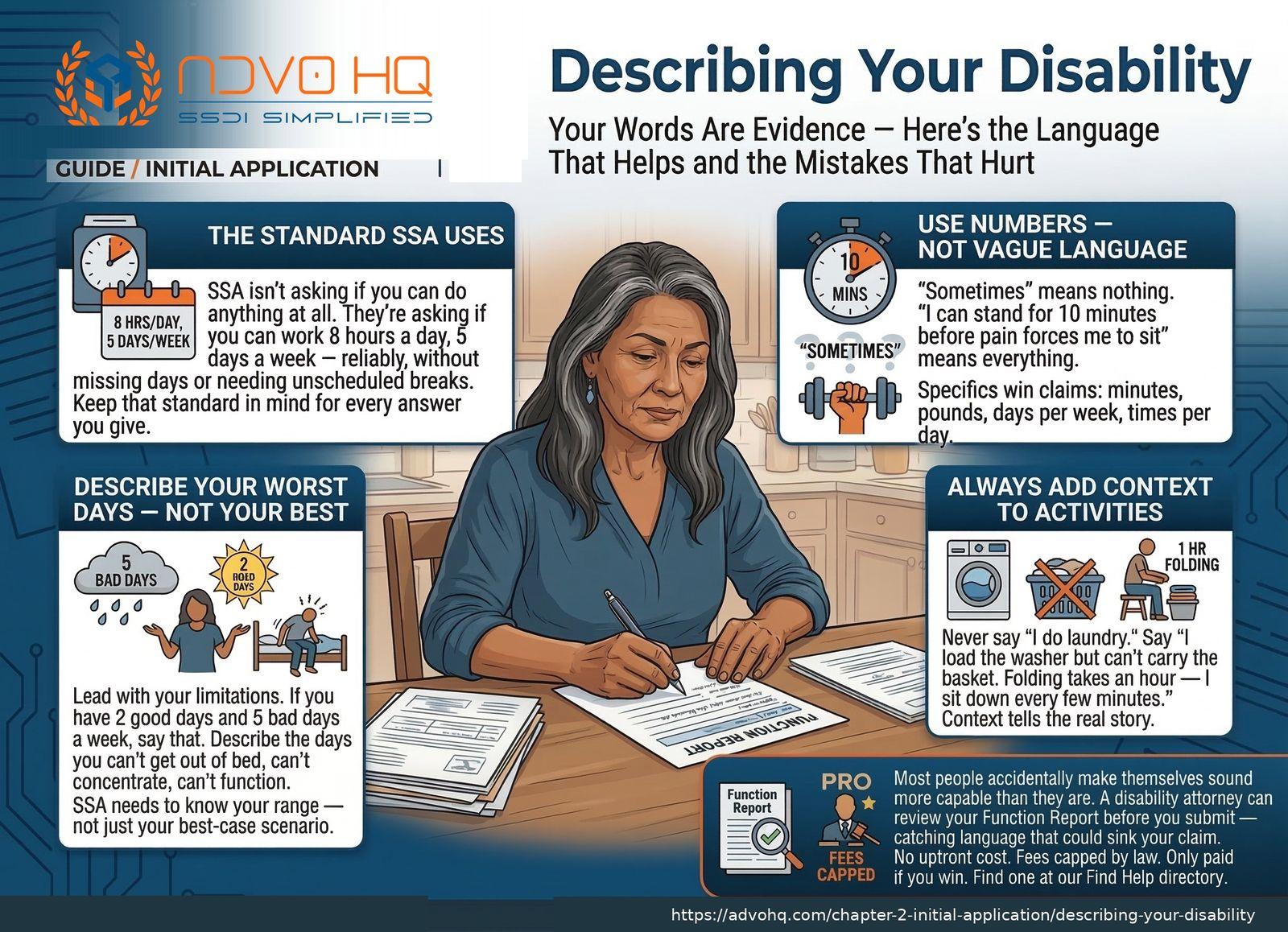
The Standard SSA Is Actually Using
A lot of people think they need to prove they're bedridden or completely helpless to qualify. That's a myth. SSA isn't asking whether you can do anything at all.
"I have to be totally helpless — unable to do anything — to qualify for SSDI."
Can you sustain full-time competitive work — 8 hours a day, 5 days a week, on a regular and continuing basis?
That's a very different question. You might wash a few dishes, walk to the mailbox, or drive to the store once a week — none of that means you can hold a full-time job. The key is explaining how you do those things: how long they take, how often you rest, what happens afterward, and whether you could do them reliably five days a week.
The Function Report: Where Your Words Matter Most
The Adult Function Report (Form SSA-3373) is a 10-page form about your daily activities, physical abilities, mental functioning, and social interactions. DDS sends it when they need more detail about how your condition affects everyday life. It's not always required — but if you get it, your answers can make or break your case.
What the Function Report asks about
- What you do from waking up until bed
- Whether you care for pets, children, or other adults
- Personal care: dressing, bathing, grooming, eating
- How you prepare meals and do chores
- Going outside, driving, transit, shopping
- Handling money and paying bills
- Hobbies and social activities
- Concentration, instructions, stress, getting along
- How your conditions changed what you can do
- Medication side effects on daily functioning
The Golden Rules for Describing Your Disability
Most people instinctively describe good days. SSA needs the days you can't get out of bed, can't sleep for pain, can't hold a conversation. Describe the full range — but lead with your limitations. Two good days and five bad days a week? Say exactly that.
Vague language kills claims. "Sometimes" and "often" mean nothing to an examiner. Use numbers: minutes you can stand, pounds you can lift, days a week in bed, times you rest during a simple task.
Never say "I do laundry" without explaining how. "I can put a small load in the washer, but I can't carry the basket — my wife moves the clothes, and folding takes over an hour because I sit down every few minutes" tells a completely different story.
SSA compares your answers to your medical records. Say you can't walk at all but your doctor's notes say you walked in unassisted, and your credibility takes a hit. You don't need to be helpless — just show you can't sustain full-time work. Honest detail beats exaggeration every time.
Drowsiness, brain fog, nausea, fatigue — say so. Trouble concentrating, remembering, following multi-step instructions, or handling stress — describe it, even if your main condition is physical. The form has specific mental-ability questions. Don't skip them.
Your answers must match your SSA-3368, your medical records, and your third-party contact's form (SSA-3380). Tell SSA you can barely walk while your friend says you shop together every Saturday, and that inconsistency gets flagged. Review all forms side by side before submitting.
Language That Hurts vs. Language That Helps
The same activity, described two ways — one gets you denied, one gets you approved:
“I cook meals.”
“I can heat up leftovers or make a sandwich. I can’t stand long enough to cook a full meal. My spouse cooks dinner every night.”
“I do laundry.”
“I can put a small load in the washer. My wife carries the basket. Folding takes over an hour because I rest every 5 minutes.”
“I have pain.”
“Constant burning pain in my lower back, 7/10 most days, 9/10 if I sit over 20 minutes. I lie down 3–4 times a day.”
“I sometimes go shopping.”
“My daughter drives me weekly. I use the motorized cart and last about 20 minutes before pain forces me out.”
“I have trouble sleeping.”
“Pain wakes me 3–4 times a night. About 4 hours of broken sleep. Exhausted by noon; I nap 2–3 hours most days.”
“I can’t work.”
“I can’t sit over 20 minutes, stand over 10, or lift over 5 pounds without sharp pain. I need unplanned breaks hourly and couldn’t keep any schedule reliably.”
“I drive sometimes.”
“I can drive 5 minutes to the pharmacy on a good day. Not more than 15 — my leg goes numb and I can’t feel the pedals.”
“I have trouble concentrating.”
“I lose track mid-sentence, can’t follow a TV plot, forget appointments even with reminders, and re-read the same page 4 times.”
Section-by-Section Tips
Daily Activities
Include everything — even "napped 3 hours" or "sat in the recliner because I couldn't move." Keep a 3-day diary before you fill this out. Don't list activities without the effort, time, and help they require.
Personal Care
If you use a shower chair, skip showers because you can't stand long enough, or need help with buttons or shoes — say so. If tasks take much longer than they used to, explain how long and why.
Meals & Household Chores
Describe what you can actually make (microwaving isn't cooking), how long it takes, and who handles most prep. Note which chores you've stopped entirely and which cause pain or exhaustion afterward.
Going Outside & Social Activities
If you rarely leave, say why. If you do go out, describe the limits: who drives, how long you last, what happens after. Explain how your social life has changed since your condition began.
Physical & Mental Abilities Checklist
Check every box that applies — and use the explanation space for each. "I can only walk about 50 feet before I stop; I use a cane." "I can't follow written instructions longer than 2 steps."
Changes Since Your Condition Began
"I used to coach my kid's baseball team; now I can't sit through a game." "I used to mow every Saturday; now my neighbor does it." The contrast tells the story.
Remarks — Don't Leave It Blank
Add anything that didn't fit: how symptoms fluctuate, good days vs. bad, medication side effects, how it's worsened over time. Use every line if you need to.
Your Third-Party Contact Matters Too
SSA may send a Third-Party Function Report (SSA-3380) to someone you listed — a family member, friend, or former coworker — describing your limitations from the outside.
- Choose someone who sees you regularly and witnesses your limitations firsthand
- Make sure their answers are consistent with yours — not identical (that looks rehearsed), but telling the same general story
- Talk to them first so they understand the importance and know to be specific and detailed
- They should describe what they've personally observed — not what you've told them
"I've seen him try to get up from a chair and it takes 2–3 minutes" beats "He told me he has trouble getting up."
Frequently Asked Questions
Not every applicant gets one. DDS sends the Adult Function Report (SSA-3373) when it needs more detail about how your condition affects daily life. If you receive it, treat it as critical — your answers can make or break the claim.
No. SSA isn't asking whether you can do anything at all — it's asking whether you can sustain full-time competitive work, 8 hours a day, 5 days a week, on a regular and continuing basis. That's the standard behind SSA's residual functional capacity (RFC) assessment. Being able to wash dishes or drive to the store once a week doesn't mean you can hold a job. Explain how you do those things — the time, rest, and help they require.
Yes. A family member, friend, or representative can help you fill it out, and a disability attorney or advocate can review it before you submit. What matters is that the answers are accurate and reflect your real experience.
It's a companion form SSA may send to someone who knows you — a family member, friend, or former coworker — asking them to describe your limitations from the outside. Their answers should tell the same general story as yours (not word-for-word identical) and describe what they've personally observed.
Inconsistencies hurt. SSA compares your Function Report against your medical file and your other forms (SSA-3368, SSA-3380). Under SSR 16-3p, examiners weigh how consistent your reported symptoms are with the overall record — SSA eliminated the term "credibility," so this is a consistency analysis, not a judgment of your character. Contradictions can undercut your claim. Be honest and detailed rather than overstating or downplaying.
What They Don't Tell You
You don't need to be bedridden to qualify
The biggest myth in SSDI is that you need to be totally helpless. You don't. You need to show you can't sustain full-time competitive work — 8 hours a day, 5 days a week, reliably. Plenty of approved claimants can do some activities. They just can't do them at a pace, duration, and consistency an employer would require.
Your Function Report can carry significant weight — sometimes tipping a borderline decision
Many disability attorneys find that when a doctor's notes are thin but your Function Report paints a clear, consistent, detailed picture of severe limitations, it can tip the balance in your favor. Conversely, great medical records can be undermined by a poorly filled-out report that makes you sound more capable than you are.
SSA reads between the lines — in the wrong direction
Say "I go to the grocery store," and SSA reads: can leave the house independently, navigate a public space, stand and walk the length of a shopping trip, carry items. Every statement without context becomes evidence of ability. Always qualify everything.
You can't easily un-say what you wrote on the Function Report
No regulation locks the form — you can submit additional or updated statements and evidence while your claim is still pending. But your first version stays in the file, and a later statement that contradicts it can read as an inconsistency that undercuts you. So get it right the first time: take your time, don't rush, have someone you trust read your answers first, and consider downloading the paper form and using it as a worksheet before entering your final answers online.
The "embarrassing" stuff matters most
Needing help in the bathroom. Not being able to dress yourself. Crying from pain or frustration. Having accidents because you can't make it to the toilet in time. These are the details people leave out because they're embarrassing — and they're often the details that prove how severe your condition really is. The DDS examiner has seen it all. Be honest.
Trade “I can't do much” for numbers SSA can use
On the Function Report (SSA-3373), swap vague phrases like "I can't do much" for concrete, measurable limits — "I can't sit more than 20 minutes," "I can't lift a gallon of milk," "I have to lie down twice a day." Then have a spouse, friend, or caregiver fill out the Third-Party Function Report (SSA-3380); an outside person confirming the same limits adds independent credibility that SSA actually weighs. If you want a second set of eyes on your answers first, see Should You Get Help Before You Apply?.
A disability attorney or advocate knows how to frame your limitations accurately without crossing into exaggeration — and they work on contingency: no upfront cost, capped fee, paid only if you win. A free consultation takes about 15 minutes. Find Help Near Me
Don't downplay. Be specific. Stay consistent.
The way you describe your disability is a skill — and most people get it wrong the first time. The answer isn't to exaggerate, and it isn't to tough it out and downplay your limitations. It's to be honest, specific, and detailed. Describe your worst days. Use numbers: minutes, pounds, times per day, days per week. Add context to every activity. Stay consistent across all forms. And don't leave the Remarks section blank. Your words are evidence — make them count.
Next Steps: Your past jobs matter more than most people realize. Read Work History: Why It Matters More Than You Think to see how SSA uses your work record to decide if you can still work.
- SSR 16-3p, Evaluation of Symptoms in Disability Claims — SSA eliminated the term "credibility"; adjudicators evaluate whether statements about the intensity, persistence, and limiting effects of symptoms are consistent with the objective medical and other evidence. Applicable to determinations/decisions on or after March 28, 2016 (superseding SSR 96-7p). ssa.gov
- 20 C.F.R. § 404.1529 — How we evaluate symptoms, including pain (two-step framework for symptom evaluation). ecfr.gov
- 20 C.F.R. § 404.1545 — Your residual functional capacity (the RFC — the most you can still do despite your limitations). ecfr.gov
- SSR 96-8p, Assessing Residual Functional Capacity in Initial Claims — RFC is the ability to work on a "regular and continuing basis," i.e., 8 hours a day, 5 days a week. ssa.gov
- Social Security Administration — Function Report – Adult (Form SSA-3373-BK). ssa.gov
- Social Security Administration — Function Report – Adult – Third Party (Form SSA-3380-BK). ssa.gov
- Social Security Administration — Disability Report – Adult (Form SSA-3368-BK). ssa.gov
- Insider tip source — concrete functional limits on the Function Report (SSA-3373, corroborated by the Third-Party Function Report (SSA-3380,; symptom evaluation under SSR 16-3p,. ssa.gov