
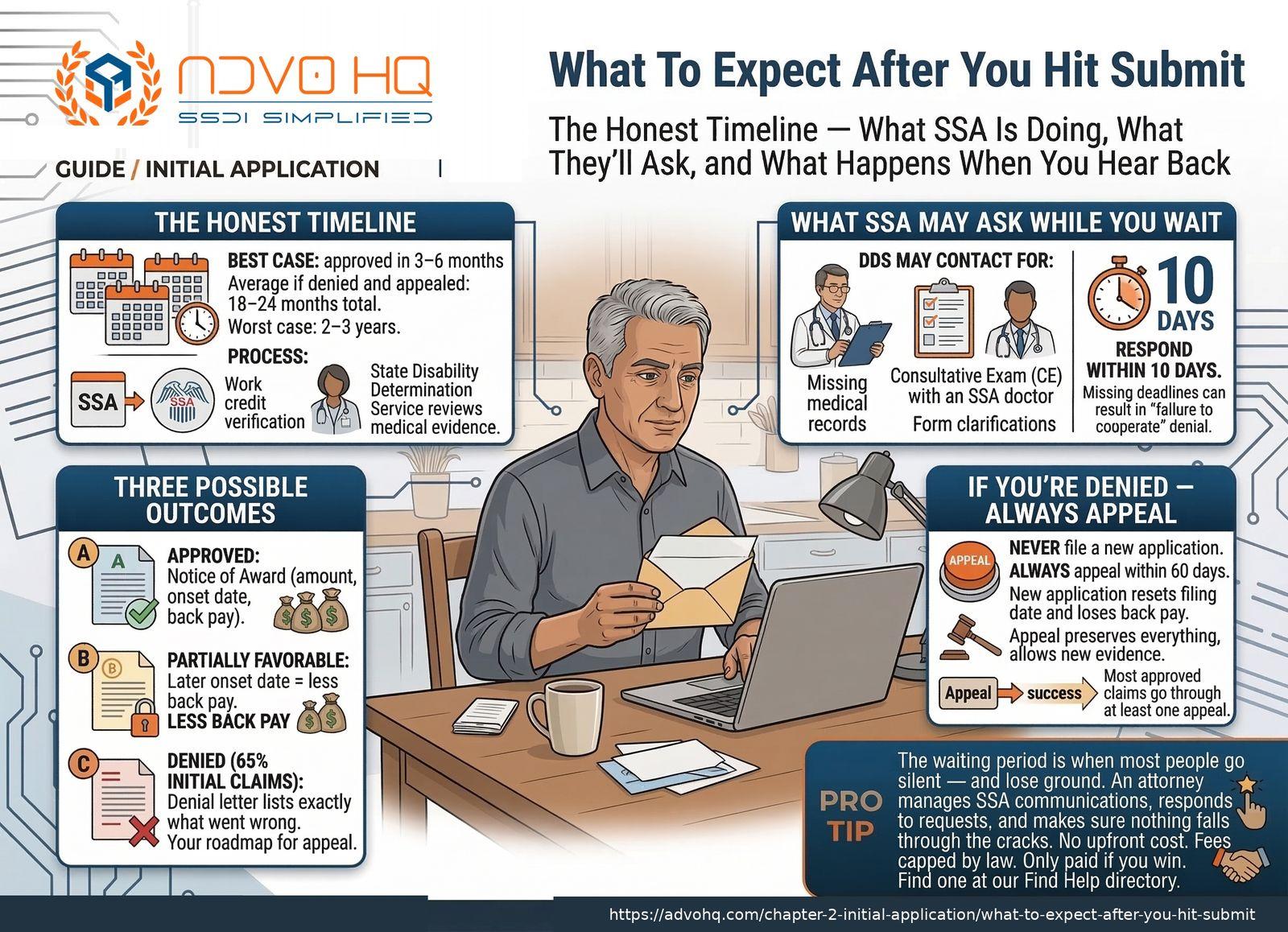
The Timeline: How Long This Actually Takes
There's no sugarcoating it: the SSDI process is slow. Here's a realistic breakdown of each stage:
Your local SSA field office checks non-medical eligibility, then sends your case to the state DDS office for medical review.
A different DDS examiner reviews your claim again. You can submit new medical evidence at this stage.
Your case goes before an Administrative Law Judge. Longest wait — but also where the most denials are overturned.
Reviews whether the ALJ made legal or procedural errors. Does not re-evaluate evidence.
Requires an attorney. Filed in federal district court. Rare, but available.
These are approximate SSA-published averages as of the latest reporting month (May 2026); your case can run faster or slower. You're approved at the initial application stage in roughly six months. Worst case scenario: Your claim goes through all appeal stages and takes two to three years or more from the date you first applied.
What Happens Right After You Submit
Within the first few weeks after you submit, here's what's happening:
You get a confirmation notice with your claim number. Applied online? Check status at my.ssa.gov. Phone or in person? A paper confirmation arrives by mail.
They verify work credits, earnings history, and basic requirements — this "technical" review doesn't look at your condition yet.
Disability Determination Services reviews your medical evidence and decides if you're disabled. A disability examiner is assigned.
The examiner contacts every provider you listed. This is often the slowest part — some offices take weeks. Submitting your own copies speeds this up considerably.
The Five-Step Evaluation: How DDS Decides
The examiner evaluates your claim using SSA's five-step sequential process:
Most claims for people aged 49–64 are decided at Steps 4 and 5, where the Grid Rules come into play. This is where your age, education level, work history, and Residual Functional Capacity all interact. The examiner determines your RFC — what you can still physically and mentally do despite your conditions — and then applies the Grid to determine whether any jobs exist that you could perform.
Things SSA Might Ask While You Wait
This isn't a "submit and forget" process. During review, SSA or DDS may contact you for:
- Additional medical info — Incomplete or outdated records? They'll ask for more. Respond fast — delays here add weeks or months.
- A Consultative Exam (CE) — A one-time exam with a doctor SSA chooses. You must attend — missing it can mean automatic denial.
- Clarification on your forms — A call or letter asking you to explain something in a form. Answer consistently with what you originally wrote.
- Contact with your doctors — DDS reaches out to your providers directly. Give your doctors a heads-up so they respond promptly.
- Updated information — New treatment, new doctor, or a condition change? Tell SSA — new evidence can only help.
Respond within 10 days.
When SSA asks you for something, respond within 10 days. If you can't meet that deadline, call SSA and ask for an extension. Ignoring requests or missing deadlines can result in your claim being denied for "failure to cooperate" — even if your medical condition would have qualified you.
How to Check Your Application Status
Online: my.ssa.gov
Log in and check claim status. Updated periodically — may not show real-time progress.
Phone: 1-800-772-1213
SSA's main line. Wait times can be long — call early morning or late afternoon. TTY: 1-800-325-0778.
Local Field Office
Visit in person — find yours at ssa.gov/locator. Bring your claim number.
Your Attorney
If you have representation, they can check status and talk to DDS directly on your behalf.
A general rule: if you haven't heard anything in 60–90 days, it's reasonable to check in. Don't call every week — it won't speed things up and can clog the system. But don't assume silence means everything is fine either. Sometimes requests get lost in the mail.
The Three Possible Outcomes
When DDS finishes, you'll get a written decision in the mail:
1. Approved — Fully Favorable
SSA agrees with your alleged onset date. Your Notice of Award covers your monthly amount, onset date, back pay, first payment date, and Medicare timing.
2. Partial — Partially Favorable
Approved, but with a later onset date than you claimed — meaning less back pay. You can accept it or appeal the onset date if your records support the earlier one.
3. Denied — ~65% of Initial Claims
The denial letter explains exactly why — insufficient evidence, non-severe condition, or SSA says you can still work. It's a roadmap for your appeal.
The 5-Month Waiting Period
Even after approval, there's a built-in delay. Federal law requires a 5-month waiting period before benefits begin — starting from your established onset date, not your approval date.
In practice, if your application takes 6+ months and your onset date was 6+ months ago, the waiting period has already passed by approval — you'll get back pay covering the gap.
If you have ALS (amyotrophic lateral sclerosis), the 5-month waiting period is waived. Benefits begin the first full month after your disability onset date.
Understanding Your Back Pay
Back pay is the lump sum SSA owes for the months between when benefits should've started and when your claim is actually approved:
- Start date: the 6th full month after your onset date (after the waiting period ends)
- End date: the month your claim is approved and regular payments begin
- Amount: your monthly benefit × the number of eligible months
- Retroactive benefits: up to 12 months before your application date, if your onset was more than 17 months before you applied
- Attorney fee: if represented, SSA withholds 25% of back pay (up to $9,200) and pays the attorney directly first
- Payment timing: typically issued within 60 days of approval, as a lump sum separate from your first monthly check
If You're Denied: The Appeals Path
Getting denied doesn't mean it's over — most claims that are eventually approved go through at least one appeal.
Always appeal. Never file a new application.
The most important thing to remember: always appeal — don't file a new application. A new application resets your filing date, loses your back pay calculation, and forces you to start over. An appeal preserves your original filing date and lets you add new evidence.
What to Do While You Wait
- Keep seeing your doctors. Gaps in treatment during review look bad. Stay consistent.
- Keep records of everything. Every letter, form, and response. Log calls with dates and names.
- Respond immediately to SSA. Within 10 days. Mark your calendar. Not optional.
- Report changes. New doctor, new diagnosis, worsening condition — notify SSA. New evidence only helps if they know about it.
- Don't start working above SGA. Earn over $1,690/month (2026) and Step 1 denies you automatically.
- Look into other support. SSI, state disability, Medicaid, SNAP, or local assistance — separate from SSDI and won't affect your claim.
After Approval: What Comes Next
- Continuing Disability Reviews (CDRs): SSA checks you're still disabled every 3 years (or 7, if improvement is unlikely).
- Medicare coverage: starts 24 months after your SSDI eligibility date — roughly 29 months after onset.
- Trial Work Period: 9 months where you can earn any amount without losing benefits, to test a return to work.
- Report earnings and changes: required — failure to report can create overpayments you'll have to repay.
- Transition to retirement: at full retirement age, SSDI automatically converts to Social Security retirement at the same amount.
Frequently Asked Questions
The initial decision alone now averages roughly six months (about 184 days as of May 2026). If you're approved at that stage, that's your total. If you're denied and appeal, expect two to three years or more through all levels: reconsideration adds about seven months on average (~208 days) and an ALJ hearing about nine months (~267 days), on top of the waits between stages. These are approximate SSA-published averages and your case may run faster or slower.
It's required by federal law, and it runs from your established onset date, not your approval date. Because the initial review now averages roughly six months (about 184 days as of May 2026), the waiting period has often already elapsed by the time you're approved. ALS is the only exception — the wait is waived entirely.
Most of them. The only primary source here is SSA's Annual Statistical Report on the SSDI Program (2024), which frames outcomes as shares of all applicants: about 20% are ultimately awarded at the initial level, so the large majority of first-stage decisions are denials. Across all levels combined, the final award rate averages about 29%. The denial letter explains the specific reason and serves as a roadmap for your appeal.
Always appeal. A new application resets your filing date and wipes out your back pay calculation, forcing you to start over. An appeal preserves your original filing date and lets you add new medical evidence. You Got Denied. Now What? walks through the appeal path step by step.
It's your monthly benefit amount multiplied by the number of eligible months — counted from the end of your 5-month waiting period through the month you're approved. Up to 12 additional retroactive months may apply if your onset date was more than 17 months before you applied.
If you haven't heard anything in 60–90 days, checking in is reasonable. Calling every week won't speed anything up and can overload the system — but don't assume silence means everything is fine, since requests occasionally get lost in the mail.
What They Don't Tell You
The 5-month waiting period usually doesn't add extra time
Because the initial review now averages roughly six months (about 184 days as of May 2026), the 5-month waiting period has almost always already passed by the time you're approved. It runs from your onset date, not your approval date — so in most cases your first check includes back pay covering the months after the waiting period ended.
Silence from SSA usually means your case is still in the queue
Don't panic if you don't hear anything for weeks. DDS offices process thousands of claims, and no news is generally neutral news — not bad news. The time to worry is if you've received a request and haven't responded, or if you've heard nothing after 8+ months.
Your online status may not update in real time
The my.ssa.gov status tracker is helpful, but it doesn't always reflect what's happening at the DDS level. Your case could be actively under review even when the online status says "pending." For real-time information, call SSA or have your attorney check.
Most denials are not the end — they're the beginning of the real process
Most initial applications are denied. But the hearing level is where the most denials get overturned, and pursuing the appeal is what carries many claims to an award: SSA's Annual Statistical Report (2024) shows that of all applicants, about 20% are allowed at the initial level and another roughly 9% are added at reconsideration and the hearing level or above, lifting the final award rate to about 29% across all levels. A denial at the initial level is disappointing, but it is not the final answer.
You can apply for other benefits while you wait
SSDI is not the only support available. SSI, Medicaid, SNAP, state-level programs, and local nonprofits can provide assistance during the months — or years — your SSDI claim is being processed. Applying for these programs does not affect your SSDI claim.
Your onset date decides how much back pay you get
Your alleged onset date drives your money: SSDI can pay retroactive benefits for up to 12 months before your application date (after the 5-month waiting period), so an accurate, well-supported onset date can be worth thousands. Save the receipt or confirmation for everything you submit. Once your field office verifies eligibility, your file goes to your state's Disability Determination Services (DDS) for the actual medical decision — where an examiner may contact you or send you to a consultative exam, so respond to every letter fast.
Slow is normal. Prepared beats fast.
Slow is normal. Prepared beats fast. Expect months, not weeks — and possibly years if you have to appeal. Keep seeing your doctors, respond to every request within 10 days, and appeal rather than restart if you're denied. The process rewards patience and consistency over speed.
Next Steps: If your decision comes back as a denial, don't start over — read You Got Denied. Now What? to learn how the appeal preserves your filing date and back pay.
- 20 C.F.R. § 404.1503, "Who makes disability and blindness determinations" (state Disability Determination Services / DDS role). ecfr.gov
- 20 C.F.R. § 404.1520, "Evaluation of disability in general" (five-step sequential evaluation). ecfr.gov
- SSA, Annual Statistical Report on the Social Security Disability Insurance Program, 2024, Sec. 4 (Outcomes of Applications), Table 60 & Chart 11 (award rates; ~29% final award, share-of-all-applicants "waterfall"). ssa.gov
- SSA, Social Security performance — Disability claim processing time (initial claim avg ~184 days; reconsideration avg ~208 days; latest month May 2026). ssa.gov
- SSA, Social Security performance — Disability appeals time (ALJ hearing avg ~267 days; latest month May 2026). ssa.gov
- 20 C.F.R. § 404.909, "Time and place to request reconsideration" (60-day reconsideration deadline). ecfr.gov
- 20 C.F.R. § 404.315, "Who is entitled to disability benefits?" (5-month waiting period); 42 U.S.C. § 423(c)(2). ecfr.gov
- 20 C.F.R. § 404.621, "What happens if I file after the first month I meet the requirements for benefits?" (12-month retroactivity / back pay). ecfr.gov
- Social Security Administration — [Disability Benefits: What happens after you apply](. ssa.gov
- Social Security Administration — [Appeal a Decision](. ssa.gov
- Retroactive benefits up to 12 months before application (after the 5-month wait) & DDS medical decision — 20 C.F.R. § 404.621, ; 20 C.F.R. § 404.315 (5-month waiting period); SSA, "Disability Determination Process,". ecfr.gov