
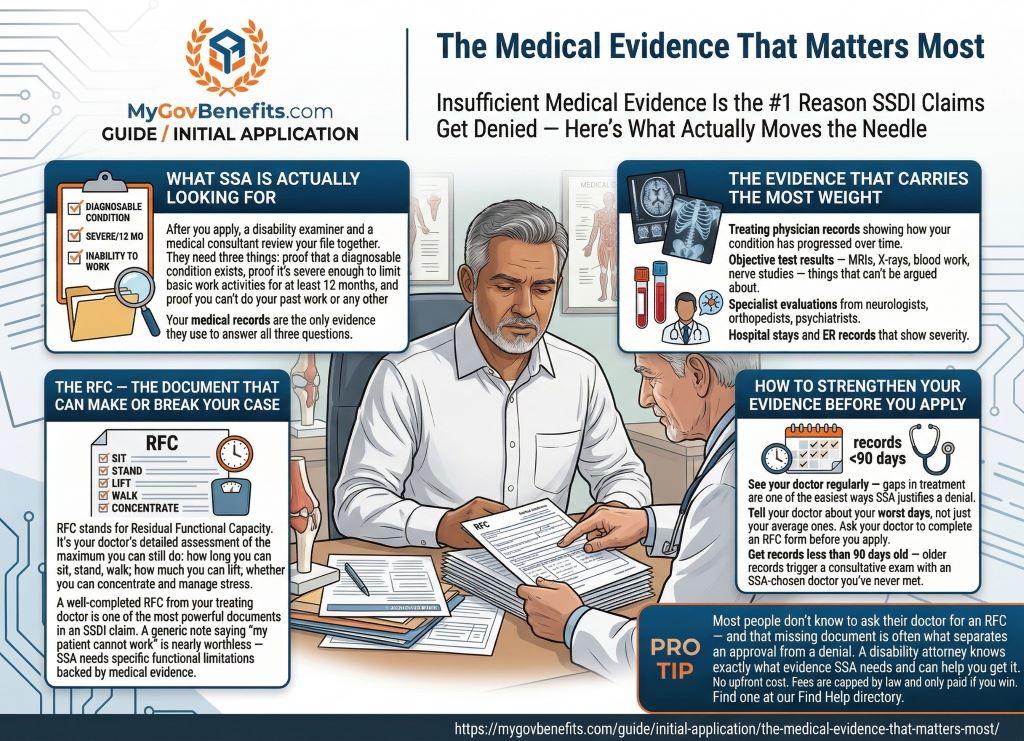
How SSA Actually Evaluates Your Medical Evidence
After you apply, your case goes to your state's Disability Determination Services (DDS). A team of two reviews it: a disability examiner (who reviews your file) and a medical consultant — a doctor or psychologist — who reviews your records. Together they decide whether your condition meets SSA's definition of disability. They're looking at three things:
Can your condition be shown through clinical and lab findings? A symptom alone (“I have pain”) isn't enough — there has to be an underlying condition a doctor has diagnosed.
Does it significantly limit basic work activities — standing, walking, sitting, lifting, concentrating, remembering — for at least 12 months?
Based on your evidence, work history, age, and education, can you do your past jobs or any other work in the national economy?
Your medical records are the evidence DDS uses to answer all three. If the evidence is thin, incomplete, or contradictory, you lose — not because you aren't disabled, but because they can't prove you are based on what's in the file.
The Evidence That Carries the Most Weight
Not all evidence is equal. Here's what matters most, ranked by how much weight SSA gives it:
Records from doctors who've treated you over time carry the most weight — they show a longitudinal picture of how your condition developed and responded to treatment.
- Office visit notes and clinical findings
- Diagnosis information and treatment plans
- What treatments were tried and whether they helped
- Observations about your symptoms, limitations, and function
The hard numbers SSA loves — things that can't be faked or argued about.
- MRIs, X-rays, and CT scans showing structural damage
- Blood work and labs confirming a diagnosis
- Nerve conduction studies / EMGs showing nerve damage
- Pulmonary function tests, cardiac stress tests, echocardiograms
- Psychological evaluations and cognitive testing
A specialist's opinion — neurologist, orthopedist, rheumatologist, psychiatrist, cardiologist — is more persuasive than a general practitioner's generic notes. If you see a specialist, make sure their records are in your file.
Records showing multiple medications tried, dosages adjusted, side effects, and ongoing symptoms despite treatment tell SSA your condition is real, managed, and still stopping you from working.
Admission records, discharge summaries, operative reports, and follow-up instructions show a condition serious enough to require acute medical care.
The Document That Can Make or Break Your Case: The RFC
RFC stands for Residual Functional Capacity — a detailed assessment of the maximum you can still do despite your limitations. SSA uses it at Step 4 and Step 5 to decide whether you can do your past work or any other work. There are two ways an RFC gets created:
DDS creates one internally
Their medical consultant fills out an RFC form from your file. These are often used to justify denials — the consultant has never examined you and may underestimate your limitations.
Your own doctor fills one out
Your treating physician knows your condition, has examined you repeatedly, and can speak to your limitations with authority. A well-completed RFC from your doctor is one of the most persuasive documents in a claim.
What a good RFC includes
- How long you can sit, stand, and walk — at one time and total over an 8-hour day
- How much weight you can lift and carry
- Your ability to reach, handle, push, pull, bend, stoop, and crouch
- For mental conditions: concentration, following instructions, interacting with others, managing stress
- References to the specific medical evidence supporting each limitation
- The doctor's opinion on whether you could maintain full-time work
"My patient cannot work" is nearly worthless.
"My patient cannot work" is nearly worthless. SSA treats that as an "issue reserved to the Commissioner" — only they get to decide if you can work. What they need is specific functional limitations supported by medical evidence. That's exactly what an RFC provides.
What Happens If Your Records Aren't Enough: The CE
If DDS can't get enough from your records, they'll schedule a Consultative Examination (CE) — a one-time exam with a doctor SSA chooses, not you.
What to know about CEs
- Typically short — 15 to 30 minutes, with a doctor who has no prior history with you
- Often basic — a routine physical or mental status exam, not a comprehensive evaluation
- Reports frequently downplay limitations, since the doctor sees you on one day — maybe not your worst
- Shows only your condition on that specific day — not how it developed over time
- You must attend — missing a CE without rescheduling can get you denied for "failure to cooperate"
The best way to avoid a CE is to provide complete, recent records upfront. If your records are detailed and less than 90 days old, DDS usually has enough. If they schedule one anyway, attend — but know your own doctor's records and RFC carry more weight than a 15-minute exam by a stranger.
Evidence Mistakes That Get Claims Denied
- Gaps in treatment — months with no visits
- Vague complaints: “I have back pain”
- One opinion with no supporting tests
- Not following your treatment plan
- Records older than 90 days
- Missing mental health documentation
- Generic note: “Patient cannot work”
- Contradictions between providers
- Consistent treatment with regular appointments
- Specific limits: “Cannot sit more than 20 minutes”
- Multiple sources: notes + tests + specialist opinions
- Documented compliance, even when treatment doesn’t fully help
- Recent records showing your current status
- Mental health records showing the combined effect
- Detailed RFC with specific functional limitations
- A consistent story across all records
How to Strengthen Your Evidence Before You Apply
- See your doctor regularly. Even if treatment isn't helping much, consistent visits build a documented trail. Gaps are one of the easiest ways for SSA to justify a denial.
- Tell your doctor everything. Bad days, pain that wakes you up, not being able to grocery shop without resting — your doctor can only document what you report.
- Include mental health. Depression, anxiety, PTSD, and cognitive issues affect your ability to work. SSA evaluates the combined effect of all impairments — get them documented.
- Follow your treatment plan. Skipping appointments or medication without a good reason lets SSA question how serious your condition is. Can't afford treatment? Document that — it's a valid reason.
- Ask your doctor for an RFC form. Schedule a dedicated appointment — don't squeeze it into a regular visit. Give them time to review your records and fill it out thoroughly.
- Get records less than 90 days old. If your most recent records are over 3 months old, SSA may order a CE instead of relying on your doctor. Visit shortly before applying.
- Don't rely on SSA to gather your records. They can request them, but it's slower, things get lost, and they may miss the full picture. Providing your own puts you in control of the story your file tells.
Frequently Asked Questions
Your state's Disability Determination Services (DDS) — a two-person team of a disability examiner and a medical consultant (a doctor or psychologist). They decide whether your condition meets SSA's definition of disability based on your file. Under the burden-of-proof rules (20 CFR § 404.1512), it's your job to provide evidence complete enough to show severity, duration, and RFC.
Residual Functional Capacity — a detailed assessment of the most you can still do despite your limitations (20 CFR § 404.1545). SSA uses it at Steps 4 and 5. Under SSR 96-8p the assessment is function-by-function across seven strength demands on a "regular and continuing basis" (8 hours a day, 5 days a week). An RFC filled out by your own treating doctor is one of the most persuasive documents you can submit.
No. SSA treats that as an "issue reserved to the Commissioner" — only they decide if you can work. They need specific functional limitations backed by medical evidence, which is what an RFC provides.
A one-time exam with a doctor SSA chooses, ordered at agency expense when your records are incomplete, outdated, or inconsistent (20 CFR §§ 404.1517–1519t). It's short (15–30 minutes) and often downplays your limitations — but you must attend, or you risk denial for "failure to cooperate." A CE is not determinative; it's one piece of evidence reviewed for adequacy.
Ideally less than 90 days old. If your most recent records are older than three months, SSA may schedule a consultative exam rather than rely on your doctor's evidence.
Your treating physician's longitudinal records and objective test results (MRIs, labs, nerve studies) carry the most in practice. For claims filed on or after March 27, 2017, SSA no longer gives any source automatic controlling weight — the two factors that matter most are supportability and consistency (20 CFR § 404.1520c). A detailed RFC and specialist opinions add significant strength on top.
What They Don't Tell You
The DDS medical consultant has never examined you
The doctor who reviews your file and helps decide your claim has never met you. They're reading notes and test results from other doctors. If those notes are vague or incomplete, the consultant fills in the gaps with assumptions — and those assumptions rarely favor you. Your own doctor's detailed RFC is the counterweight.
A consultative exam is not on your side
CEs exist to fill gaps in the record, not to build your case. The doctor performing the exam is paid by SSA, and the exam is brief. The report often says things like "patient was able to sit during the exam" — which SSA can read as "patient can sit for 8 hours." Your own records need to already tell the real story before the CE happens.
SSA gives more weight to "objective evidence" than your symptoms
Your pain is real, but pain alone — without objective findings that explain it — is hard for SSA to act on. An MRI showing disc herniation plus your complaint of radiating pain is compelling. The complaint alone, without the MRI, is not. Push for the diagnostic testing that documents what's wrong.
Mental health records are undervalued until you submit them
Many applicants leave mental health out entirely. But depression, anxiety, PTSD, and cognitive issues can be the tipping point. Even if your primary condition is physical, adding documented mental health limitations often pushes a borderline claim into approval territory — SSA weighs the combined effect of all impairments.
Your doctor's cooperation isn't guaranteed
Some doctors have "no forms" policies and won't fill out an RFC. Some will, but rush it or let you answer the questions yourself (SSA can tell when the handwriting doesn't match the signature). Schedule a dedicated appointment and explain that this is the most important document in your claim. If your doctor won't cooperate, a disability attorney can help navigate it.
SSA needs objective proof — not a doctor's say-so
SSA won't accept your symptoms, a diagnosis, or even a doctor's "he's disabled" letter as proof your condition exists — it needs objective evidence like imaging, lab work, and clinical exam findings from an "acceptable medical source." Make sure your file actually contains those test results and exam findings, not just narrative letters. Without the objective backing, SSA can treat the impairment as unestablished, no matter how supportive your doctor is. A representative can spot exactly these gaps — see Should You Get Help Before You Apply?.
A disability attorney knows exactly what to ask your doctor for — and they work on contingency: no upfront cost, a capped fee, paid only if you win. A free consultation takes about 15 minutes. Find Help Near Me
Being disabled isn't enough — your file has to prove it.
Your SSDI claim lives or dies on your medical evidence. The strongest claims have consistent treatment records from multiple sources, objective test results that confirm the diagnosis, detailed documentation of functional limitations, and — ideally — an RFC from your treating doctor that spells out exactly what you can and can't do. Don't wait for SSA to build your case for you. Gather your evidence, fill the gaps, and put the complete picture in their hands.
Next Steps: Next up is how to describe your disability in a way SSA actually understands — the words that matter, the mistakes that hurt, and how to talk about your worst days. Read Describing Your Disability.
- 20 CFR § 404.1520c — "How we consider and articulate medical opinions and prior administrative medical findings for claims filed on or after March 27, 2017" (no source gets controlling weight; supportability and consistency are the most important factors) — (source rule: 82 FR 5844, "Revisions to Rules Regarding the Evaluation of Medical Evidence"; pre-3/27/2017 claims governed by 20 CFR § 404.1527). ecfr.gov
- 20 CFR § 404.1513 — "Categories of evidence" / acceptable medical sources. ecfr.gov
- 20 CFR § 404.1545 — "Your residual functional capacity" (RFC = the most you can still do despite limitations). ecfr.gov
- SSR 96-8p — "Assessing Residual Functional Capacity in Initial Claims" (function-by-function assessment on a regular and continuing basis, 8 hours/day, 5 days/week). ssa.gov
- 20 CFR § 404.1519a — "When we will purchase a consultative examination and how we will use it" — (see also §§ 404.1517–404.1519t). ecfr.gov
- 20 CFR § 404.1520 — "Evaluation of disability in general" (five-step sequential evaluation). ecfr.gov
- 20 CFR § 404.1512 — "Responsibility for evidence" (claimant's burden to furnish evidence). ecfr.gov
- Social Security Administration — [Disability Evaluation Under Social Security (Blue Book)](. ssa.gov
- Establishing an impairment (objective medical evidence required; symptoms/diagnosis alone insufficient) & acceptable medical sources — [20 CFR § 404.1521]( and 20 CFR § 404.1502. ecfr.gov