
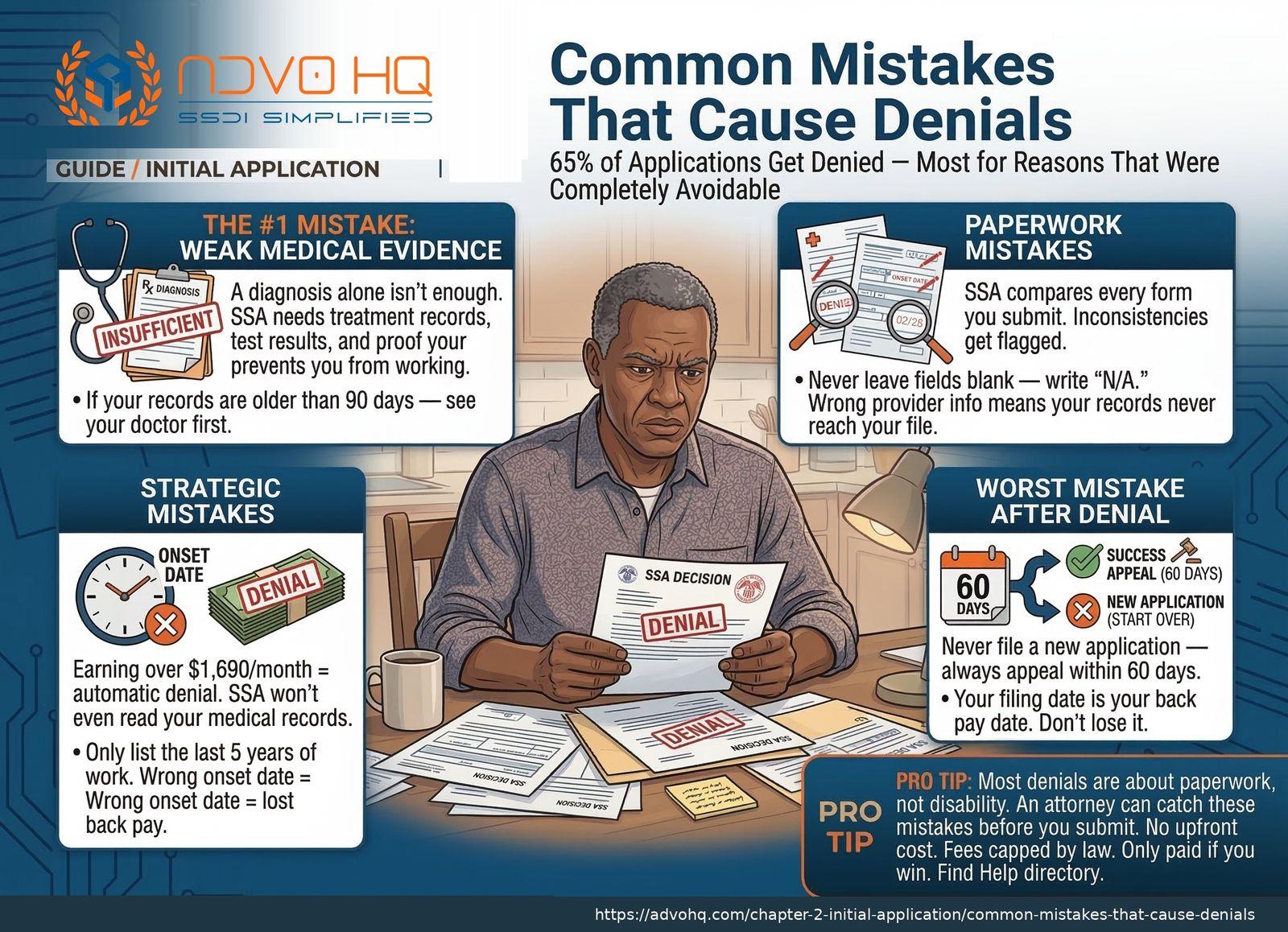
Most SSDI denials are preventable. They don't come from applicants who aren't really disabled — they come from good claims with fixable errors. Here are the 12 most common mistakes, grouped into three buckets, each with the fix.
The #1 reason for denial. Your file doesn't prove your condition is severe, has lasted 12+ months, and prevents work. A diagnosis alone isn't enough — SSA needs treatment records, test results, and documented functional limitations.
Months or years with no visits, and SSA assumes your condition improved or wasn't severe enough to treat. Gaps are one of the easiest ways for an examiner to justify a denial.
Missed appointments, unfilled prescriptions, or ignored advice make SSA question how bad your condition really is — their logic: if you were truly disabled, you'd do everything to get better.
Many applicants with physical conditions also have depression, anxiety, PTSD, or cognitive issues — but skip them. SSA weighs the combined effect of ALL impairments; a borderline physical claim plus documented mental health can flip to approval.
SSA cross-checks everything — your SSA-16, SSA-3368, Function Report, Work History Report, and third-party contact. Say you can't stand 10 minutes but cook dinner every night, and that contradiction gets flagged.
Missing forms, blank fields, wrong dates, and bad provider info cause delays and denials. The SSA-3368 alone has 11 sections — any incomplete one creates holes in your case.
After you apply, SSA or DDS may request more info, forms, or a consultative exam. Miss their timeframe (usually 10 days) and your claim can be denied for "failure to cooperate."
Earn above the SGA threshold — $1,690/month in 2026 — and SSA denies you automatically at Step 1. They don't even look at your medical evidence, no matter how severe your condition.
SSA only considers past relevant work from the last 5 years — measured back from the date SSA decides your claim, not your onset date (SSR 24-2p). Jobs from 10–15 years ago — especially desk or skilled positions — hand SSA ammunition to deny you at Step 4 or find transferable skills at Step 5.
Your alleged onset date (AOD) affects everything: when your 5-month waiting period starts, how much back pay you get, which jobs count as past work, and which records matter most. Too early or too late both cost you.
Denied applicants often file a brand-new application instead of appealing — almost always a mistake. A new claim starts over, and the next examiner sees your prior denial. An appeal keeps your original filing date and lets you address the exact reasons you were denied.
SSDI is tied to work credits, and they expire — you need 20 credits in the last 10 years. Wait too long after stopping work and your Date Last Insured (DLI) can pass. Once it does, you're locked out of SSDI entirely.
Pre-Submission Checklist
Run through this before you hit submit — tap each item as you confirm it:
Frequently Asked Questions
Roughly two-thirds of initial applications are denied — but often for preventable reasons like incomplete paperwork, missing records, treatment gaps, or bad timing, not because the person isn't disabled. A meaningful share of initial denials are "technical" (non-medical) — the applicant lacks work credits, earns above SGA, or fails another eligibility rule — so the claim never reaches a doctor's review at all. (SSA confirms technical denials occur but does not publish a single headline percentage for them.) (Per SSA's Annual Statistical Report on the SSDI Program, 2024, about 20% of all applicants are ultimately allowed at the initial level, ~2% at reconsideration, and ~7% at hearing — a share-of-all-applicants "waterfall," not per-stage grant rates — with a final award rate averaging about 29%.)
Appeal — almost always. A new application starts the process over and forfeits your original filing date, which protects your back pay. Filing a Request for Reconsideration within 60 days keeps that date and lets you submit evidence aimed at the specific reasons you were denied. See What If I Get Denied?.
Only below the Substantial Gainful Activity limit — $1,690/month in 2026 for non-blind individuals ($2,830 for blind). Earn above it and SSA denies you at Step 1 without reviewing your medical evidence. Impairment-related work expenses (IRWE) can lower your countable earnings.
Only the last 5 years — measured from the date SSA decides your claim, not from your onset date (SSR 24-2p). SSA no longer looks back 15 years. Listing older jobs — especially skilled or desk positions — can hand examiners transferable-skills arguments to deny you.
60 days from the date you receive your denial letter. SSA assumes you received it 5 days after mailing, so your real window is about 65 days from the date on the letter. Miss it and you're forced to start over — losing your filing date and potentially months of back pay.
What They Don't Tell You
The denial rate is not a reflection of your claim
Roughly two-thirds of initial applications are denied, and many of those denials are for preventable, technical reasons — not because the person isn't disabled. Incomplete paperwork, missing records, and bad timing cause more denials than weak medical cases. Avoid the 12 mistakes above and you're already ahead of most applicants.
Your denial letter is a roadmap
If you get denied, the letter tells you exactly why, using phrases like "non-severe" or "does not meet listings." These aren't vague rejections — they're specific findings you can challenge with the right evidence on appeal. Read it carefully and respond to each reason directly.
Technical denials don't even look at your medical evidence
If you lack enough work credits, earn above SGA, or fail a basic non-medical requirement, your claim is denied before a doctor ever reviews your records. These "technical denials" are 100% preventable by confirming eligibility before you file.
SSA keeps a record of previous denials
If you've been denied before and file a new application instead of appealing, the new examiner sees that history. A previous denial isn't a death sentence, but it does create an uphill battle. Appealing protects your filing date and your credibility.
The 60-day appeal window is strict — and shorter than you think
You have 60 days from receiving your denial to appeal, and SSA assumes you received the letter 5 days after mailing. So your real window is about 65 days from the date on the letter. Miss it and you're forced to start over, losing your original filing date and potentially months of back pay.
Skipping treatment can sink a valid claim — unless you document why
One of the fastest ways to sink a legitimate claim is failing to follow prescribed treatment without a good reason — SSA can deny you if you skip medications or appointments a doctor said would restore your ability to work. If cost, side effects, or fear is why you stopped, get that reason documented in your file. There are recognized "good cause" exceptions, but only if SSA actually knows about them. A representative can help you head off this and the other traps on this list — see Should You Get Help Before You Apply?.
A disability attorney reviews all of this before you submit — and works on contingency: no upfront cost, capped fee, paid only if you win. A free consultation takes about 15 minutes. Find Help Near Me
You can't control your diagnosis — but you control every one of these.
Most SSDI denials aren't about whether you're disabled — they're about whether your paperwork proves it. Every mistake on this list is avoidable. Gather complete medical records. Fill out every form accurately and consistently. Don't volunteer extra work history. Make sure you're below SGA. Respond to everything SSA sends you. And if you get denied, appeal — don't start over. The system has a high denial rate, but the people who avoid these 12 mistakes have a significantly better shot.
Next Steps: Should you get help before you apply? Should You Get Help Before You Apply? covers what a disability attorney actually does, what they cost, and how to decide if you need one.
- Substantial Gainful Activity (2026: $1,690/mo non-blind, $2,830/mo blind) — SSA, "Substantial Gainful Activity," 20 C.F.R. § 404.1574. ssa.gov
- Effect of working / SGA thresholds at Step 1 — 20 C.F.R. § 404.1571 (general effect of work) & § 404.1572 (what "substantial gainful activity" means). ecfr.gov
- Medical evidence required to prove disability — 20 C.F.R. § 404.1512 (evidence / your responsibility to submit). ecfr.gov
- Five-step sequential evaluation — 20 C.F.R. § 404.1520. ecfr.gov
- Past relevant work — 5-year look-back — SSR 24-2p; 20 C.F.R. §§ 404.1560, 404.1565; final rule 89 Fed. Reg. 27653 (eff. June 8, 2024). ssa.gov
- Impairment-Related Work Expenses (IRWE) — 20 C.F.R. § 404.1576. ecfr.gov
- Work credits / insured status (20-in-40) & Date Last Insured — 42 U.S.C. § 423(c); 20 C.F.R. §§ 404.130, 404.131. law.cornell.edu
- Appeals — reconsideration & 60-day deadline, 5-day mailing presumption — 20 C.F.R. §§ 404.900, 404.909, 404.901. ecfr.gov
- Approval/allowance rates (waterfall = shares of all applicants; ~29% final award rate) — SSA, Annual Statistical Report on the Social Security Disability Insurance Program, 2024, Sec. 4 (Table 60 / Chart 11). ssa.gov
- Statutory definition of disability & 12-month duration — 42 U.S.C. § 423(d)(1)(A); 20 C.F.R. §§ 404.1505, 404.1509.
- Need to follow prescribed treatment (with recognized good-cause exceptions) — 20 C.F.R. § 404.1530. ecfr.gov