
Personal Information & Identification
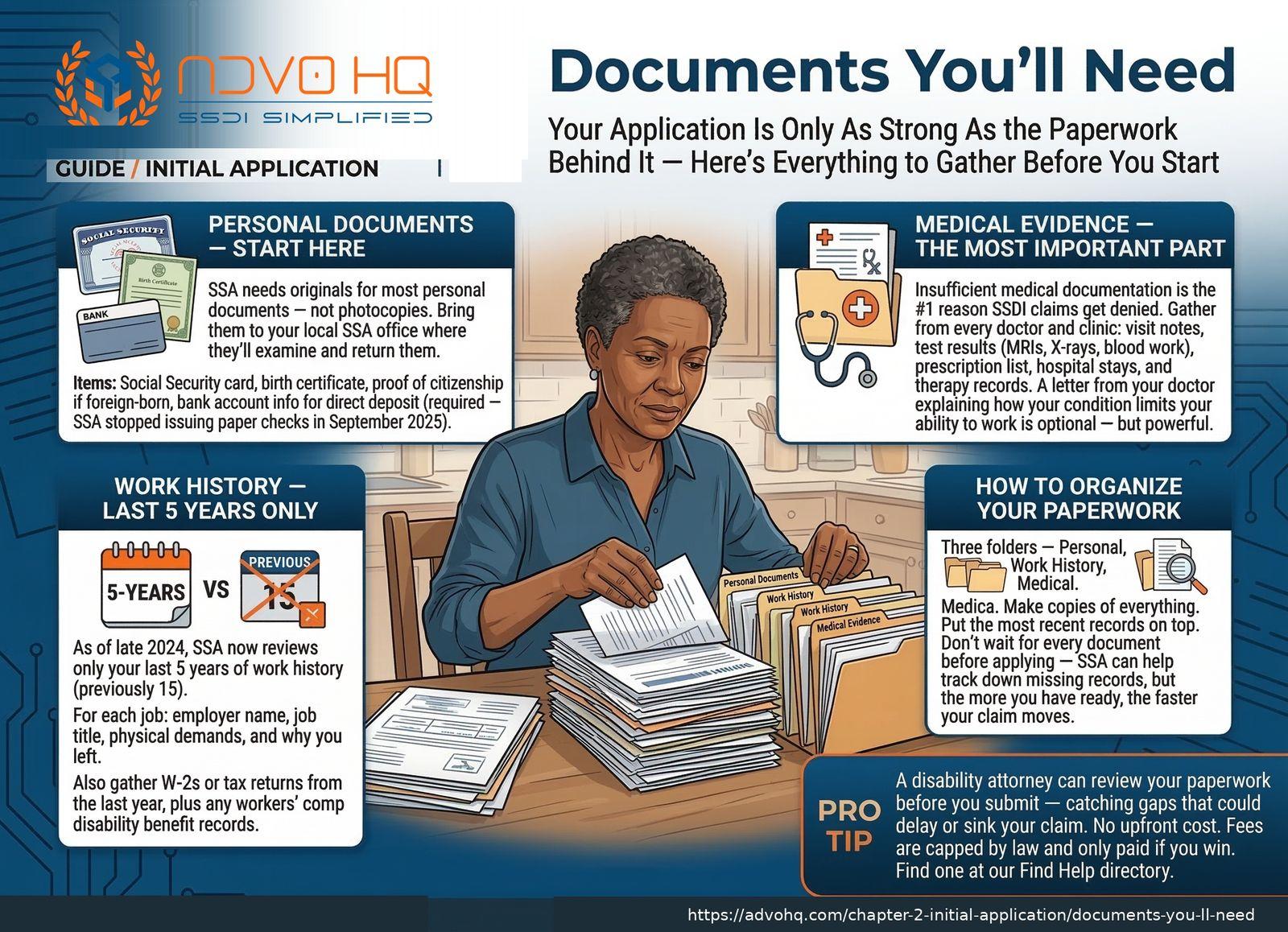
These are the basics SSA needs to confirm who you are, set up your claim, and deposit your benefits. Most of these you probably have at home — but double-check now so you're not scrambling later.
- Birth certificate
- Proof of age
- Most other identity documents
- W-2 forms
- Tax returns
- Medical records
SSA accepts photocopies of W-2s, tax returns, and medical records. But for most other documents — like your birth certificate — they need to see the original. Don't mail originals. Bring them to your local SSA office where they'll examine and return them.
Your Work History
SSA uses your work history for two things: confirming you have enough work credits to qualify, and determining whether you can still do any type of work.
SSA now reviews only your last 5 years of work — not 15
For each job in the past 5 years, have this ready:
You'll also need:
- W-2 forms or tax returns from the last year (especially important if you're self-employed)
- Workers' compensation records if you've received any short-term disability, long-term disability, or workers' comp payments
- Any other disability benefit records (VA disability, employer-provided disability, etc.)
Medical Evidence — The Most Important Part
This is where most applications succeed or fail. SSA doesn't just want to know you're sick — they need proof that your condition is severe enough to keep you from working for at least 12 months.
Insufficient medical documentation is the single most common reason SSDI claims are denied. Everything else on this page matters — but this is the part that decides most cases.
Gather all of the following from every doctor, hospital, and clinic that has treated your condition:
- A complete list of all medical conditions — physical and mental. Don't leave anything out, even conditions you think aren't "bad enough."
- Names, addresses, phone numbers, and patient ID numbers for every doctor, specialist, hospital, and clinic
- Medical records: doctor's notes, visit summaries, diagnosis information, and treatment plans
- Test results: MRIs, X-rays, CT scans, blood work, psychological evaluations, and any other diagnostic tests
- Prescription list: every medication, the dosage, and which doctor prescribed it
- Treatment and therapy records: physical therapy, counseling, rehabilitation, or ongoing treatment
- Hospital stays and ER visits: admission records, discharge summaries, follow-up instructions
- Doctor's letter (optional but powerful): a "medical source statement" explaining how your condition limits your ability to work
Records more than about 90 days old can be treated as insufficient — SSA wants a recent picture of your condition. If your most recent visit was months ago, get an updated appointment on the books before you file.
Information About Your Daily Life
SSA will also ask how your condition affects your everyday activities. This isn't a trick — they're trying to understand what you can and can't do in real life. Be ready to describe:
- How your condition affects cooking, cleaning, shopping, and caring for yourself
- How far you can walk, and how long you can sit or stand at one time
- Whether you can drive, use public transportation, or go out alone
- Your sleep patterns and how pain or symptoms affect your rest
- Any hobbies or activities you've had to give up because of your condition
You'll also need the names and contact information for two people (not doctors) who know about your condition and can speak to how it affects you — a close friend, family member, or former coworker.
The Forms SSA Will Ask You to Fill Out
When you apply, SSA will have you complete two main forms:
If you apply online, these forms are built into the application process. If you apply by phone or in person, a claims representative will walk you through them. Either way, having your documents ready before you start makes these forms much easier to complete.
How to Organize Your Paperwork
You don't need a fancy filing system. Start with three folders — physical or digital:
A few habits that pay off:
- Make copies of everything before you submit it — keep your own complete set
- Put the most recent records on top so SSA sees your current condition first
- Write down your doctors' contact info now — names, addresses, phone numbers, and patient ID numbers for every provider
- Don't wait for records to arrive before applying — SSA can help you get missing records, but the more you have ready, the faster your claim moves
Your Complete Document Checklist
Tap each item as you gather it. Your progress saves visually as you go — aim to check every box before you file.
Frequently Asked Questions
No. SSA specifically says to apply even if you don't have everything — they can help you request missing records, and delaying your application only pushes back your potential back-pay start date. Gather what you can, then file. You can supply the rest as it comes in.
They can request them, and you'll sign Form SSA-827 authorizing exactly that. But relying on SSA alone is risky: requests take time, records get lost, and the file that comes back may be incomplete. Providing your own records upfront keeps you in control of your story and speeds up the decision.
Recent matters. Evidence more than about 90 days old may be treated as insufficient, and if your file looks outdated SSA can send you to a consultative exam with one of their doctors instead of relying on yours. Keep your records current and submit the most recent ones on top.
The two core forms are the SSA-16-BK (Application for Disability Insurance Benefits) and the SSA-3368-BK (Adult Disability Report). You'll also sign the SSA-827 authorization. Online applicants complete these within the application; by phone or in person, a claims rep walks you through them.
Under SSR 24-2p (the 2024 final rule, 89 FR 27653, effective June 8, 2024), SSA now looks at "past relevant work" performed in the last 5 years — down from the old 15-year window. Listing much older jobs can actually hurt you by giving SSA work you could arguably still do, so stick to the last 5 years.
What They Don't Tell You
Insider knowledge that can make or break your application:
SSA can request your records — but you shouldn't count on it
Yes, SSA can contact your doctors for records. But it takes longer, records sometimes get lost, and SSA may not get the complete picture. Providing your own records upfront puts you in control of your own story.
Records older than 90 days may need updates
Disability practitioners commonly find that once your most recent records are more than about three months old, SSA is more likely to send you to a "consultative exam" with one of its own doctors instead of relying on yours. The 90-day mark is a practitioner rule of thumb, not a codified deadline — formally, a consultative exam is ordered to fill gaps in the record (20 CFR 404.1519a). Those exams are often brief; practitioners frequently describe them as lasting only about 15 minutes, and the reports don't always capture your limitations fully.
The "Function Report" is a trap if you're not careful
SSA will ask you to fill out a form about your daily activities — cooking, cleaning, shopping, hobbies. If you write "I do laundry" without explaining that it takes you 3 hours and you need breaks every 10 minutes, SSA reads it as "this person can do laundry." Always describe your worst days, not your best.
Don't list more than 5 years of work history
Some websites and even SSA employees still reference the old 15-year rule. As of SSR 24-2p (2024 final rule, effective June 8, 2024), only the last 5 years matter. Listing a desk job from 12 years ago gives SSA ammunition to argue you could still do that work.
Mental health records matter just as much as physical
Depression, anxiety, PTSD — if these conditions affect your ability to work, include them. Many people leave mental health off their application because of stigma. SSA considers the combined effect of all your conditions, and mental health documentation can be the thing that tips your claim from denied to approved.
List every provider on your SSA-827 — even the long shots
The SSA-827 you sign is a blanket authorization — it lets SSA request records from every provider you list. So list ALL of them: hospitals, therapists, clinics, and doctors you saw only briefly or years ago, even if you can't get the records yourself. SSA generally only pulls records from the sources you actually name, so a provider you leave off is evidence the examiner never sees. When in doubt about whether to bring in help gathering it all, see Should You Get Help Before You Apply?.
Your SSDI application tells a story—and your documents are the evidence.
Your SSDI application tells a story — and your documents are the evidence. The stronger and more complete your paperwork, the harder it is for SSA to deny your claim. Gather your personal documents, organize your last 5 years of work history, and most importantly, get every medical record you can. Describe your daily limitations honestly, focusing on your worst days. Don't wait for everything to be perfect before applying, but don't rush it either.
Next Steps: Ready to file? Choosing How To Apply walks you through the three ways to apply — online, by phone, or in person — and which one is best for your situation.
- 20 C.F.R. § 404.1512 — Responsibility for evidence. ecfr.gov
- 20 C.F.R. §§ 404.1517–404.1519t — Consultative examinations at SSA expense. ecfr.gov
- 20 C.F.R. § 404.1509 — Duration requirement (impairment must last or be expected to last 12 months). ecfr.gov
- 20 C.F.R. § 404.1520c — How SSA considers medical opinions (supportability and consistency; no controlling weight to any opinion for claims filed on/after March 27, 2017). ecfr.gov
- Past Relevant Work = 5-year window: "Intermediate Improvement to the Disability Adjudication Process," 89 Fed. Reg. 27653 (Apr. 18, 2024), effective June 8, 2024; SSR 24-2p; 20 C.F.R. §§ 404.1560, 404.1565. federalregister.gov
- Form SSA-16-BK — Application for Disability Insurance Benefits. ssa.gov
- Form SSA-3368-BK — Adult Disability Report. ssa.gov
- Form SSA-827 — Authorization to Disclose Information to SSA. ssa.gov
- Attorney/representative fee cap — 25% of past-due benefits or $9,200, whichever is less (eff. Nov. 30, 2024): 42 U.S.C. § 406(a)(2); 20 C.F.R. § 404.1720; "Maximum Dollar Limit in the Fee Agreement Process," 89 Fed. Reg. (May 10, 2024) [2024-10248]. ssa.gov
- Social Security Administration — Apply for Disability Benefits. ssa.gov
- Social Security Administration — Adult Disability Checklist. ssa.gov
- SSA-827, Authorization to Disclose Information to SSA (blanket authorization — name every provider). ; POMS DI 11005.056 (completing the SSA-827). ssa.gov