
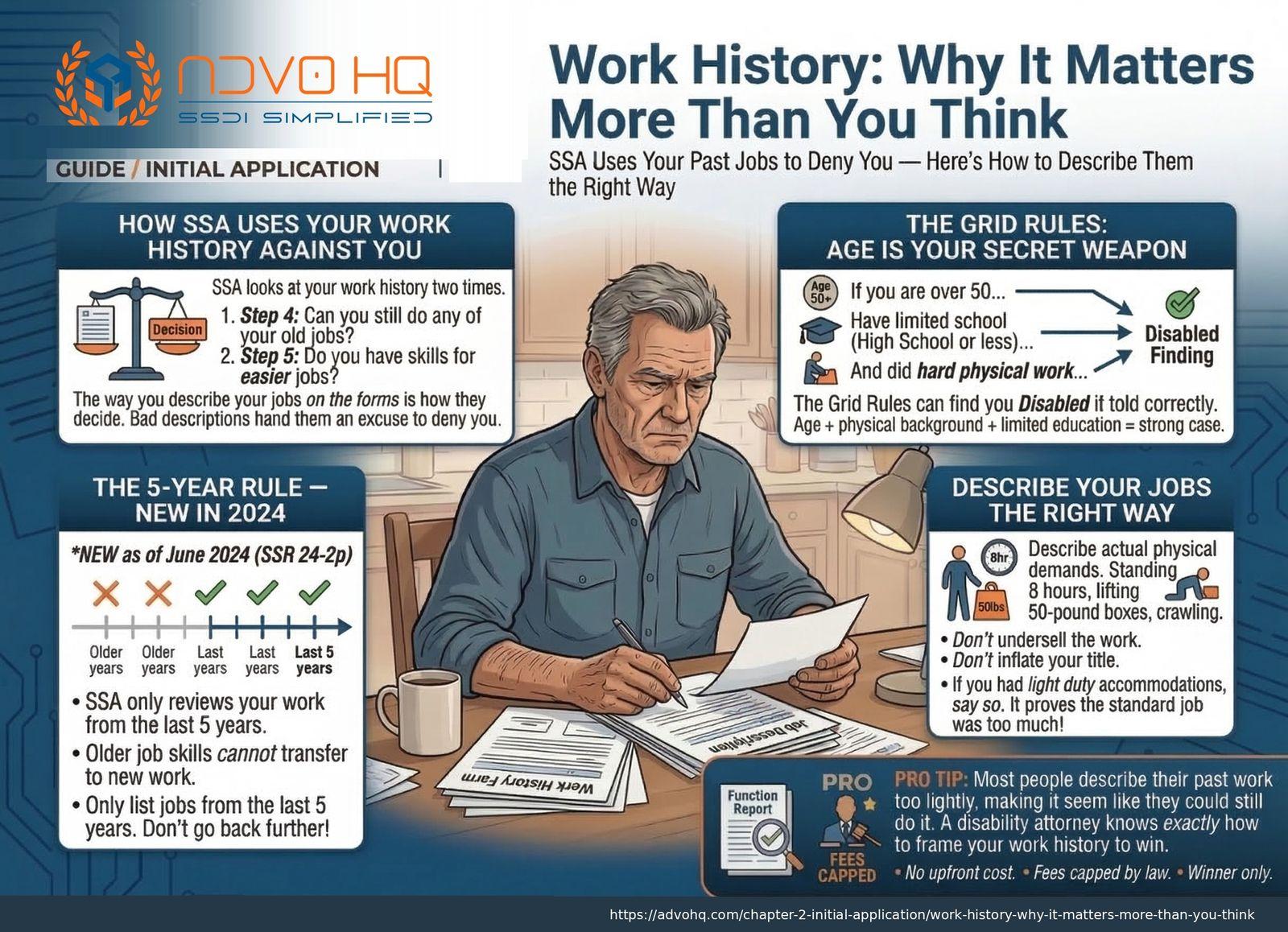
How SSA Uses Your Work History Against You
SSA's 5-step evaluation uses your work history at two critical decision points — Step 4 (can you do your past work?) and Step 5 (can you do any other work?). How your jobs are described directly shapes both answers.
The 5-Year Rule: A Major Change in Your Favor
Until recently, SSA looked at all jobs from the last 15 years when evaluating past relevant work. As of 2024, that window shortened to 5 years — a huge benefit for applicants.
Why it matters: if you had a desk job 8 years ago but did physical labor for the last 5, SSA can no longer point to that desk job and say "you could still do that." Skills from older jobs fall outside the window and are no longer "transferable." If you've only done physical, unskilled work recently, SSA has fewer options to find other work you're "capable" of.
Only list jobs from the last 5 years.
Only list jobs from the last 5 years. You are not required to go further back — and doing so can hurt you by giving SSA more ammunition to deny your claim. Every job you list is a potential reason for denial.
What Counts as "Past Relevant Work"
Not every job counts as past relevant work (PRW). To qualify, a job must meet all four of these:
You did the job within the five years ending on the date SSA decides your claim — not measured from your alleged onset date.
You worked it long enough to learn how to do it. A few weeks at a job you never mastered doesn't count.
You earned above the SGA threshold ($1,690/month in 2026). Part-time or below-SGA work doesn't qualify.
You actually performed real duties. Being on payroll but not actively working doesn't count.
If a past job doesn't meet all four, SSA shouldn't count it as PRW. The fewer qualifying past jobs you have, the fewer options SSA has at Step 4 to deny you.
Skill Levels: Why They're a Big Deal
SSA sorts every job into one of three skill levels. Your level determines whether SSA can argue you have "transferable skills" that would let you do different work:
an electrician's knowledge might "transfer" to a desk job like estimator or inspector. A warehouse worker has no specialized skills to transfer — and that works in your favor. The fewer transferable skills you have, the stronger your case at Step 5.
The Grid Rules: Age + Work History = Your Secret Weapon
If SSA agrees you can't do your past work, they use the Medical-Vocational Guidelines — the "Grid Rules" — to decide whether other work exists for you. The Grid combines four factors: your RFC, age, education, and work experience. Where you land can direct a finding of "disabled" or "not disabled."
How age changes everything:
How education factors in:
if you're between 49 and 64, have a high school education or less, and have worked physical or unskilled jobs for the last 5 years, the Grid Rules can work strongly in your favor — if your work history is described correctly.
How to Describe Your Past Jobs the Right Way
The Work History Report (SSA-3369) asks you to describe your past jobs in detail. Every answer feeds SSA's decision about your skill level, physical demands, and transferable skills. Here's how to get it right:
- Describe the actual physical demands: Standing 8 hours, lifting 50-pound boxes, crawling under equipment — say so. Don't describe a lighter version. The heavier your past work, the harder it is for SSA to say you can still do it.
- Don't inflate your skill level. A warehouse worker who loaded trucks is unskilled — not “logistics management.” A delivery driver is semi-skilled — not a fleet planner. Use plain language matching what you actually did.
- Explain your accommodations. If you kept your job for a while because your boss let you take extra breaks, work from a dark room, or avoid heavy lifting — explain that. This is called a “special accommodation,” and it prevents SSA from thinking you can do that job normally anywhere else.
- Include all physical activities. For each job: walking, standing, sitting, lifting, carrying, bending, reaching, climbing — hours per day, weight, and how often. This directly builds your RFC comparison.
- Mention supervisor duties carefully. Supervising workers can get a job classified as skilled. If your “supervision” was just being the senior person on a crew with no real management, make that clear.
- Only list 5 years of work. SSA only considers work in the five years ending on the date it decides your claim (or your date last insured, if your insured status has lapsed). Don’t volunteer older history — every job you list is a potential reason for denial.
Frequently Asked Questions
Five years, as of the 2024 final rule (down from 15). The window is the five years ending on the date SSA decides your claim (or your date last insured, if your insured status has lapsed) — not measured from your alleged onset date. Only list jobs from that window — going further back just gives SSA more to work with.
It has to meet all four tests: recent (within the last 5 years), lasted long enough for you to learn it, performed at the SGA level ($1,690/month in 2026), and involving real work duties. Miss any one and SSA shouldn't count it as PRW.
Your skill level determines whether SSA can argue you have transferable skills. Unskilled work is best for your claim — there's nothing to transfer. Skilled work is the most harmful, because SSA can point to less physical jobs your skills might fit.
Under the Grid Rules, older age helps. At 50–54 with a sedentary RFC and unskilled past work, the Grid often directs "disabled." At 55 and up with no transferable skills, you're very likely to win. Under 50 is the hardest group.
The Work History Report, form SSA-3369. It asks you to describe each past job's duties and physical demands in detail — and every answer feeds SSA's skill-level and transferable-skills analysis.
No. Inflating your title or skill level only makes it easier for SSA to argue you can do other work. Describe each job in plain language, exactly as you actually performed it.
What They Don't Tell You
A strong work record strengthens how SSA weighs your symptoms
Federal courts have long held that "a claimant with a good work record is entitled to substantial credibility when claiming an inability to work." SSA no longer uses the word "credibility" — under SSR 16-3p, adjudicators evaluate the consistency of your reported symptoms with the overall record rather than judging your character — but a steady lifetime of work is exactly the kind of evidence that supports that consistency finding. It tells the judge you'd work if you could, not that you're looking for a handout.
If you leave out details, the examiner fills them in — against you
List "administrative assistant" with no duties and the DDS examiner assumes the standard version: computer skills, scheduling, filing, all transferable to a desk job. Spell out what you actually did, or SSA's assumptions will favor denial.
Every extra job you list is more ammunition
Each job is a potential past-relevant-work match. List a desk job from four years ago and, if your RFC allows sedentary work, SSA can deny you at Step 4. Only list the last 5 years.
Your job title doesn't matter — your duties do
SSA classifies work by what you actually did, not your title. A "field supervisor" who spent eight hours a day digging trenches did physical labor, not management. Describe the work, not the label.
The 5-year window is measured back from the date SSA decides your claim — not from your onset date
Under SSR 24-2p, the past-relevant-work period is generally the five years ending on the date of the determination or decision (the date of adjudication) — not your alleged onset date. In a Title II claim where your insured status has already lapsed, the period instead ends on your date last insured. Either way, it is never measured from onset, so the window keeps sliding toward the present while your claim is pending. Practically: if SSA decides your claim in 2026, it looks at work you did in roughly 2021–2026, regardless of when your onset was.
SSA now tests you on 5 years of work — not 15
Thanks to a 2024 rule change, SSA now looks only at the work you did in the last 5 years — not the old 15 — when deciding whether you can return to "past relevant work," and jobs you held fewer than 30 days no longer count at all. That means an old career you can't do anymore may no longer help or hurt you. So describe your recent jobs' physical and mental demands carefully, because those are the ones SSA will test you against. A representative can make sure you don't describe them in a way that hands SSA an easy denial — see Should You Get Help Before You Apply?.
A disability attorney knows exactly how to classify your past work and apply the Grid Rules to your profile — and they work on contingency: no upfront cost, capped fee, paid only if you win. A free consultation takes about 15 minutes. Find Help Near Me
Describe your past work honestly, heavily, and only 5 years back.
Your work history isn't just background information — it's one of the most powerful tools SSA uses to decide your claim. Every job you list, every duty you describe, and every skill you mention feeds directly into the decision. For people 49 to 64 with physical work backgrounds, the combination of the new 5-year rule, the Grid Rules, and a carefully described work history can be the difference between approval and denial. Describe the physical reality of your jobs. Don't inflate skills or titles. And only go back 5 years.
Next Steps: Ready to sidestep the errors that sink claims? Read Common Mistakes That Cause Denials.
- 20 C.F.R. §§ 404.1560, 404.1565 — Past relevant work; work experience as a vocational factor (5-year look-back). ·. ecfr.gov
- 89 Fed. Reg. 27653 (Apr. 18, 2024) — "Intermediate Improvement to the Disability Adjudication Process, Including How We Consider Past Work" (final rule reducing the PRW period from 15 to 5 years; effective June 8, 2024). federalregister.gov
- Social Security Ruling SSR 24-2p — Titles II and XVI: How We Evaluate Past Relevant Work (5-year period). ssa.gov
- 42 U.S.C. § 423(c)(1) — Insured-status / work-credit requirement (20 credits in the 40-quarter period), and 20 C.F.R. § 404.130 (Rule I). ·. law.cornell.edu
- 20 C.F.R. § 404.1520 — Five-step sequential evaluation of disability. ecfr.gov
- 20 C.F.R. Pt. 404, Subpt. P, App. 2 — Medical-Vocational Guidelines (Grid Rules); Tables 1 & 2 and § 200.00 (rules directing "disabled"/"not disabled," including 201.12, 201.14, 201.27, 202.01, 202.02). ecfr.gov
- Social Security Ruling SSR 16-3p — Evaluation of Symptoms in Disability Claims (consistency of symptoms; SSA no longer assesses "credibility"). ssa.gov
- Social Security Administration — Substantial Gainful Activity (2026: $1,690/mo non-blind). ssa.gov
- Social Security Administration — Form SSA-3369, Work History Report. ssa.gov
- Jobs held fewer than 30 days excluded from past relevant work; SSA plain-language explainer of the 2024 change — SSA blog (2024-06-26), (companion to Final Rule 89 Fed. Reg. 27653, effective June 8, 2024). ssa.gov