
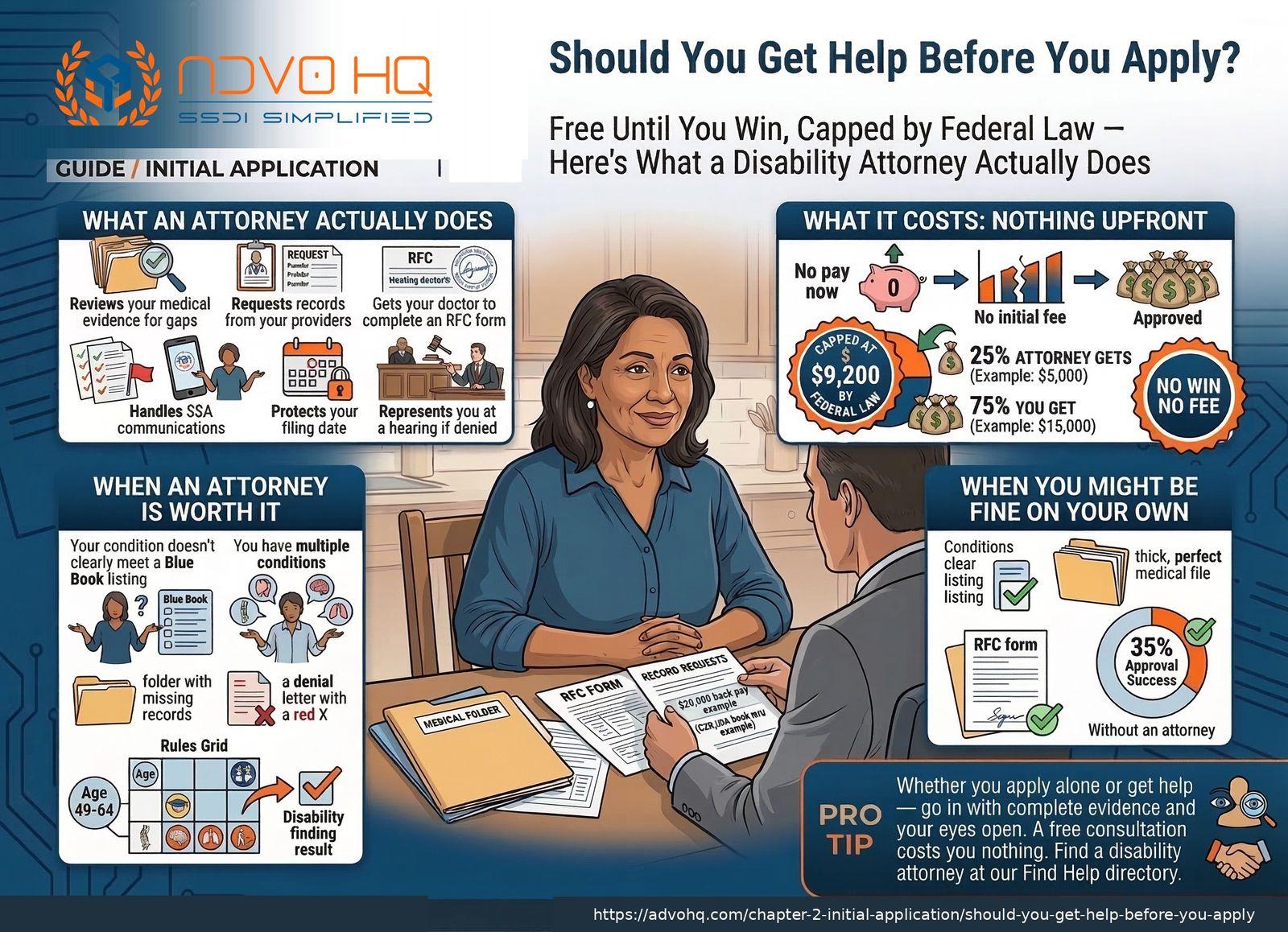
What a Disability Attorney Actually Does
A lot of people think hiring an attorney means handing off the whole process and waiting for a check. It doesn't work like that. What an attorney does is make sure your application tells the strongest possible story — and that you don't make the mistakes that get claims denied.
- Reviews your medical evidence for gaps — they know what DDS examiners look for and can spot missing records and weak areas before you submit.
- Helps gather medical records — they contact your providers directly and make sure everything reaches SSA complete and on time.
- Works with your doctors — they know how to request an RFC form from your treating physician and guide them on the limitations SSA needs documented.
- Reviews your forms for inconsistencies — SSA-16, SSA-3368, Function Report, Work History Report — making sure nothing contradicts your records or onset date.
- Applies the Grid Rules to your case — analyzing how age, education, work history, and RFC interact to build the most favorable strategy.
- Handles communications with SSA — no more missed deadlines, confusing letters, or accidentally saying the wrong thing on a follow-up call.
- Represents you on appeal — files within the 60-day deadline, submits new evidence, and represents you before an Administrative Law Judge if it goes to a hearing.
- Protects your filing date — so you don't lose months or years of back pay by missing deadlines or filing a new application when you should have appealed.
What It Actually Costs: The Contingency Fee
Here's the part most people don't realize: you pay nothing upfront. Federal law requires disability attorneys to work on contingency.
- How it's paid — SSA withholds the fee directly from your back pay and pays the attorney. You never write a check.
- Monthly benefits — The fee comes only from back pay. It does not touch your ongoing monthly SSDI payments.
- Additional costs — Some firms charge small expenses for record retrieval. Most reputable firms cover these and only collect if you win.
Say SSA approves your claim with $20,000 in back pay. Your attorney receives 25% = $5,000. You receive $15,000, plus your ongoing monthly benefits. For very large back-pay awards, the fee stops at the $9,200 federal maximum rather than continuing at 25% — so on a $50,000 award the fee is capped at $9,200, not $12,500.
When You Might Not Need an Attorney
To be fair, not every claim needs representation. You may be able to handle it yourself if:
You may be fine on your own if…
- Your condition clearly meets a Blue Book listing (ALS, certain cancers, organ transplants)
- You have extensive, recent, well-documented records from multiple sources
- Your treating doctor will complete an RFC form and actively supports your claim
- You're comfortable with complex government forms and consistent, detailed answers
- You have the time and energy to track deadlines and manage the process yourself
If all of those are true, you may be fine applying on your own — especially since you're studying the process right now. About 35% of initial applications are approved without attorney involvement.
When You Should Seriously Consider One
An attorney becomes significantly more valuable when:
Your condition doesn't clearly meet a listing
Most approved claims don't — they win through medical-vocational allowances where the Grid Rules, RFC, age, and work history interact. An attorney knows how to navigate this.
You have multiple conditions
SSA weighs the combined effect of all impairments. An attorney knows how to present physical and mental conditions together for the strongest case.
Your records have gaps or your doctor won't help
An attorney can fill evidence gaps, request RFC forms from alternative sources, and work around "no forms" policies.
You have a complicated work history
Skilled or semi-skilled jobs in the last 5 years can create transferable-skill arguments. An attorney keeps your descriptions from handing SSA that opening.
You've already been denied
Appealing? An attorney is almost always worth it — they read the denial, submit targeted new evidence, and represent you at a hearing.
You're overwhelmed by the process
Dealing with a disability is hard enough. If the paperwork and deadlines are causing stress, that's exactly what attorneys handle.
You're between 49 and 64
This is where the Grid Rules become most favorable — but only if applied correctly. An attorney can build a case around your vocational profile.
Attorney vs. Advocate vs. Non-Attorney Rep
You'll see different titles in the SSDI world. Here's the difference:
Disability Attorney
A licensed lawyer specializing in Social Security disability law. Can represent you at every level, including federal court.
When to use: Complex cases, appeals, and hearings — the full process from initial application through federal court.
Disability Advocate
A non-lawyer authorized by SSA to represent claimants, often employed by disability firms or non-profits.
When to use: Initial applications and reconsiderations. Cannot represent you in federal court.
Non-Attorney Rep
Similar to an advocate; must be registered with SSA and follows the same fee rules.
When to use: Straightforward claims — but confirm they have specific SSDI experience, not just general legal knowledge.
All three types work under the same federal fee rules: 25% of back pay, up to a federal maximum of $9,200, paid only if you win. The key difference is that only a licensed attorney can take your case to federal court if all administrative appeals are exhausted.
How to Choose the Right Attorney
Disability law is its own world. Look for someone who focuses on Social Security disability — not a personal-injury lawyer doing it on the side.
Most reputable disability attorneys offer one. If someone wants to charge for the first conversation, keep looking.
25% of back pay, capped at $9,200, no upfront cost. Ask about extra expenses and whether they front them.
An attorney who knows your local DDS office and the ALJs in your region has a real advantage.
Ask how they reach you (phone, email, portal) and how quickly they typically respond.
The best outcomes come from attorneys who get involved at the initial application — not only at the hearing level.
Questions to Ask During a Free Consultation
Come prepared with these:
- How many SSDI cases do you handle per year?
- Do you get involved at the initial application stage or only at appeals?
- Will I work directly with you or with a paralegal / case manager?
- How do you communicate with clients, and how quickly can I expect a response?
- Do you front costs for medical records, or will I be billed separately?
- What is your fee structure, and are there any costs beyond the standard contingency fee?
- How do you work with my doctors to get RFC forms and medical opinions?
- What do you see as the strengths and weaknesses of my case?
- How long do you expect the process to take?
- What happens if my initial claim is denied — do you handle the appeal?
Frequently Asked Questions
Nothing upfront. Representatives work on contingency: they collect a fee only if you win, and it comes out of your back pay — not your ongoing monthly benefits. The fee is 25% of your past-due benefits, up to a federal maximum of $9,200 (effective November 30, 2024).
No. If your claim is denied and you recover no back pay, you owe no attorney fee. The most you might be billed is small out-of-pocket costs like medical-record retrieval, and most reputable firms front those and only collect if you win.
You can hire at any stage, including before you file. Getting help at the initial application stage means your claim is built correctly from day one — which is usually cheaper and faster than fixing a denied claim on appeal.
Both can represent you through SSA's administrative levels — initial application, reconsideration, and the ALJ hearing — under the same fee rules. Only a licensed attorney can take your case to federal court if every administrative appeal is exhausted.
Not necessarily. If your condition clearly meets a listing and your records are complete and recent, many people succeed on their own. Representation adds the most value when approval depends on a medical-vocational allowance rather than a clean listing match. When You Should Seriously Consider One covers when it's most worth bringing someone in.
What They Don't Tell You
You can hire an attorney at any stage
You don't have to wait for a denial. You can bring someone in before you even file. Getting help at the initial application stage means your claim is built correctly from day one — significantly cheaper and faster than fixing a denied claim on appeal.
The fee is capped by federal law — not by the attorney
Every disability representative in the country is subject to the same rule: 25% of back pay, up to a federal maximum of $9,200, and SSA must approve every fee. No reputable attorney can charge you more. If someone asks for money upfront or promises a fee above the cap, that's a red flag.
An attorney doesn't guarantee approval
No one can — and it's worth being clear about what the evidence actually shows. A 2017 GAO report (GAO-18-37) found that represented claimants were allowed at higher rates than unrepresented ones, but that's a correlation, not proof that representation turns a denial into an approval. The most rigorous study to date (NBER Working Paper 29871, 2022) found that representation mainly speeds awards and reduces appeals — it did not change the ultimate probability of being awarded benefits. What an attorney does is make sure your evidence is complete, your forms are accurate, and your case is presented in the most favorable light. They can't change your medical condition — but they can change how it's documented and presented, and help you get there faster and with fewer rounds of appeal.
The cost of NOT having help can be measured in time
A denied claim means months of waiting for an appeal hearing, potential loss of back pay to missed deadlines, and added stress during a period when you're already dealing with a disabling condition. Representation is associated with faster decisions and fewer trips through the appeals process — which is where much of the delay, and much of the lost back pay, comes from.
The dollar cap is $9,200 — and it changes only when SSA raises it
The current federal maximum is $9,200, effective November 30, 2024 (up from $7,200). The percentage — 25% of back pay — never changes. The dollar ceiling is not tied to an automatic annual cost-of-living adjustment: SSA raises it only when it chooses to and publishes a notice at that time, so always confirm the current figure in your fee agreement rather than assuming it has gone up.
You can appoint a rep on day one — not just after a denial
You can appoint a representative from day one — you don't have to wait until you're denied. Representatives generally work on contingency, and their fee is capped by federal law: under the fee-agreement process the cap is currently $9,200 (raised from $6,000, effective November 30, 2024), paid only out of your back pay if you win. Getting help at the application stage can head off the very mistakes that trigger denials in the first place — an inconsistent onset date, a thin RFC, or a work-history description that hands SSA a transferable-skills argument. If you've already been denied, representation is almost always worth it for the appeal.
Contingency means no upfront cost, a capped fee, and payment only if you win. Find Help Near Me
Cost isn't the deciding factor — complexity is.
Getting help with your SSDI application isn't about admitting you can't do it alone. It's about making sure a complex, high-stakes process goes right the first time. The application has dozens of forms, specific evidence requirements, strategic decisions about what to include, and deadlines that can cost you months of benefits if you miss them. A disability attorney works for free until you win, is fee-capped by federal law, and specializes in exactly the kind of case you're filing. Whether you apply on your own or get help, go in with your eyes open and your evidence ready.
Next Steps: Ready to submit? What Happens After You Apply walks through the timeline, the waiting, and what SSA is doing with your claim while you wait.
- Social Security Act, Title II — 42 U.S.C. § 406(a)(2) (fee-agreement process; 25% of past-due benefits, subject to the maximum dollar limit). law.cornell.edu
- 20 C.F.R. § 404.1720 (fees for representation before SSA). ecfr.gov
- Federal Register — "Maximum Dollar Limit in the Fee Agreement Process," 89 FR (May 10, 2024), doc. 2024-10248 (raises cap to $9,200 effective November 30, 2024). federalregister.gov
- Federal Register — "Maximum Dollar Limit in the Fee Agreement Process — Partial Rescission," 90 FR (May 6, 2025), doc. 2025-07813 (leaves the $9,200 cap unchanged; ends the commitment to publish annual notices). federalregister.gov
- Social Security Administration — "Fee Agreements". ssa.gov
- Social Security Administration — "Appointed Representatives" (getting help with your claim). ssa.gov
- Evaluation of medical opinions (no controlling weight; supportability and consistency) — 20 C.F.R. § 404.1520c. ecfr.gov
- SSA, Annual Statistical Report on the Social Security Disability Insurance Program, 2024 (approval/allowance shares of all applicants). ssa.gov
- U.S. Government Accountability Office, Social Security Disability: Additional Measures and Evaluation Needed to Enhance Accuracy and Consistency of Hearings Decisions, GAO-18-37 (2017) (represented claimants allowed at higher rates — a correlation, not a causal effect). gao.gov
- Hoynes, Maestas & Strand, Legal Representation in Disability Claims, NBER Working Paper 29871 (2022) (representation speeds awards and reduces appeals but does not change the ultimate probability of an award). nber.org
- Appointing a representative from the start — Form SSA-1696, Appointment of Representative, ; fee-agreement cap $9,200 (eff. Nov. 30, 2024), 89 FR 40318 / Fed. Reg. doc. 2024-10248, ; 42 U.S.C. § 406(a). ssa.gov