
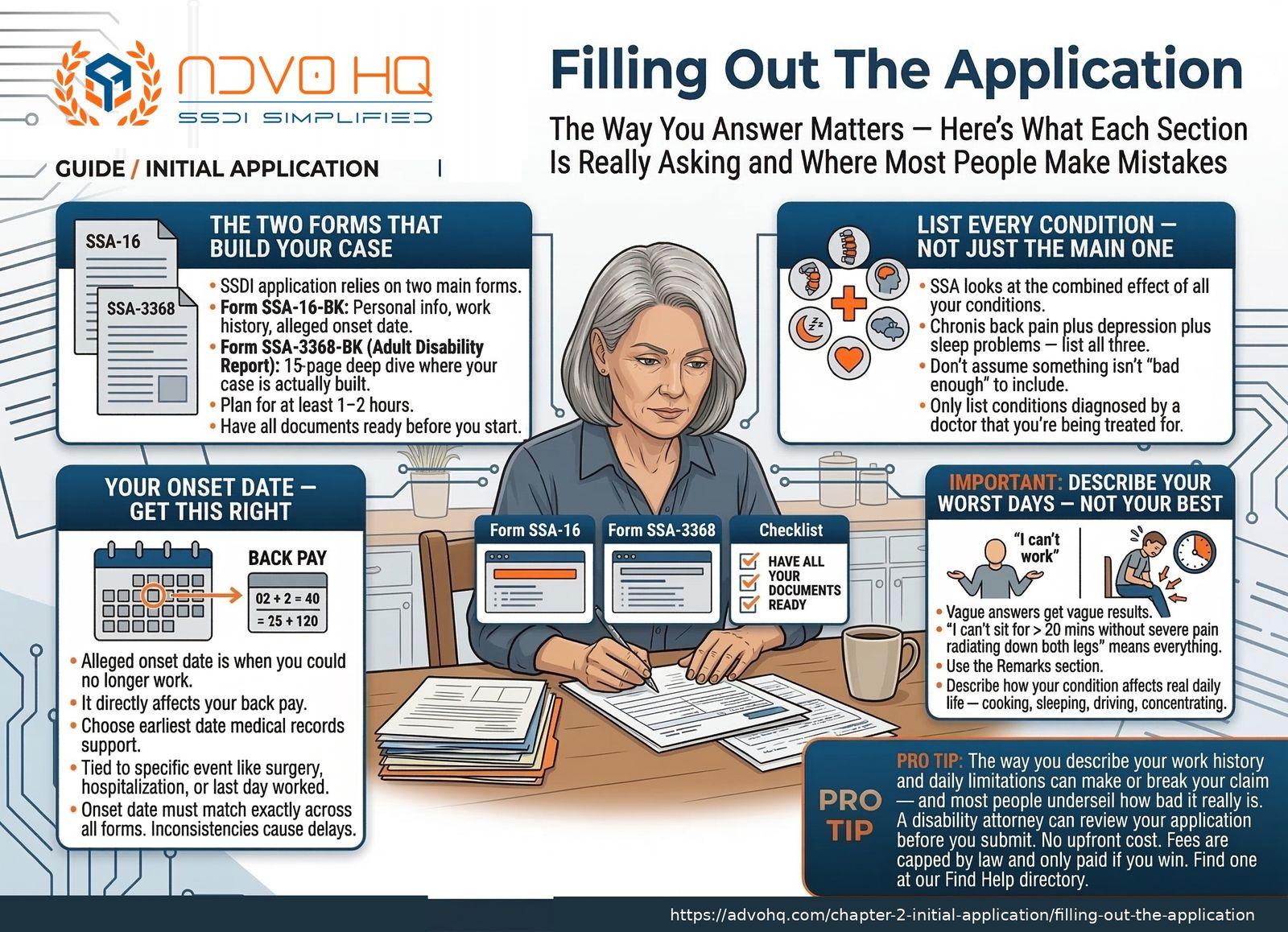
The Two Forms That Make Up Your Application
Whether you apply online, by phone, or in person, your application boils down to two forms:
If you apply online, both forms are built into one continuous application. If you apply by phone or in person, the representative walks you through them. Either way, plan for at least 1–2 hours, and have all your documents from Article 2 ready before you start.
Form SSA-16-BK: The Main Application
This form is straightforward, but there are a few spots where people trip up. Here's what each section asks — and what to watch for:
Personal Information
Name, date of birth, Social Security number, contact info, and citizenship status.
Watch out: Everything must match your Social Security card exactly — a misspelled name or wrong SSN will delay your claim.
Marriage & Family
Your current spouse, former spouses, and dependent children. They may qualify for benefits on your record — minor children (under 16) or a spouse caring for them could receive monthly payments if you're approved.
Watch out: Don't leave blank lines — write “None” if something doesn't apply.
Work & Earnings
Your current and recent employment — employer names, dates, and earnings. Self-employed applicants provide tax return info. This is just the current and prior year; your full history goes on the SSA-3368.
Disability Dates
Q18a asks if you're still unable to work; Q18b asks the date you became unable to work — your alleged onset date (AOD), which directly affects your back pay.
Watch out: This is critical. Pick a date tied to a specific event and the earliest your records support (see below).
Workers' Comp & Pensions
Whether your condition is work-related (workers' comp coordination) and whether you receive a pension from work not covered by Social Security.
Watch out: If you only worked regular U.S. jobs and paid Social Security taxes, most of this won't apply to you.
Banking Information
Your bank's routing number and account number for direct deposit. As of September 2025, SSA no longer issues paper checks to new beneficiaries.
Watch out: Double-check every digit — a wrong one sends your payments to the wrong place.
Your onset date is money — choose it carefully.
This is critical. Question 18a asks if you're still unable to work because of your conditions. Question 18b asks the date you became unable to work. This is your alleged onset date (AOD) — and it directly drives your back pay. Pick a date that's tied to a specific event: the day you quit your job, had surgery, or were hospitalized. Choose the earliest date your medical records support.
Form SSA-3368-BK: The Adult Disability Report
This is where your case is really built. The SSA-3368 runs about 15 pages across 11 sections, and what you provide here is what the Disability Determination Services (DDS) examiner uses to decide your claim. Take your time with this one.
- Your InformationName, SSN, contact info, and a third-party contact who knows about your condition
- Your Disabling ConditionAll conditions — physical and mental — that limit your ability to work
- Contact PersonName and number of someone (not a doctor) who knows about your limitations
- Work ActivityWhen you stopped working, why, and your onset date
- Education & TrainingHighest grade completed, plus any specialized training or certifications
- Work HistoryJob titles, duties, and physical demands for the last 5 years
- MedicationsEvery medication: dosage, reason, and prescribing doctor
- Medical TreatmentEvery doctor, hospital, and clinic — with dates and contact info
- Medical TestsAny tests: MRIs, X-rays, blood work, psychological evals, etc.
- Other InfoSSI-specific questions (skip if only applying for SSDI)
- RemarksOpen space to add anything that didn't fit elsewhere
The Sections That Matter Most
Your Disabling Conditions
List every condition that affects your ability to work — not just the main one. SSA looks at the combined effect of all your conditions. Chronic back pain and depression and sleep problems? List all three. Don't assume something isn't “bad enough.”
Use plain language. If you don't know the medical term, describe it — “severe lower back pain that shoots down my left leg” works fine. You don't need to be a doctor.
Only include conditions that have been diagnosed and that you're being treated for. Listing undiagnosed or untreated conditions can hurt your case — SSA may question why you're not seeking treatment.
Work Activity & Your Onset Date
This asks when you stopped working and why. If you stopped because of your condition, say so. If you were laid off and your condition worsened after, explain that clearly.
Your onset date must match across all forms — the date on the SSA-16 must be the exact same date on the SSA-3368. Inconsistencies raise red flags and cause delays.
If your employer gave you accommodations before you stopped — lighter duties, extra breaks, reduced hours — mention it. SSA needs these details because they aren't visible in your earnings record.
Work History
SSA uses your work history to decide whether you can still do any of your past jobs. Under the current rule, they review the last 5 years only.
Describe each job's physical and mental demands: lifting, standing, walking, sitting, bending, reaching — the heaviest weight and how often. Describe the job as actually performed, not the title. A “secretary” who also moved boxes has a very different physical profile than one who only typed.
If your past jobs sound too easy, SSA may decide you can still do them. If you had multiple jobs in the last 5 years, SSA may send a separate Work History Report (SSA-3369) for more detail.
Medications, Treatments & Tests
Section 7 (Medications): Every medication — prescription and over-the-counter — with name, dosage, reason, and prescriber. Not sure why something was prescribed? Write “unsure.” Your pharmacy can print a complete list.
Section 8 (Medical Treatment): The most time-consuming section. Name, address, phone, patient ID, and treatment dates for every provider. If SSA can't find your providers, they can't get your records — and your claim stalls.
Section 9 (Medical Tests): Every test — MRIs, X-rays, CT scans, blood work, nerve studies, psych evals — with who ordered it and when. These results are the hard evidence behind your claim.
Remarks — Don't Skip This
This open-ended section is your chance to tell SSA what doesn't fit anywhere else. Use it. Describe how your condition affects daily life — your worst days, needing to lie down for three hours every afternoon, medication that makes you too drowsy to concentrate.
Be specific. “I can't work” means nothing. “I can't sit for more than 20 minutes without severe pain radiating down both legs” means everything.
Other Forms SSA May Send You
After you submit the SSA-16 and SSA-3368, SSA may ask you to complete more forms:
When SSA sends you additional forms, respond within 10 days. Delays on your end cause delays on their end, and your claim can sit in limbo for weeks or months.
Frequently Asked Questions
Two: the SSA-16-BK (Application for Disability Insurance Benefits) and the SSA-3368-BK (Adult Disability Report). You'll also sign the SSA-827, which authorizes SSA to request your medical records. Online, all of this is folded into one continuous application; by phone or in person, a representative walks you through it.
It's the date you say you became unable to work, and it directly drives your back pay — SSDI can pay retroactive benefits for up to 12 months before your application date, but only if your onset date reaches back that far and your medical records support it. Because the 5-month waiting period also applies, an onset date up to about 17 months before you file is what captures the full 12 payable months. Pick the earliest date your records can back up.
Yes. You can amend your alleged onset date during the claim, but starting with the right one — tied to a specific event and supported by records — saves time and avoids inconsistencies.
They may. A spouse and your children can each receive up to 50% of your primary insurance amount (PIA) as auxiliary benefits if your claim is approved. Your spouse qualifies at age 62 or older, or at any age while caring for your child who is under 16 (or disabled). Children generally qualify while unmarried and under 18 (or 19 if a full-time secondary-school student), or 18+ if a disability began before age 22. Total payments to your family are subject to a family maximum. For how these auxiliary amounts and the family maximum are figured, see How Much Will I Get Paid?. List them on the SSA-16 even if you're unsure.
Respond within 10 days. Common follow-ups are the SSA-3369 (Work History Report), SSA-3373 (Function Report), SSA-827 (records authorization), and SSA-3380 (third-party Function Report). Delays on your end stall the whole claim.
What They Don't Tell You
The DDS examiner won't read between the lines
The person reviewing your claim is looking at dozens of cases. They read what you wrote, not what you meant to write. If you say "I have trouble walking" instead of "I can't walk more than 50 feet without stopping to rest because of pain in both knees," you've given them a reason to check "can walk." Be specific. Be detailed. Describe your worst days.
Inconsistencies between forms will flag your case
If your onset date on the SSA-16 says March 2025 but your SSA-3368 says June 2025, that's a problem. If you say you stopped working because of your condition on one form but list "layoff" on another, that's a problem. Review your forms side by side before submitting.
Listing too many jobs hurts you
SSA only looks at the last 5 years of work now (SSR 24-2p). If you list a sedentary desk job from 8 years ago, SSA might use that to argue you could still do sedentary work. Only list what's required.
Your education level matters more than you think
SSA uses your education to determine whether you could be trained for other work. If you're over 50 with limited education and physical limitations, you're more likely to qualify under the "grid rules." Mark the highest grade you completed — not the highest grade you started.
"I can do laundry" could cost you benefits
On the Function Report, if you write "I do laundry" without explaining that it takes you 4 hours with multiple rest breaks, SSA reads it as "this person can handle regular activity." Every answer about daily activities needs context: how long it takes, how often you rest, and what happens when you push through.
List every condition — SSA must weigh them combined
List every medical condition you have — even minor or seemingly "unrelated" ones — because SSA is legally required to consider the combined effect of all your impairments together, not just your worst one. A back problem plus depression plus diabetes can add up to disabling even when no single condition would qualify on its own. But that only works if each condition is actually written on your application. If you want help making sure nothing gets left off, see Do I Need a Lawyer or Advocate?.
Most disability attorneys work on contingency: no upfront cost, a capped fee, paid only if you win. A free consultation takes about 15 minutes. Find Help Near Me
Take your time, be specific, keep your dates consistent.
The SSDI application is long, but it's not complicated once you know what each section is asking for. The key is preparation: have your documents ready, keep your dates consistent across all forms, describe your conditions in specific and detailed language, and don't downplay your limitations. The DDS examiner can only work with what you give them. Give them everything.
Next Steps: Next comes the evidence that decides your claim. Read The Medical Evidence That Matters Most to learn what SSA actually looks for and why a doctor's records can make or break your case.
- Social Security Administration — [Apply for Disability Benefits](. ssa.gov
- Social Security Administration — [Form SSA-16-BK, Application for Disability Insurance Benefits](. ssa.gov
- Social Security Administration — [Form SSA-3368-BK, Disability Report — Adult](. ssa.gov
- Social Security Administration — [Form SSA-827, Authorization to Disclose Information to SSA](. ssa.gov
- Social Security Administration — [Form SSA-3369-BK, Work History Report](. ssa.gov
- Social Security Administration — [Form SSA-3373-BK, Function Report — Adult](. ssa.gov
- 20 C.F.R. § 404.1512 — Responsibility for evidence. ecfr.gov
- Past relevant work window reduced from 15 years to 5 years — 89 Fed. Reg. 27653 (Apr. 18, 2024), effective June 8, 2024; SSR 24-2p; [20 C.F.R. § 404.1560](; 20 C.F.R. § 404.1565. ecfr.gov
- Spouse's benefit (up to 50% of PIA; entitled at 62+ or while caring for the worker's child under 16 or disabled) — 42 U.S.C. § 402(b)–(c); [20 C.F.R. § 404.330](. ecfr.gov
- Child's benefit (up to 50% of PIA; unmarried and under 18, or 19 if a full-time secondary student, or a disabled adult child whose disability began before age 22) — 42 U.S.C. § 402(d); [20 C.F.R. § 404.350](; [20 C.F.R. § 404.367](. ecfr.gov
- Family maximum, disability (85% of AIME, floored at the PIA, capped at 150% of the PIA) — 42 U.S.C. § 403(a); [20 C.F.R. § 404.403(a)](. ecfr.gov
- Combination of impairments (SSA must consider the combined effect of all impairments) — [20 C.F.R. § 404.1523](. ecfr.gov