
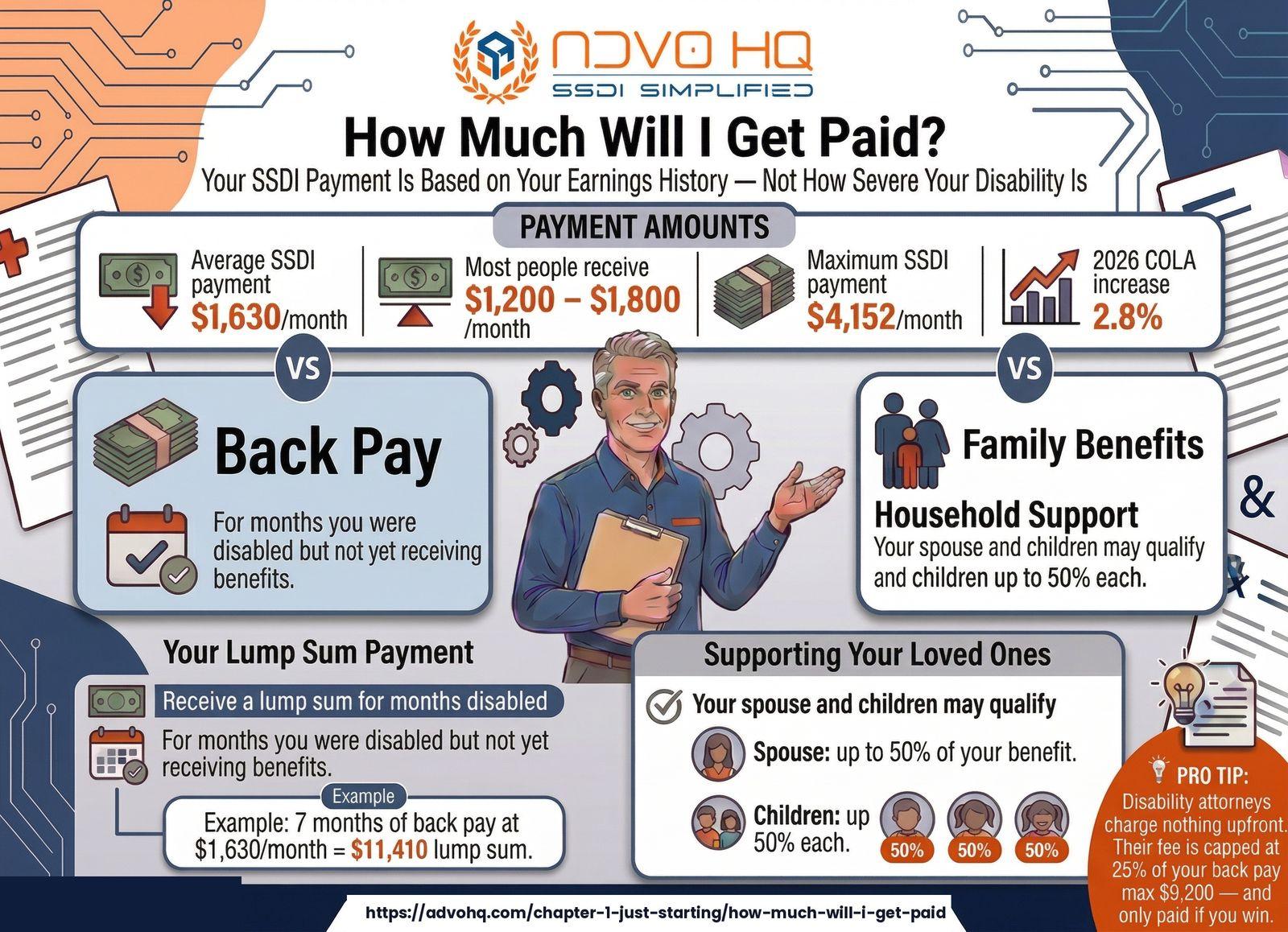
SSDI Payment Amounts (2026)
Most people receiving SSDI in 2026 get somewhere between $1,200 and $1,800 per month. Here's where that number comes from — and why the maximum is much rarer than SSA's headline figure suggests.
The maximum payment ($4,152) is rare — only people who earned high incomes and paid maximum Social Security taxes for 35+ years reach that level.
How Your Benefit Is Calculated
SSA uses a three-step formula. The math is intentionally progressive — lower earners replace a higher percentage of their previous income than higher earners do.
SSA pulls your full earnings history and selects your 35 highest-earning years. If you worked fewer than 35 years, the missing years count as $0 — which drags your average down.
Past earnings are adjusted for wage growth to reflect today's dollars. The result is your Average Indexed Monthly Earnings (AIME) — the number the formula runs on.
SSA applies a tiered formula using bend points to produce your Primary Insurance Amount (PIA) — your base monthly benefit. The 2024 formula:
Create a free "my Social Security" account at ssa.gov. Your statement shows an estimate based on your actual earnings.
Family Benefits
When you qualify for SSDI, certain family members can also receive monthly payments based on your earnings record — without affecting your own benefit amount.
The disability family maximum is capped at 85% of your AIME — but never less than your PIA and never more than 150% of your PIA. If you have multiple dependents, their individual amounts may be reduced to stay within the cap.
What Can Reduce Your Payment
- Workers' compensation: If you receive workers' comp or other public disability benefits, SSA reduces SSDI so the combined total doesn't exceed 80% of your pre-disability earnings.
- Government pension offset: Pensions from government jobs not covered by Social Security (some federal, state, local positions) can reduce your benefit.
- Medicare Part B premium: After 24 months on SSDI, Medicare kicks in. The 2026 Part B premium of $174.70/month is typically deducted directly from your benefit check.
Private long-term disability insurance, VA disability benefits, and SSI payments don't affect your SSDI amount.
Back Pay: The Lump Sum You May Receive
If approved, you don't just get benefits going forward. You also receive back pay for every month you were disabled but hadn't started receiving payments yet.
If You Qualify for SSI Instead
SSI payments are a flat federal rate — not based on your work history. Amounts are lower, and your income and living situation can reduce them further.
SSDI (2026)
- Average: $1,630/month
- Maximum: $4,152/month
- Based on your lifetime earnings record
- Family members may also receive benefits
- Not reduced by private insurance or VA benefits
SSI (2026)
- Individual: $994/month
- Couple (both eligible): $1,491/month
- Flat federal rate — not based on earnings
- Some states add a supplement
- Reduced by other income and free room/board
Frequently Asked Questions
Yes. Create a free "my Social Security" account at ssa.gov and open your Social Security Statement. It shows an estimated benefit based on your actual earnings record — the closest number to what you'd actually receive.
No. Your monthly amount is based on your earnings history, not the severity of your disability. The only routine increase is the annual cost-of-living adjustment (2.8% in 2026).
It depends on how long approval takes. Back pay equals your monthly benefit times the number of payable months from your first payable month through approval. Quick approvals mean little or no back pay; cases that take 18 months to several years can produce lump sums of $19,000 to $45,000+ at typical benefit levels.
Sometimes. If your combined income tops $25,000 (single) or $32,000 (married filing jointly), up to 50–85% of your benefits can be federally taxable. Many recipients with no other income owe nothing.
Your SSDI automatically converts to Social Security retirement at full retirement age (67 for most people). The amount stays the same — same check, different label. You don't reapply.
Usually within about 60 days of approval, paid as a lump sum. If you used a representative, the SSA-approved fee (25% of back pay, capped at $9,200) is deducted before you receive the balance. Learn more in Do I Need a Lawyer or Advocate?.
What They Don't Tell You
Insider knowledge that can make or break your application:
Your benefit is the same as your retirement benefit
SSDI pays what you would have received at full retirement age. When you reach retirement age, your SSDI automatically converts — same check, different label.
Severity doesn't affect payment
Whether your disability is "worse" than someone else's doesn't matter. A person with severe limitations and low earnings will get less than someone with moderate limitations and high earnings.
Back pay can be substantial
If you're approved and your case took 2 years (not uncommon), you could receive $30,000+ in back pay — though the actual amount varies with your benefit rate and onset date. This is why attorneys work on contingency — they get paid from this lump sum.
Attorney fees are capped
Disability attorneys can charge 25% of your back pay, up to a maximum of $9,200 in 2026. They only get paid if you win.
COLA increases happen every year
Your benefit automatically adjusts for inflation. In 2026, the increase was 2.8%. Over time, these add up significantly.
Your benefit is sized to your earnings, not your illness
Your check comes from your lifetime covered earnings (your AIME), not the severity of your disability — so two people with the same illness can be approved for very different amounts. Get your real number before you apply: your free my Social Security account at ssa.gov/myaccount shows a personalized disability-benefit estimate based on your actual record. That figure lets you plan for the 5-month unpaid waiting period and decide whether you'll also need to apply for SSI.
Your SSDI payment is based on your earnings history — not how severe your condition is.
Your SSDI payment is based on your earnings history — not how severe your condition is. Most people receive between $1,200 and $1,800 per month, though it can go higher. On top of monthly payments, you may receive a lump sum in back pay for the months you waited, and your spouse and children may qualify for additional benefits on your record.
Next Steps: Ready to file? Read How Do I Apply for SSDI? to learn the three ways to apply and what documents you'll need before you start.
- 20 C.F.R. §§ 404.211–404.212 — AIME/PIA computation. ecfr.gov
- SSA, Primary Insurance Amount (90/32/15 benefit formula). ssa.gov
- SSA, "my Social Security" (personalized disability benefit estimate) — ; SSA, "Benefits Planner: Disability". ssa.gov
- SSA, Benefit Formula Bend Points ($1,286 / $7,749 for 2026). ssa.gov
- SSA, 2026 Social Security Changes / COLA Fact Sheet (2.8% COLA; avg $1,630; max $4,152; SSI $994 individual / $1,491 couple). ssa.gov
- 20 C.F.R. § 404.403 — family maximum (disability family maximum = 85% of AIME, floor PIA, ceiling 150% of PIA). ssa.gov
- CMS, "2026 Medicare Parts A & B Premiums and Deductibles" (standard Part B premium $202.90/month, 2026; released Nov. 14, 2025). cms.gov
- 42 U.S.C. § 424a; 20 C.F.R. § 404.408 — workers' compensation / public disability offset (combined benefits capped at 80% of average current earnings).
- 20 C.F.R. § 404.315(a)(4); 42 U.S.C. § 423(c)(2) — five-month waiting period.
- 20 C.F.R. § 404.621(a)(1) — retroactive/back pay (up to 12 months before filing, net of waiting period).
- 42 U.S.C. § 406(a)(2); 20 C.F.R. § 404.1720; Fed. Reg. 2024-10248 — representative fee cap (25% of past-due benefits, capped at $9,200, effective Nov. 30, 2024).
- 26 U.S.C. § 86; IRS Publication 915 — taxation of benefits ($25,000 single / $32,000 MFJ base amounts).
- Social Security Act, Title II — 42 U.S.C. §§ 401–434.
- SSA — Disability Benefits. ssa.gov