
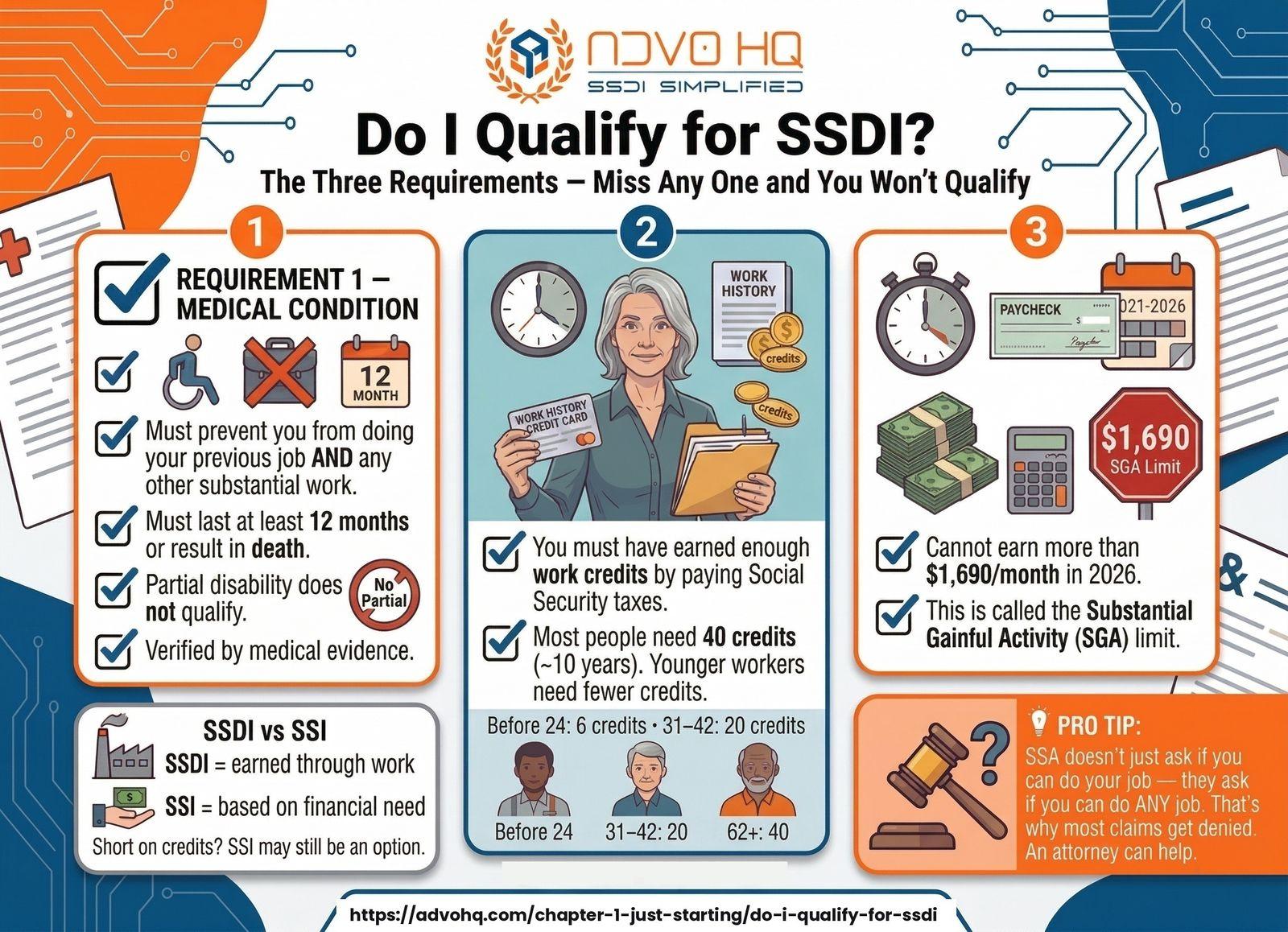
There are exactly three gates between you and SSDI benefits. Social Security doesn't grade on a curve — you either meet the requirements or you don't. The good news: most people who are genuinely unable to work can clear all three. The bad news: the details matter a lot.
You paid into Social Security through your job. SSA needs to verify that before paying out benefits.
Your condition must prevent all substantial work for at least 12 months — not just your current job.
If you're earning above SSA's Substantial Gainful Activity threshold, the claim stops there.
Requirement #1: Work Credits
SSDI is earned through work. Every time you pay Social Security taxes, you earn "work credits." In 2026, you get one credit for every $1,890 you earn, up to 4 credits per year.
Most people need 40 credits (about 10 years of work) to qualify — but the exact number depends on your age when you become disabled. Younger workers need fewer credits.
For a deeper look at how credits are calculated, how to check yours online, and what to do if you're short, see How Work Credits Work.
You also need "recent" work credits — usually 20 credits (5 years) earned in the 10 years before your disability began. For a deeper look at how credits are calculated, how to check yours online, and what to do if you're short, see How Work Credits Work.
Requirement #2: A Qualifying Medical Condition
Social Security uses a strict, all-or-nothing definition of disability. Partial disability doesn't count — if you can still do some kind of work, even a completely different job than before, SSA may deny your claim.
Prevents all substantial work
Not just your previous job — any job that exists in the national economy given your age, education, and experience.
Lasts 12 months or more
Must be expected to last at least one continuous year, or be expected to result in death. Short-term conditions don't qualify.
Medically documented
Verified by objective medical evidence from licensed doctors, hospitals, or clinics. Your personal statement alone is not enough.
We'll cover qualifying conditions in detail in the next article: What Medical Conditions Qualify?
Requirement #3: Income Below the Limit
If you're earning too much, Social Security assumes you're able to work — regardless of your medical condition. This earning cap is called Substantial Gainful Activity (SGA).
If you earn more than $1,690 per month while applying, SSA will deny your claim at Step 1 of their review — before even looking at your medical records.
This limit applies to countable earnings. Certain disability-related work expenses can be deducted from gross pay before the comparison is made.
Frequently Asked Questions
You may still qualify for SSI (Supplemental Security Income), which is based on financial need rather than work history — but it comes with strict limits ($2,000 in resources for an individual). SSI uses the same medical definition of disability as SSDI. If your SSDI benefit is low, you might even qualify for both at once ("concurrent benefits").
Social Security must consider the combined effect of all your medically determinable impairments together, not just each one in isolation. You don't need a single "qualifying" diagnosis — what matters is whether your conditions, taken as a whole, keep you from working at the SGA level for at least 12 months.
Wages are measured against the $1,690/month SGA limit, but self-employment is evaluated differently. Social Security looks at your net earnings after business expenses, plus factors like the hours you work and the value of your services to the business — not just the dollars you take home.
It can. Social Security's rules recognize that it's harder for older workers to adjust to new types of work. Once you reach age 50, the "medical-vocational guidelines" make it progressively easier to be found disabled, especially if you're limited to lighter or sedentary work.
Possibly — as long as your earnings stay below the $1,690/month SGA limit (2026). But be careful: even part-time work can be used as evidence that you're able to work, so it may weaken your case. Certain disability-related costs (Impairment-Related Work Expenses) can be subtracted from your earnings when SGA is calculated. Can I Work While Applying or Receiving SSDI? covers the earnings rules in detail.
What They Don't Tell You
The things that trip up otherwise eligible applicants:
There's no such thing as "partial" SSDI
You're either fully disabled or you're not. If Social Security thinks you can do any kind of work — even part-time, even a desk job — they can deny your claim.
Your diagnosis alone won't qualify you
Social Security uses a 5-step evaluation process. Having a condition on their list helps, but they also look at how it limits your ability to work — not just what it's called.
Apply even if you're not sure you qualify
There's no penalty for applying and being denied. But waiting too long can cost you back pay and even cause you to lose your insured status when your Date Last Insured passes.
SSI can be a backup plan
If you don't have enough work credits for SSDI, you may still qualify for SSI based on financial need. You can even apply for both at the same time.
Prove your disability began before your Date Last Insured
Qualifying isn't only about being disabled now — you have to prove your disability began on or before your Date Last Insured (DLI), the date your work-credit coverage runs out. If you stopped working years ago, your DLI may already be in the past, which means you'd have to show you were disabled back then, using older records. Find out your DLI first — it quietly controls whether you can qualify at all. How Work Credits Work shows how to look yours up.
Three requirements. All three. No exceptions.
SSDI eligibility comes down to three things: enough work credits, a medical condition that prevents all work for at least 12 months, and income below the SGA limit ($1,690/month in 2026). Miss any one of the three and you won't qualify. If you're short on work credits, SSI may be an option — but it comes with strict income and asset limits.
Next Steps: Not sure if you have enough work credits? Read How Work Credits Work to check — it's free and takes five minutes at ssa.gov.
- Social Security Administration — 2026 COLA Fact Sheet
- Social Security Administration — Disability Benefits Overview
- Social Security Act, Title II — 42 U.S.C. §§ 401–434