
The Review Process: Who Does What
Your application moves through two separate agencies with two separate jobs. Understanding who does what helps you know where your case is — and what they're actually looking for.
Social Security Administration (SSA)
Handles everything outside the medical determination:
- Verifies your identity
- Confirms your work credits
- Checks you're not earning above SGA ($1,690/mo)
- Routes your file to DDS for medical review
Disability Determination Services (DDS)
A state agency fully funded by the federal government:
- Disability examiner reviews your medical records
- A contracted doctor reviews the file (never meets you)
- Applies the 5-step evaluation to your case
- Issues the approval or denial decision
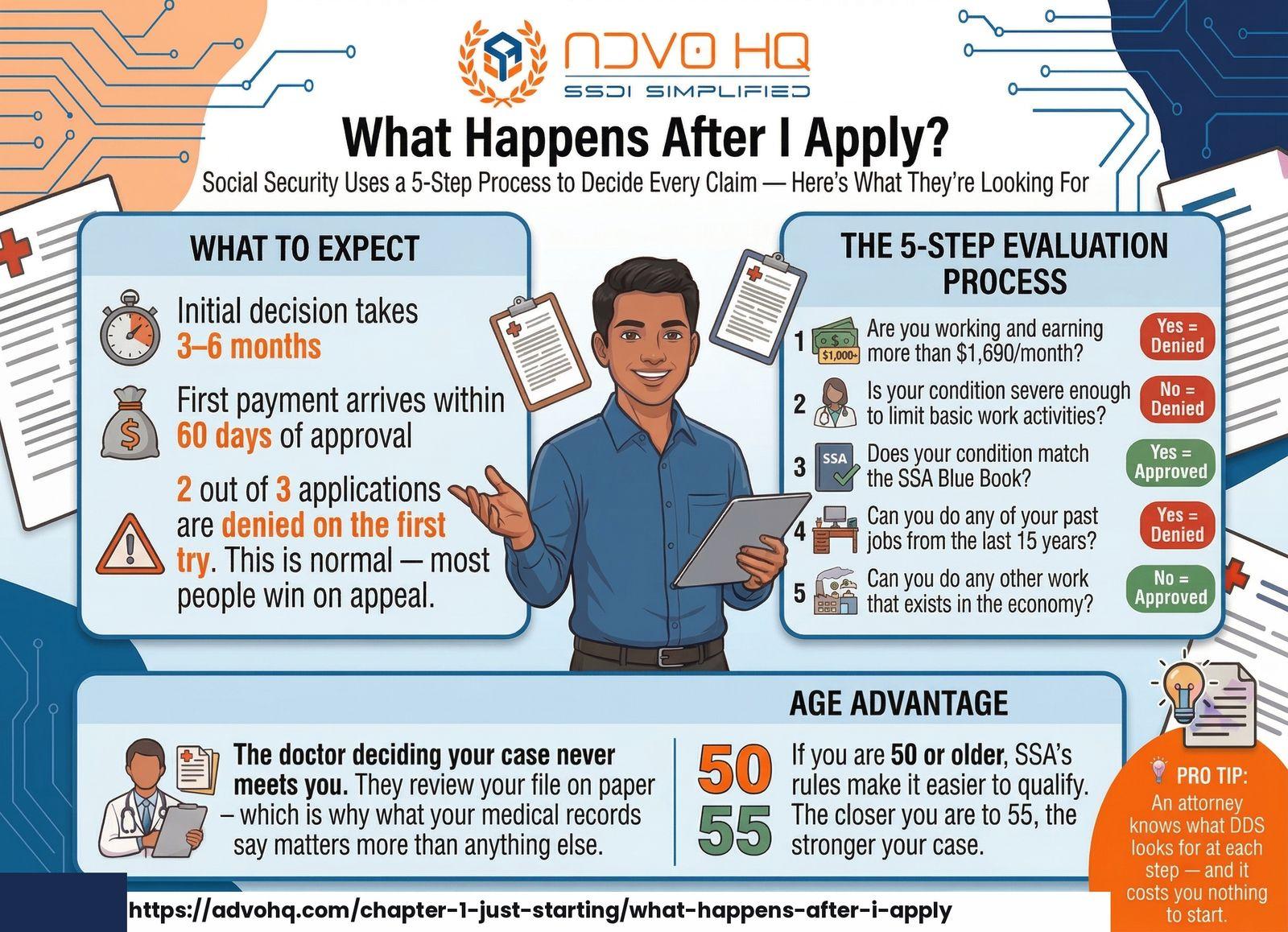
The 5-Step Evaluation Process
DDS evaluates every SSDI claim in the same sequence. Your application can be approved or denied at any step — the process stops the moment a determination can be made.
Most claims are decided at Step 4 or 5, not Step 3. Even if your condition doesn't "meet a listing," you can still be approved if you can't do your past work or any other work.
Your Residual Functional Capacity (RFC)
At Steps 4 and 5, DDS builds an RFC — a detailed profile of what you can still do despite your condition. This becomes the foundation for comparing your abilities against job requirements.
- How long you can sit, stand, or walk
- How much you can lift or carry
- Whether you can bend, stoop, climb, or reach
- Mental abilities: concentration, following instructions, dealing with stress
- Environmental limits: heat, cold, noise, hazards
DDS then compares your RFC to your past jobs and to jobs that exist in the national economy. Your age, education, and work experience all factor in — older applicants (50+) with limited education often have an easier path to approval under SSA's grid rules.
Consultative Examinations
If DDS doesn't have enough medical evidence, they may schedule you for a consultative examination (CE) with a contracted doctor.
Free to You
Social Security pays for the exam directly — there is no cost to you.
Brief — 15 to 30 Minutes
This is not a comprehensive medical exam. Don't confuse it with a full workup from your own doctor.
You Must Attend
Missing a scheduled CE without good cause can trigger an automatic denial of your claim.
Your Doctor Carries More Weight
Detailed ongoing records from your treating physician matter more than a single brief exam from a contracted stranger.
How to Check Your Application Status
You can track your claim without calling SSA every week.
Check about 30 days after filing to confirm SSA received everything. Then check periodically — but don't expect daily updates. The process takes months, not days.
When You Get a Decision
Your decision arrives by mail. What comes next depends entirely on which letter you receive.
✓ Approved
Notice of Award
- Your monthly benefit amount
- When payments start
- Any back pay you're owed
Payments typically begin within 60 days of approval. Back pay arrives as a lump sum.
✗ Denied
Notice of Disapproval
- The specific reason for denial
- Your right to appeal
- The 60-day deadline to file
Don't give up. About 2/3 of initial applications are denied — and many people win on appeal.
Typical Waiting Times
The processing-time figures above are SSA's published national averages as of May 2026 and are approximate — actual waits vary by state, hearing office, and case complexity, and some states have much longer backlogs than others.
Frequently Asked Questions
Yes — and you should. Send new records to your DDS examiner directly or upload them through your my Social Security account. New diagnoses, hospitalizations, or treatment changes are worth submitting right away, because DDS decides your case on what's in the file.
Tell SSA in writing as soon as possible if you have a new diagnosis, a hospitalization, a change in treatment, or any meaningful change in what you can do. Include documentation with your notice so the examiner can factor it in before deciding.
Your RFC sets your exertional level — sedentary, light, medium, or heavy. Combined with your age, education, and work history, that level drives the Step 5 "grid" rules. For example, a sedentary RFC at age 55 with limited education is often enough to be approved even without matching a Blue Book listing.
60 days from the date on the denial letter, plus 5 days for mailing — so effectively about 65 days. Miss it and you generally have to start a new application, losing your place in line and your back-pay position. Put the deadline on your calendar the day the letter arrives. What If I Get Denied? walks through the appeal levels and forms.
Yes, substantially. Ask your treating physician to complete a Residual Functional Capacity form documenting your specific limitations. DDS does its own RFC assessment. For claims filed on or after March 27, 2017, no doctor's opinion — not even your treating physician's — automatically gets "controlling" weight; instead, SSA weighs how well an opinion is supported by evidence and how consistent it is with the rest of the record. A detailed, well-documented form from the doctor who actually treats you scores high on both counts, so it can carry real weight at Steps 4 and 5.
What They Don't Tell You
Insider knowledge that can make or break your application:
The doctor deciding your case never meets you
A DDS physician reviews your medical records on paper. They don't examine you, don't call your doctors, and often have hundreds of cases to review. That's why detailed, thorough medical records matter so much.
"Other work" can mean theoretical jobs
At Step 5, SSA considers whether jobs exist anywhere in the national economy — not whether you could actually get hired, commute to work, or whether those jobs are available in your area.
Age matters a lot
The "grid rules" make it easier to qualify at age 50, and even easier at 55. If you're close to one of these ages, timing your application strategically could help.
Ignoring an SSA request can get your claim denied outright
If SSA or DDS asks for more information or schedules an exam, failing to respond lets SSA decide on the incomplete record — or deny you for failure to cooperate — no matter how strong your disability is. Answer every request promptly; delays alone can also add months to your case.
"Fast track" programs exist
Compassionate Allowances (for 200+ serious conditions like ALS and certain cancers) and Quick Disability Determination can approve claims in days or weeks instead of months.
A consultative exam is a warning sign, not a favor
If DDS schedules you for a "consultative examination" (CE), read it as a warning sign, not a favor: SSA buys one when your own medical records are too thin to decide the case. That CE doctor is paid by SSA, has never treated you, and may spend 15 minutes with you — yet the whole decision can hinge on it. The counter-move is to get there first: make sure your treating providers' records, and ideally a signed functional-capacity (RFC) statement, are already in your file so a stranger's brief exam isn't the last word. A representative knows how to get that evidence in on time — see Do I Need a Lawyer or Advocate?.
After you apply, your claim goes to your state's Disability Determination Services where a disability examiner and a doctor review your medical records through a 5-step evaluation.
After you apply, your claim goes to your state's Disability Determination Services, where a disability examiner and a doctor review your medical records through a 5-step evaluation. They're deciding one thing: can you work or can't you? An initial decision takes roughly six months on average, and appeals add many months more. You can check your status anytime at ssa.gov, and if you're scheduled for a consultative exam — show up. Missing it can sink your case.
Next Steps: Got a denial letter? Don't panic — and don't start over. Read What If I Get Denied? to learn why most people get denied and what to do about it.
- 20 C.F.R. § 404.1520 — five-step sequential evaluation of disability. ecfr.gov
- 20 C.F.R. § 404.1503 — determinations by state Disability Determination Services (DDS). ecfr.gov
- 20 C.F.R. § 404.1545 — residual functional capacity (RFC). ecfr.gov
- 20 C.F.R. Part 404, Subpart P, Appendix 2 — Medical-Vocational Guidelines (the "grids"). ecfr.gov
- 20 C.F.R. §§ 404.1560, 404.1565 — past relevant work (5-year look-back), as amended by 89 Fed. Reg. 27653 (Apr. 18, 2024), eff. June 8, 2024; SSR 24-2p. federalregister.gov
- 20 C.F.R. § 404.1520c — evaluation of medical opinions (treating-physician rule eliminated for claims filed on/after Mar. 27, 2017). ecfr.gov
- 20 C.F.R. § 404.1519a — when SSA will purchase a consultative examination (CE ordered when your own evidence is insufficient to decide). ecfr.gov
- 20 C.F.R. § 404.909 — 60-day deadline to request reconsideration; 20 C.F.R. § 404.901 — 5-day mailing presumption. ecfr.gov
- SSA, "Substantial Gainful Activity" (2026 SGA = $1,690/mo, non-blind). ssa.gov
- SSA, Annual Statistical Report on the Social Security Disability Insurance Program, 2024, Sec. 4 (Table 60 / Chart 11) — application outcomes and award rates (~20% initial / ~2% reconsideration / ~7% hearing / ~29% final, as shares of all applicants). ssa.gov
- SSA, "Social Security performance — Disability claim processing time" and "Disability appeals time" (national average processing times, latest month May 2026: initial ~184 days, reconsideration ~208 days, ALJ hearing ~267 days). and. ssa.gov
- 42 U.S.C. § 426(b) — 24-month Medicare qualifying period. law.cornell.edu
- SSA — [Check Your Application or Appeal Status]( and [Disability Benefits](. ssa.gov
- Social Security Act, Title II — 42 U.S.C. §§ 401–434.