
Why Claims Get Denied
A denial doesn't mean you don't qualify. It means SSA couldn't confirm eligibility from what was submitted. Read your denial letter carefully — the specific reason tells you exactly what to fix on appeal.
Insufficient medical evidence
Your records don't clearly show how severe your condition is or how it limits your ability to work. The most common denial reason — and the most fixable.
Earning too much
You're working and earning above the SGA limit ($1,690/month in 2026). SSA stops the review at step 1.
Condition not severe enough
SSA determined your condition doesn't significantly limit basic work activities. Usually means stronger functional limitation documentation is needed.
Failure to follow prescribed treatment
You're not following your doctor's treatment plan without a valid reason. SSA can deny claims for non-compliance — but exceptions exist for cost, religion, or fear of surgery.
Technical issues
Not enough work credits, missed deadlines, or incomplete paperwork. These are administrative — not medical — and may require a fresh application rather than an appeal.
The 60-Day Rule: Don’t Miss This Deadline
This is the only deadline in the entire SSDI process that can permanently close a door.
The Four Levels of Appeal
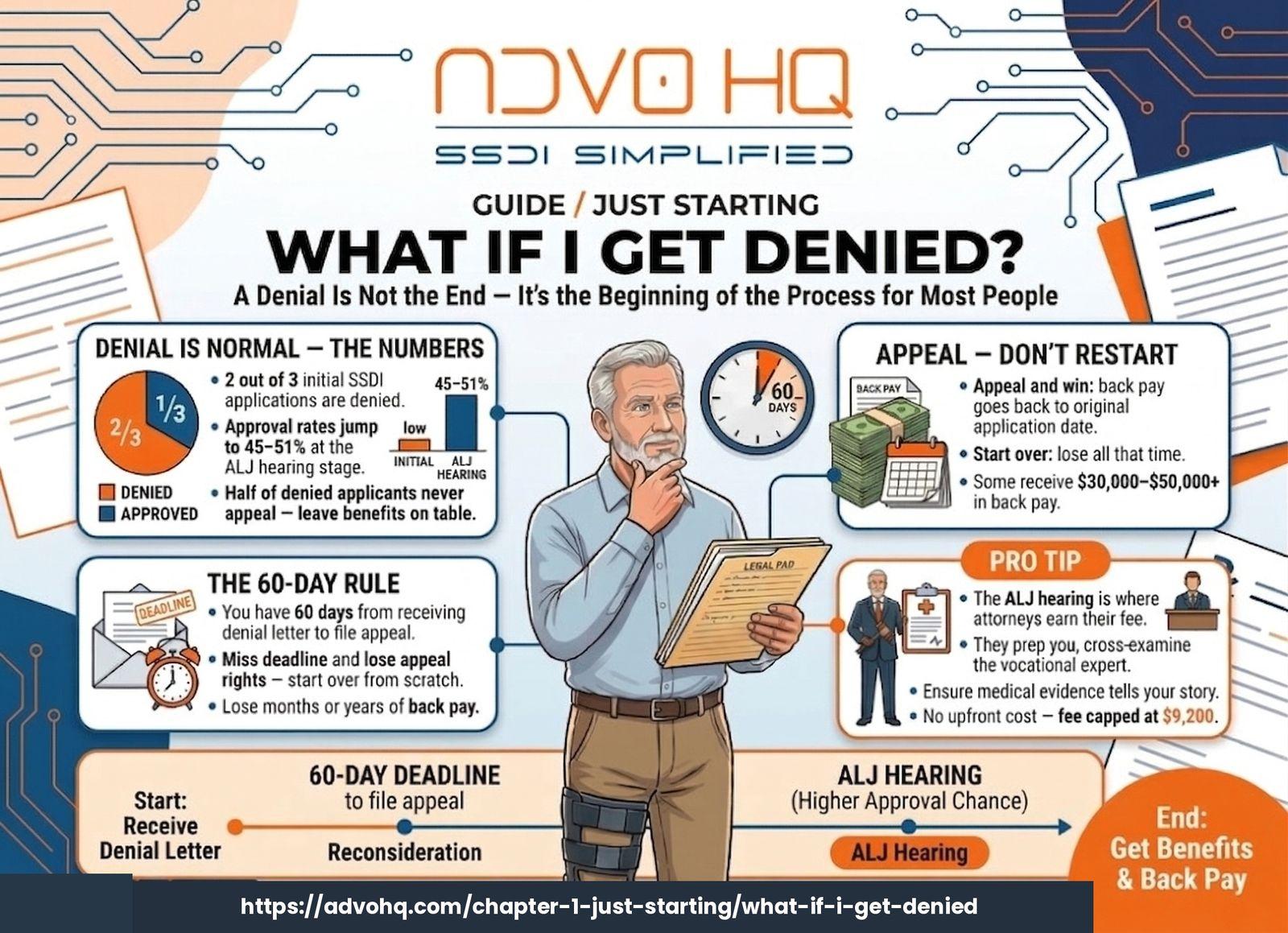
SSDI appeals move through a defined sequence. Most people win — if they win at all — at Level 2.
A different DDS examiner reviews your file
You testify before a judge
Reviews for legal/procedural errors
A federal judge reviews for legal errors
Level 1: Reconsideration
A paper review by a different DDS examiner. They look at your original file plus any new evidence you submit. The process is similar to the initial review — which is why approval rates stay low.
To file: Complete Form SSA-561 (Request for Reconsideration) online at ssa.gov, by mail, or in person.
Most people are denied again. But reconsideration is required before you can request an ALJ hearing. Use this stage to submit every piece of new medical evidence you have — updated records, specialist reports, RFC forms from your doctors.
Level 2: ALJ Hearing (Your Best Chance)
If reconsideration is denied, request a hearing before an Administrative Law Judge. This is the most important stage in the entire appeals process — and where most successful appeals are won.
At the hearing you testify about your condition, your daily limitations, and why you can't work. The judge may call medical or vocational experts to testify. This is the first time a real human decision-maker hears directly from you.
Attorneys have significantly higher ALJ approval rates. Studies consistently show claimants with attorneys win more often at ALJ hearings. An attorney knows what evidence judges find persuasive, can prepare your testimony, and knows how to cross-examine vocational experts whose testimony can sink your case. They still only get paid if you win — capped at 25% of back pay up to $9,200.
They still only get paid if you win — capped at 25% of back pay up to $9,200. See Do I Need a Lawyer or Advocate?
Levels 3 and 4: Appeals Council and Federal Court
Level 3: Appeals Council
Reviews whether the ALJ made legal or procedural errors — not your medical evidence. Most common outcomes: uphold the denial or remand to a new ALJ. Direct reversals are rare. Wait time: 6–12 months.
Level 4: Federal Court
A federal judge reviews whether SSA applied the law correctly — not the medical merits of your case. Technical, slow, and almost always requires an attorney. Wait time: 12+ months.
Appeal vs. Starting Over
Almost always appeal rather than filing a new application. The math strongly favors staying in the process.
✓ Appeal (Recommended)
- Back pay preserved from your original filing date
- Higher odds — ALJ approval rate is ~45-51% vs. ~35% on initial
- Fresh review — an ALJ hears directly from you
- No reset on the waiting period clock
✗ New Application
- Loses your original filing date
- Forfeits all accumulated back pay
- Restarts the entire waiting period
- Same ~35% initial approval odds
A new application may make sense if you have a technical denial (insufficient work credits) that an appeal can't fix, or if significant time has passed and your medical situation has fundamentally changed.
Frequently Asked Questions
Each level has its own form, and each carries the same 60-day deadline: Reconsideration is Form SSA-561, an ALJ hearing is Form HA-501, and Appeals Council review is Form HA-520. Federal court is a civil action filed under 42 U.S.C. § 405(g). You can file the first two online at ssa.gov.
You can request an extension — but you must show "good cause" (hospitalization, serious illness, death in the family, postal problems, or SSA misinformation). Extensions are not guaranteed. If denied, you'll need to start a brand new application and lose your original filing date.
The ALJ hearing. By outside estimates of SSA data, grant rates run about 45–51% there — far higher than reconsideration (roughly 13–15%) or the initial decision (about 35%). (SSA's own official framing counts these as shares of all applicants — about 20% initial, 2% reconsideration, 7% hearing-or-above — but points to the same conclusion: the hearing is your best shot.) It's also the first stage where you speak directly to the person deciding your case.
Almost always appeal. Winning on appeal preserves back pay from your original filing date, while starting over forfeits it and resets the waiting period. The main exception is a technical denial (like insufficient work credits) that an appeal can't cure.
Back pay is calculated from your established onset date minus the 5-month waiting period, and it keeps accumulating throughout the appeals process. When you win, it's paid as a lump sum — minus attorney fees if you had representation.
What They Don't Tell You
Insider knowledge that can make or break your application:
Many denied applicants give up instead of appealing
People walk away after the first denial and leave benefits on the table. If you have a legitimate disability, keep fighting.
Reconsideration is often a "formality."
Allowance rates at the reconsideration stage run only around 13–15% (SSA disposition data, 2024), so most people are denied again. But you have to go through it to reach the ALJ hearing, where your odds improve dramatically.
The ALJ hearing is your day in court
For the first time, you can tell your story to the decision-maker. Prepare thoroughly — describe your worst days, not your best days.
Vocational experts can make or break your case
At ALJ hearings, a vocational expert testifies about jobs you could theoretically do. An experienced attorney knows how to ask the right questions to challenge their testimony.
More back pay accumulates while you wait
The longer the process takes, the larger your back pay check when approved. Some people receive tens of thousands of dollars in back pay after winning on appeal.
Appeal within 60 days — don't start over
After a denial, appeal — do not quietly start a brand-new application. You have 60 days to file a Request for Reconsideration; refiling instead throws away your original protective filing date (and the back pay attached to it), and SSA can reject the new claim on the same facts that sank the first one. The one time starting over is smarter is when your appeal deadline has already passed and you have genuinely new evidence — otherwise, appeal. A representative can file it correctly and on time; see Do I Need a Lawyer or Advocate?
A denial is not the end — it's the beginning of the process for most people.
A denial is not the end — it's the beginning of the process for most people. About two-thirds of initial applications are denied, but by outside estimates approval rates climb to roughly 45–51% at the ALJ hearing stage. The single most important thing you can do right now? File your appeal within 60 days. Miss that deadline and you're starting over from scratch — losing months or years of back pay in the process.
Next Steps: Wondering whether it's time to get professional help? Read Do I Need a Lawyer or Advocate? to see the numbers, understand the fees, and decide if it makes sense for your situation.
- 20 C.F.R. § 404.900 — the four-step administrative review process (reconsideration → ALJ hearing → Appeals Council → federal court):. ecfr.gov
- 20 C.F.R. § 404.909 — reconsideration; 60-day filing deadline:. ecfr.gov
- 20 C.F.R. § 404.901 — "date you receive notice" defined as 5 days after the notice date (the +5-day mailing presumption):. ecfr.gov
- 20 C.F.R. §§ 404.929–404.933 — right to and request for an ALJ hearing; 60-day deadline; de novo review:. ecfr.gov
- 20 C.F.R. § 404.938 — notice of hearing mailed at least 75 days before the hearing date:. ecfr.gov
- 20 C.F.R. § 404.935 — 5-business-day rule for submitting evidence before the hearing:. ecfr.gov
- 20 C.F.R. §§ 404.967–404.970 — Appeals Council review; 60-day deadline (§ 404.968) and standards of review (§ 404.970):. ecfr.gov
- 42 U.S.C. § 405(g) — federal court (judicial) review; civil action within 60 days; substantial-evidence standard:. ssa.gov
- SSA, "Appeal a decision we made" (60-day deadlines; reconsideration):. ssa.gov
- SSA, Pub. No. EN-05-10058, "Your Right to Question the Decision Made on Your Claim":. ssa.gov
- Form SSA-561, Request for Reconsideration:. ssa.gov
- Form HA-501, Request for Hearing by Administrative Law Judge:. ssa.gov
- Form HA-520, Request for Review of Hearing Decision/Order:. ssa.gov
- 20 C.F.R. § 404.1520 — five-step sequential evaluation (severity, SGA, listings, past work, other work):. ecfr.gov
- SSA, "Substantial Gainful Activity" — SGA $1,690/month (non-blind), 2026:. ssa.gov
- 42 U.S.C. § 406(a)(2); 20 C.F.R. § 404.1720 — representative fee cap (25% of past-due benefits, up to $9,200 effective Nov. 30, 2024):. ssa.gov
- SSA, Annual Statistical Report on the Social Security Disability Insurance Program, 2024, Sec. 4 (Table 60 / Chart 11) — application outcomes as shares of all applicants (~20% initial, ~2% reconsideration, ~7% hearing-or-above, ~29% final award):. ssa.gov
- SSA, "Social Security performance — Disability claim processing time" — initial ~184 days; reconsideration ~208 days:. ssa.gov
- SSA, "Social Security performance — Disability appeals time" — ALJ hearing (OHO) ~267 days from hearing request to decision:. ssa.gov