
SSDI vs SSI
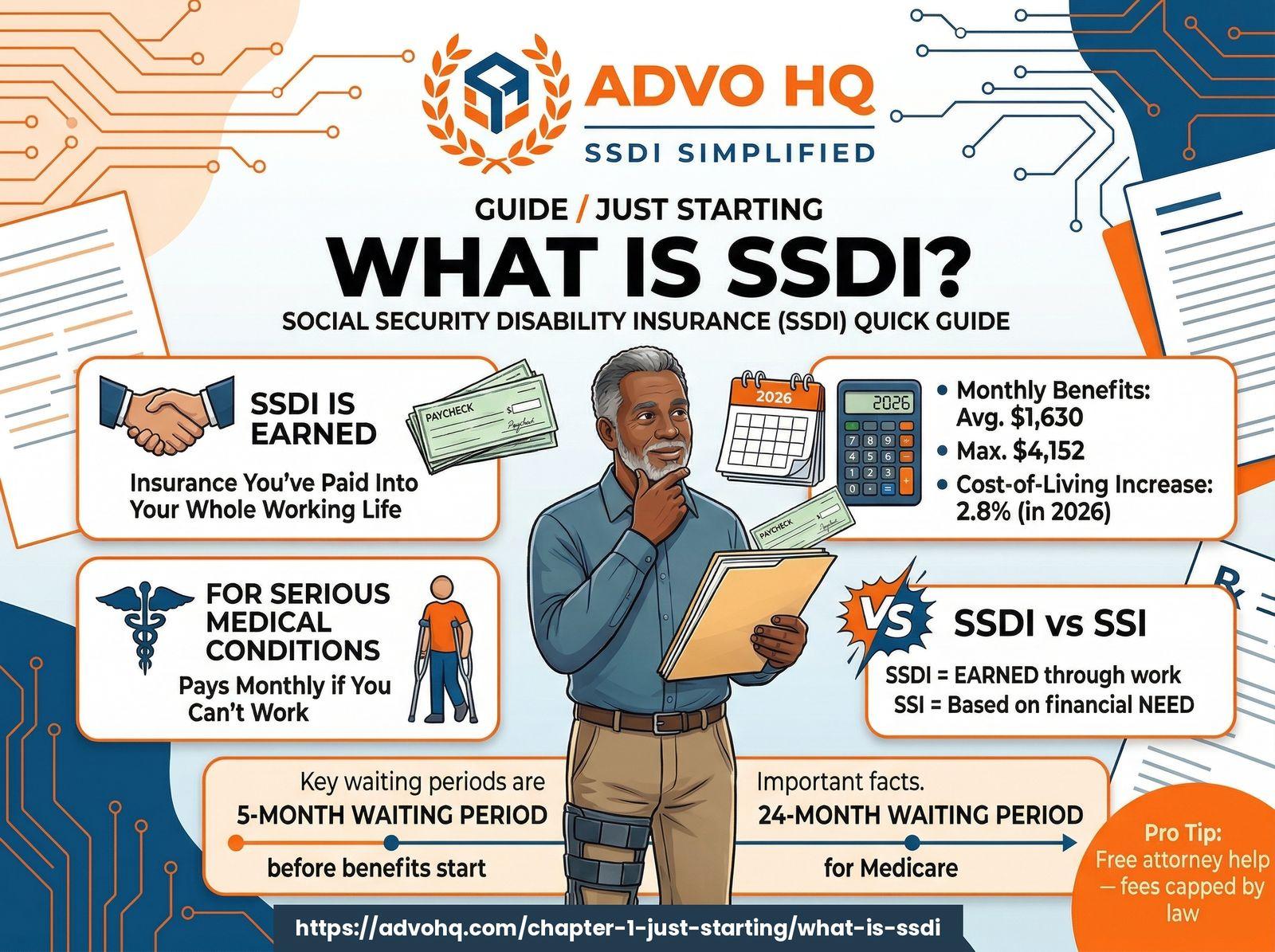
People often confuse these two programs. Here's the key difference: SSDI is based on your work history — you earned it. SSI is based on financial need.
SSDI
- Based on your work history
- Requires work credits
- 2026 maximum: $4,152/month
- Average payment: $1,630/month
- Medicare after 24 months
SSI
- Based on financial need
- No work credits required
- 2026 maximum: $994/month
- Resource limit: $2,000 individual
- Medicaid coverage (most states)
You can receive both SSDI and SSI at the same time if you qualify for both.
Who Pays for SSDI?
You do — through payroll taxes. If you've ever looked at your pay stub, you've seen "FICA" or "Social Security" deducted from your check. Part of that money goes into the Disability Insurance Trust Fund, which is what pays SSDI benefits.
That's why SSDI isn't a handout — it's insurance you've already paid for.
SSDI By The Numbers (2026)
Frequently Asked Questions
Your payment is based on your earnings record, not the severity of your condition. In 2026 the average is about $1,630/month and the maximum is $4,152/month. The more you earned (and paid into Social Security) over your career, the higher your benefit. How Much Will I Get Paid? breaks down the formula and back pay.
SSDI requires work credits and pays based on your earnings history. SSI is based on financial need with a fixed federal rate. SSDI tops out at $4,152/month; SSI tops out at $994/month in 2026.
Often, yes. Retroactive benefits can reach up to 12 months before your application date, but the 5-month waiting period is subtracted — so up to about 7 months of pre-application back pay, plus benefits for the months you waited during processing.
It comes down to two things: enough recent work credits, and a medical condition expected to last at least 12 months (or result in death) that keeps you from working at a substantial level. Do I Qualify for SSDI? walks through both.
24 months after your SSDI entitlement date. The main exception is ALS, where Medicare starts immediately with no waiting period. What Happens After Approval covers the Medicare timeline and how to bridge that gap.
What They Don't Tell You
Insider knowledge that can make or break your application:
There's a 5-month waiting period
SSDI benefits don't start until the 6th full month after your disability begins. Plan your finances accordingly — you won't see a check right away.
You can get back pay
If it takes 12–18 months to get approved (which is common), you'll receive a lump sum for those months — minus the 5-month waiting period. Don't assume that time is lost money.
Medicare doesn't start for 24 months
Even after you're approved for SSDI, you'll wait 2 more years before Medicare kicks in. You'll need another health insurance plan to bridge that gap.
Apply ASAP — you can lose eligibility entirely
SSDI requires "insured status," which is built on recent work credits that age out over time. Your coverage expires at your date last insured (DLI) — often around five years after you stop working. Wait too long and you can be genuinely disabled yet no longer eligible to collect.
SSDI converts to retirement automatically
When you reach full retirement age, your SSDI becomes regular Social Security retirement. Same check, different label. No need to reapply.
A low SSDI check can qualify you for SSI too
Because SSDI is an earned benefit sized to your past paychecks — not to how sick you are — a modest work history can produce a surprisingly small monthly check. If that check lands below the SSI limit ($994/month in 2026), you can collect SSI at the same time — called "concurrent benefits" — which in most states also opens the door to Medicaid.
Don't assume it's SSDI or SSI; ask SSA to screen you for both in one sitting so you don't leave money and health coverage on the table. Do I Qualify for SSDI? shows where the two programs overlap.
SSDI isn't welfare — it's insurance you've already paid for.
It's insurance you funded yourself, through the FICA taxes on every paycheck you earned. That's the key difference from SSI, which is based on financial need rather than work history. If a serious medical condition stops you from working, this program exists to replace part of that lost income. Two timing realities are worth planning for: benefits don't start until after a 5-month waiting period, and Medicare doesn't begin until 24 months in — though an approved claim often comes with back pay for the months you waited.
Next Steps: Not sure if you qualify? Read Do I Qualify for SSDI? to find out what it takes.
- Social Security Act, Title II — 42 U.S.C. §§ 401–434 (Federal Old-Age, Survivors, and Disability Insurance).
- Statutory definition of disability — 42 U.S.C. § 423(d)(1)(A); 20 C.F.R. § 404.1505. law.cornell.edu
- Work credits / insured status (20-of-40 rule) — 42 U.S.C. § 423(c)(1); 20 C.F.R. § 404.130. ssa.gov
- Five-month waiting period — 20 C.F.R. § 404.315(a)(4); 42 U.S.C. § 423(c)(2). ecfr.gov
- Retroactive (back pay) benefits, up to 12 months before filing — 20 C.F.R. § 404.621(a)(1). ecfr.gov
- Medicare 24-month qualifying period; ALS immediate entitlement — 42 U.S.C. § 426(b), (h). law.cornell.edu
- Attorney fee cap (25% of past-due benefits or $9,200, whichever is less; effective Nov. 30, 2024) — 42 U.S.C. § 406(a)(2); 20 C.F.R. § 404.1720; 89 Fed. Reg. ssa.gov
- 2026 dollar figures (average $1,630/mo, maximum $4,152/mo, SSI $994/mo, COLA 2.8%) — SSA, "2026 Social Security Changes" Fact Sheet. ssa.gov
- SSDI beneficiary counts (~7.1M disabled workers; ~8.1M total DI beneficiaries including spouses and children) — SSA, Monthly Statistical Snapshot, January 2026. ssa.gov
- Concurrent Title II / Title XVI (SSDI + SSI) claims — SSA POMS DI 11055.001; SSA, "Understanding SSI." ssa.gov
- Social Security Administration — Disability Benefits