
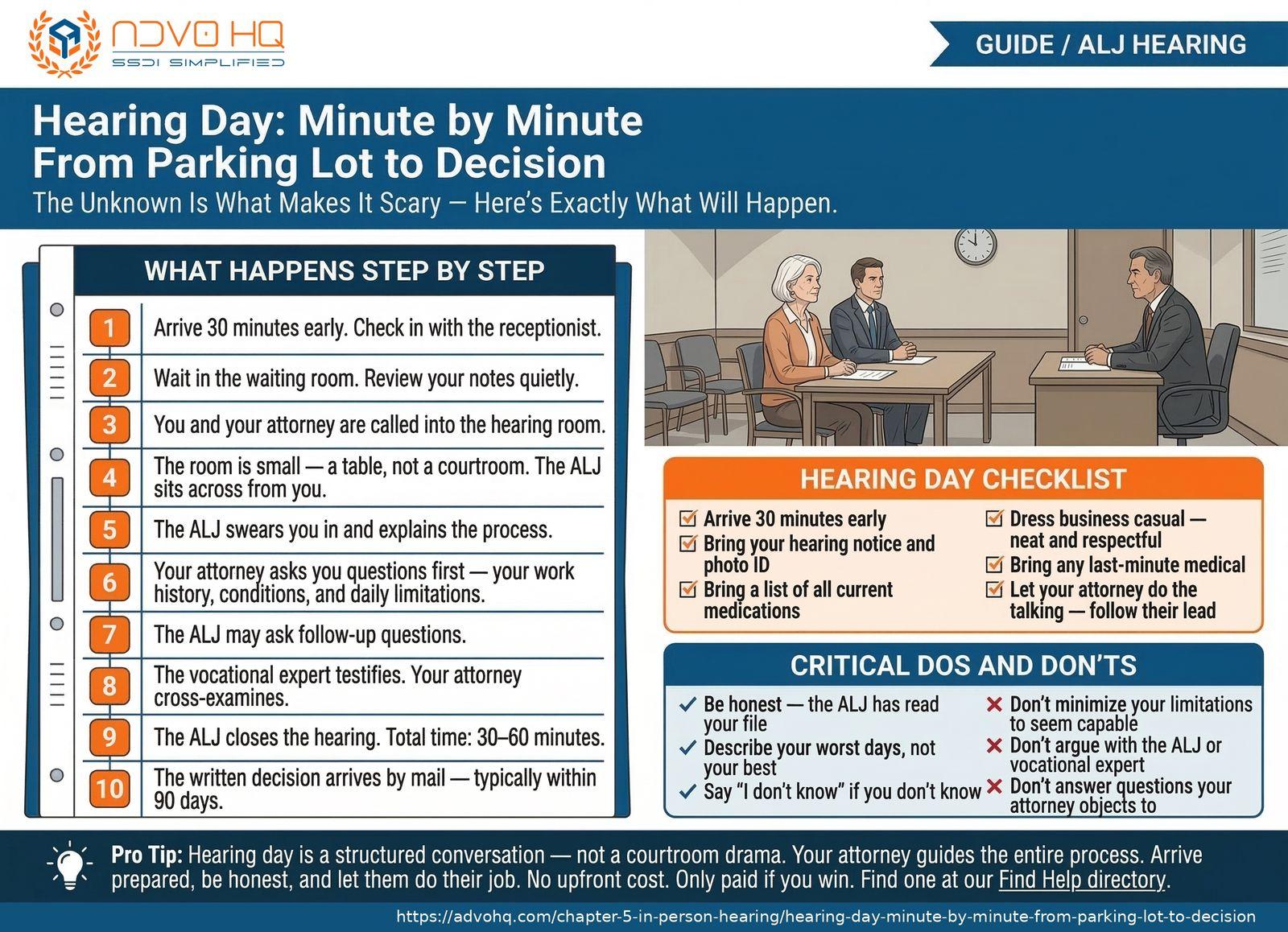
Before You Leave Home: The Hearing Day Checklist
What To Wear
- Clean, neat casual clothing—khakis/dark pants and a collared shirt or blouse
- Comfortable shoes you can walk in
- Whatever you would wear to a doctor’s appointment
- Layers if the building temperature is unpredictable
- Suit and tie or formal business attire (you’re not a lawyer)
- Dress shoes that make you walk differently than normal
- Workout clothes, pajamas, or anything that looks like you didn’t care enough to try
- Heavy cologne or perfume (small hearing rooms)
You're not going to court as a defendant. You're presenting yourself to a judge as someone who deserves benefits. Clean, respectable, and comfortable is the right target. Don't overdress and don't underdress.
The In-Person Hearing: Step By Step
Arrive 30 minutes early. Check in with the receptionist. Show your ID. Your attorney may meet you here or may already be inside.
You wait in a small waiting area. The ALJ, Vocational Expert, and Medical Expert (if present) are already in the hearing room or connected remotely. Your attorney may use this time for final preparation.
A clerk or the ALJ’s assistant calls you into the hearing room. It’s small—usually a conference room, not a courtroom. No jury, no audience, no gallery.
The ALJ turns on the recording and opens the hearing. They identify everyone present, confirm your identity, and ask if you object to anyone participating. They explain the process.
You are sworn in under oath. Everything from this point forward is on the record. Your attorney may make a brief opening statement.
Your attorney asks you questions about your conditions, limitations, daily life, work history, and why you can’t work. The ALJ may also ask questions. This is typically 20–45 minutes.
If a medical expert is present, the ALJ questions them about your conditions, listings, and limitations. Your attorney cross-examines.
The ALJ asks the Vocational Expert to classify your past work and poses hypothetical questions. Your attorney then cross-examines with their own hypotheticals.
Your attorney may make brief closing remarks. The ALJ explains what happens next—you’ll receive a written decision, typically in 1–3 months.
The ALJ turns off the recording. The hearing is over. You leave. Your attorney may debrief with you briefly outside.
The Video Hearing: How It’s Different
- Location — You attend from your attorney’s office, a local SSA office, or in some cases your home. The ALJ is at the hearing office.
- Setup — You’ll be in front of a camera and monitor. You can see the ALJ. They can see you. The Vocational Expert and Medical Expert may appear on separate screens.
- Camera tips — Look at the camera when speaking. Sit naturally—don’t try to hide discomfort. If you need to shift positions, do it naturally. The ALJ is watching.
- Audio — Speak clearly and slightly louder than normal conversation. Video connections can have audio lag—pause briefly after the ALJ finishes speaking before you respond.
- Technical issues — If the connection drops or audio is unclear, say so immediately. Technical problems are documented and won’t be held against you.
- Advantage — You’re in a familiar, comfortable setting. Less travel stress. If you’re at your attorney’s office, they can provide real-time support.
If attending from home, choose a quiet room with good lighting. Face a window or light source so the camera can see you clearly. Remove distractions. Treat it exactly like you're in the hearing room — you're under oath and being recorded.
During The Hearing: Critical Dos And Don’ts
- Address the ALJ as "Judge" or "Your Honor"
- Answer the question asked, then stop
- Ask to stand or change positions if you’re in pain
- Say "I don’t know" if you genuinely don’t know
- Be respectful to everyone in the room
- Show genuine emotion if discussing your losses
- Let your attorney handle objections
- Take your medications on the normal schedule
- Use first names or be overly casual
- Ramble, tell stories, or go off on tangents
- Suffer in silence—your discomfort IS evidence
- Guess or make up answers
- Get argumentative, even if questions feel unfair
- Force tears or put on a performance
- Try to argue legal points yourself
- Skip medications to appear more alert
If You Need Accommodations
Sitting for the full 30–60 minutes may not be possible with certain back, hip, or pain conditions.
Fatigue, pain, or cognitive symptoms can make extended testimony difficult.
If English is not your primary language, you have the right to testify in your own language.
If you have difficulty hearing, standard audio in the hearing room may not be sufficient.
Hearing offices are required to be ADA accessible, but it is worth confirming in advance.
Frequently Asked Questions
Most hearings run 30 to 60 minutes, though a complex case with both a medical expert and a vocational expert can run longer. Your own testimony is usually the biggest chunk — around 20 to 45 minutes. After more than a year of waiting, it's often over faster than people expect.
Almost never. The ALJ takes your case "under advisement" and mails a written decision later — often within a few months, though the exact turnaround varies by office and caseload and isn't fixed by regulation. A "bench decision" — a favorable ruling announced on the spot — does happen occasionally, but it's rare. Don't read anything into not getting an answer that day. After The Hearing: Decisions, Appeals Council, And What Comes Next explains what the written decision will say and what to do next.
Yes. You're sworn in near the start of the hearing, and everything after that is on the record. That's exactly why honest, specific answers matter — guessing or exaggerating can undercut your credibility.
The ALJ runs the hearing. Your attorney sits with you. A vocational expert (VE) is usually present to classify your past work and answer hypotheticals, and a medical expert (ME) may attend to address your conditions. There's no jury, no audience, and no lawyer arguing against you.
Say so. Ask to stand, stretch, or take a break through your attorney. Needing accommodations isn't a weakness — it's live evidence of your limitations that the judge observes firsthand.
What They Don't Tell You
Insider knowledge that can make or break your application:
The hearing is not a courtroom drama
It's a small room with a few people having a structured conversation. No jury, no audience, no opposing counsel. The ALJ is asking questions to find the truth, not to trap you. Most claimants say it wasn't as scary as they expected — and if you're represented, your attorney sits right beside you (or appears with you on video), asks the questions, handles the experts, and manages the hearing, so you're not alone. Your job is to answer honestly and show the ALJ who you are.
The hearing typically lasts 30–60 minutes
Many disability attorneys and claimants report that hearings usually run well under an hour — you may have waited close to a year for this, and it's over quickly. That's why preparation matters so much. You have a limited window to present your case effectively.
The ALJ usually doesn't give a decision at the hearing
Don't expect to walk out knowing whether you won. The ALJ takes the case under advisement and issues a written decision by mail some weeks or months later (the exact timing varies and isn't set by rule). Occasionally an ALJ will issue a "bench decision" (a decision on the spot), but this is rare.
Needing accommodations is evidence
If you ask to stand, take breaks, or can't sit through the hearing comfortably, that demonstrates your limitations to the ALJ in real time. Don't hide your pain or limitations during the hearing.
The real deadline is 5 business days before the hearing
The real deadline isn't hearing day — it's five business days before it. Under SSA's "5-day rule," you must submit (or at least tell the judge in writing about) all your evidence no later than 5 business days before the hearing, or the ALJ can refuse to consider it (20 CFR 404.935). There are narrow exceptions — SSA's own error, a serious illness or death in the family, records lost to something like a fire, or diligent efforts that just came up short — but you have to prove one applies, so chase down late records early rather than planning to hand them over at the hearing.
Hearing day is the culmination of everything you’ve done—every form, every doctor visit, every piece of evidence.
Hearing day is the culmination of everything you've done — every form, every doctor visit, every piece of evidence. It's a structured conversation in a small room, not a courtroom drama. Arrive prepared, dressed respectfully, with your materials. Let your attorney guide the hearing. Be honest, be specific, and don't hide your limitations. In 30–60 minutes, you'll have presented your case to the only person who matters — the judge who decides whether you receive the benefits you've earned.
Up Next: After The Hearing: Decisions, Appeals Council, And What Comes Next—what the written decision means, what to do if you win, and your options if you don’t.
Your Attorney Is With You Every Step Of Hearing Day
From preparation to testimony to the Vocational Expert cross-examination, your attorney manages every aspect of the hearing. You focus on telling your story honestly. They handle the rest. Free consultation. No upfront cost.
→ Find A Disability Attorney In Your County
→ Get Free Help Preparing For Your Hearing
Not affiliated with SSA or any government agency. For informational purposes only — not legal advice.
- 20 C.F.R. § 404.929 — Hearing before an administrative law judge — general (right to a de novo hearing; ALJ looks at all issues and may consider evidence not before the state agency). ecfr.gov
- 20 C.F.R. § 404.936 — Time and place for a hearing before an administrative law judge (setting the hearing; in-person, video, and telephone appearance). ecfr.gov
- 20 C.F.R. § 404.950 — Presenting evidence at a hearing before an administrative law judge (right to appear and present evidence, testimony under oath, and to question witnesses including vocational and medical experts). ecfr.gov
- 20 C.F.R. § 404.935 — Submitting written evidence to an administrative law judge (the "5-day rule": submit or inform the ALJ about evidence no later than 5 business days before the hearing; narrow good-cause exceptions). ecfr.gov
- Social Security Act, Title II — 42 U.S.C. § 405(b) (evidentiary hearings). ssa.gov
- Social Security Administration — [Hearing Before an Administrative Law Judge](. ssa.gov
- Social Security Administration — [Information About Your Hearing (HALLEX I-2-0-1)](. ssa.gov