
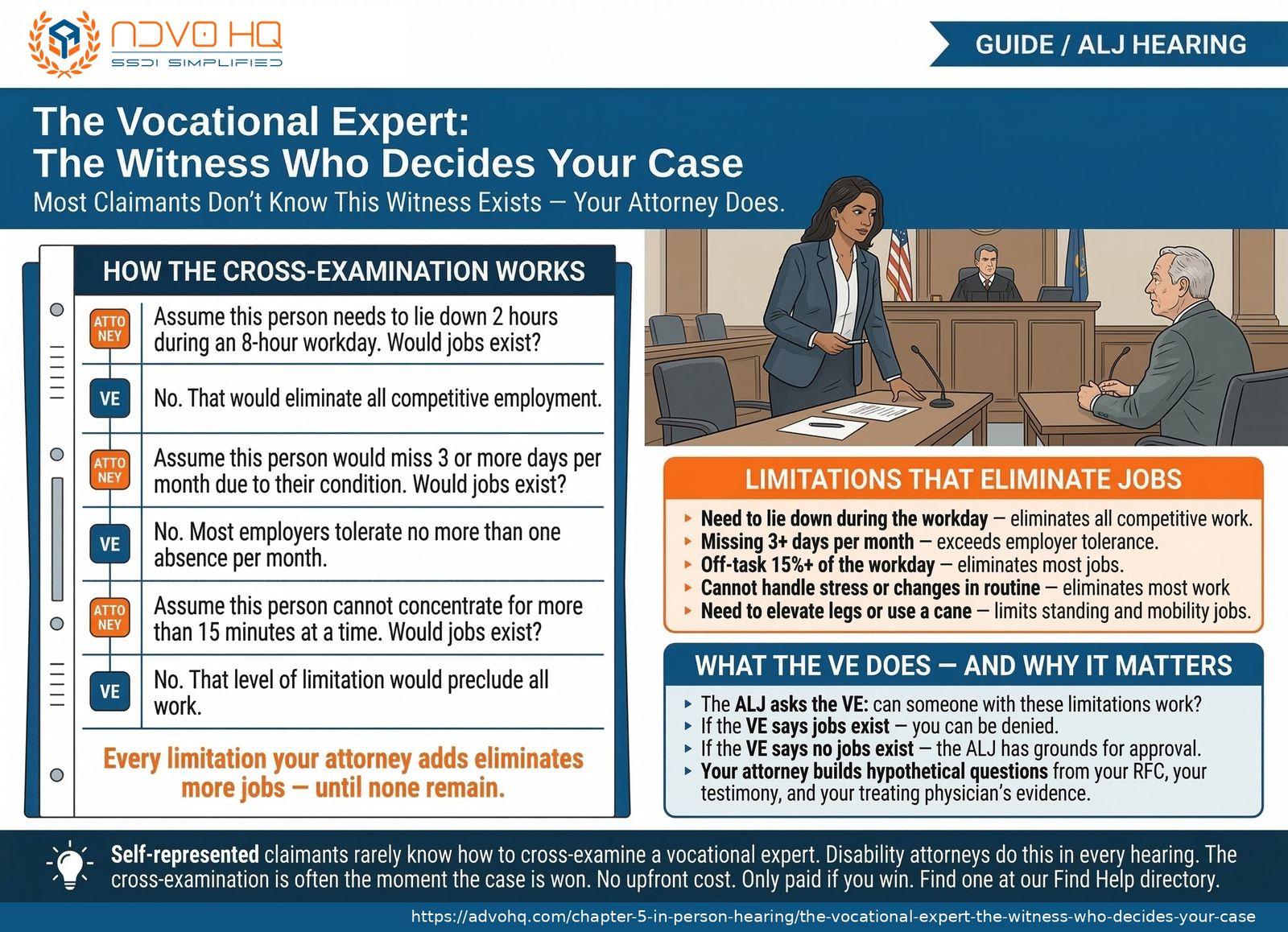
How Hypothetical Questions Work
The ALJ and your attorney ask the Vocational Expert hypothetical questions—scenarios describing a person with specific limitations—and the Vocational Expert testifies about what jobs that person could do. Here's how the sequence typically works:
Asks the Vocational Expert to classify your past work by DOT (Dictionary of Occupational Titles) code and exertional level (sedentary, light, medium, heavy, very heavy).
Describes a hypothetical person with your age, education, and work history, limited to the RFC that SSA's records support. Asks if this person could do your past work, and if not, any other work.
May describe a different RFC—often more restrictive—to see if jobs still exist at that level.
Describes a hypothetical person with ALL the limitations your evidence supports—including the ones the ALJ's hypothetical may have omitted: need to lie down, absences, off-task time, mental limitations.
Asks: "If I add to the hypothetical that this person would need to lie down for 30 minutes twice during the workday, would there be any jobs?" Adds limitations one by one until the Vocational Expert says no jobs exist.
When the Vocational Expert testifies that no competitive employment exists for the hypothetical person, your attorney has established the foundation for a disability finding—IF the ALJ accepts those limitations.
The VE's testimony only matters if the ALJ accepts the hypothetical as accurate. Your attorney's hypothetical must be supported by medical evidence — your treating physician's RFC, your testimony, and your medical records. That's why building your evidence file throughout this process has been so important.
The Limitations That Eliminate Jobs
Certain limitations are particularly effective at eliminating available jobs. Your attorney builds hypothetical questions around these:
- Need to lie down 2+ hours during workday — No employer allows employees to lie down for extended periods. This eliminates virtually all competitive employment.
- Absent 4+ days per month — Most employers tolerate 1–2 absences per month. Exceeding that means you can't maintain employment. Vocational Experts consistently testify that 4+ absences eliminates all jobs.
- Off-task 15–20%+ of workday — Being off-task more than 10–15% due to pain, medication effects, or mental health symptoms exceeds employer tolerance. Vocational Experts typically confirm no jobs exist at 20%+ off-task.
- Cannot sustain concentration for 2-hour blocks — Competitive employment requires the ability to maintain concentration for 2-hour periods between breaks. Inability to do this eliminates most jobs.
- Cannot interact with supervisors, coworkers, or public — Social functioning limitations eliminate jobs requiring even minimal interpersonal interaction—which is virtually all jobs.
- Sit/stand option with frequent position changes — While some jobs allow a sit/stand option, requiring position changes every 10–15 minutes dramatically narrows available work.
Your Attorney's Cross-Examination: How It Actually Works
Here's a simplified example of the cross-examination exchange that wins cases:
Your attorney doesn't need the VE to say "no jobs" on just one limitation — they establish multiple paths. If the ALJ finds ANY of these limitations credible based on the medical evidence, the vocational testimony supports disability. This is why having multiple documented limitations (physical + mental + absences + off-task) gives your attorney the most ammunition.
When The Vocational Expert's Testimony Hurts Your Case
- Vocational Expert identifies jobs at your RFC level — Attorney adds additional limitations from the evidence to narrow or eliminate those jobs.
- Vocational Expert's job numbers seem inflated — Attorney challenges the basis for the numbers: "What is the source of your job numbers? Are those full-time positions? Do they account for the sit/stand option requirement?"
- Vocational Expert identifies jobs that don't exist in practice — Attorney asks whether the jobs identified are actually available in the current economy, not just theoretically described in the DOT.
- Vocational Expert relies on outdated DOT classifications — The Dictionary of Occupational Titles hasn't been updated since 1991. Attorney can argue that jobs described in the DOT may no longer exist as described.
Frequently Asked Questions
A VE is an independent contractor with expertise in job classifications, labor market data, and the physical and mental demands of different occupations. SSA hires them to testify about whether jobs exist in the national economy for someone with your specific limitations. They are not SSA employees, and they are supposed to remain neutral — but their testimony is only as good as the questions they are asked. A VE is typically called at Step 5, once your case involves non-exertional limitations that the Medical-Vocational Guidelines (the "grids") can't resolve on their own.
The ALJ and your attorney describe a hypothetical person with your age, education, and work history plus specific functional limitations, and the VE testifies about what jobs — if any — that person could do. Your attorney layers in additional limitations one at a time until the VE testifies that no jobs remain.
At Step 5, the burden is on SSA to prove that jobs exist in significant numbers that you can perform. When the VE testifies that no competitive employment exists for a person with your documented limitations, SSA can no longer meet that burden — and the ALJ has the foundation to approve your claim, provided the ALJ accepts those limitations as credible.
They are supposed to provide neutral expert testimony, not advocate for or against your claim. In practice, VEs testify at hearings constantly and know exactly which limitations eliminate jobs. A well-prepared attorney draws honest answers through properly framed hypothetical questions.
Yes — your attorney has the right to cross-examine the VE, and this is where cases are won. Your attorney can add omitted limitations, question whether DOT classifications are still current, and challenge the source of the VE's job numbers. Note that under Biestek v. Berryhill (2019), a VE's testimony can count as "substantial evidence" even if the expert declines to hand over the underlying data — but a refusal can reduce the weight the ALJ gives it, which is exactly why pressing the VE on their sources matters.
Without an attorney, no one crafts the hypothetical questions that include every documented limitation. The ALJ asks questions, but they may not capture your full functional picture. Effective cross-examination — layering in absences, off-task time, and mental limitations — is what converts your medical evidence into a disability finding.
What They Don't Tell You
Insider knowledge that can make or break your application:
The VE cross-examination is the single most important moment of your hearing
Everything else — your testimony, medical records, the pre-hearing brief — builds toward this moment. When the VE says "no jobs exist" for a person with your limitations, and the ALJ accepts those limitations based on your evidence, your case is in the strongest possible position.
Without representation, the right hypothetical questions often don't get asked
You have the right to question the VE yourself even without an attorney (20 CFR 404.950(e)) — pro se claimants can and do cross-examine. But the ALJ's own hypothetical questions may not include every limitation your evidence supports, and knowing which limitations to add, and how to frame them, is a skill. An attorney's hypothetical is built to include every limitation the record supports; without one, those questions frequently go unasked.
The VE has heard these questions thousands of times
VEs testify at hearings regularly and know the limitations that eliminate jobs. The VE's honest answers to well-crafted hypothetical questions are powerful precisely because they're expert testimony, not advocacy.
Your attorney prepares the hypothetical questions before the hearing
This isn't improvised. Your attorney reviews your RFC, medical evidence, and testimony plan, then writes specific hypothetical questions designed to elicit "no jobs" answers based on YOUR documented limitations.
Make the vocational expert show their work
When the VE says jobs exist that you can do, make them show their work: ask for the exact DOT code for each job, the source of the job-number figures, and whether those jobs still exist as described and truly fit every limitation in your RFC. The Supreme Court in Biestek v. Berryhill (2019) confirmed you can demand that underlying data on cross-examination — and while a VE isn't automatically disqualified for refusing, a vague or unsupported answer on the record hands you a powerful appeal issue. If you don't have representation yet, that's exactly the kind of questioning you'll miss — see Do I Need a Lawyer or Advocate?.
The vocational expert's testimony often determines whether you win or lose.
The vocational expert's testimony often determines whether you win or lose. Your attorney's hypothetical questions — built on your medical evidence, treating physician RFC, and testimony — are designed to show the VE and the ALJ that no jobs exist for someone with your limitations. This is the culmination of everything you've done: every doctor visit, every form, every piece of evidence. It all comes together in the VE cross-examination.
Up Next: The Medical Expert: What They Say About Your Conditions—when an ME testifies, what they evaluate, and how your attorney handles them.
Your Attorney's Cross-Examination Wins Cases
The vocational expert cross-examination is where disability hearings are won. An experienced attorney prepares hypothetical questions tailored to your specific limitations. Free consultation. No upfront cost.
→ Find A Disability Attorney In Your County
→ Get Free Help Preparing For Your Hearing
Not affiliated with SSA or any government agency. For informational purposes only — not legal advice.
- U.S. Supreme Court — Biestek v. Berryhill, 139 S. Ct. 1148 (2019) (a VE's testimony may constitute substantial evidence even without the underlying data; refusal to produce data can affect the weight given). supremecourt.gov
- 20 C.F.R. § 404.1560 — "When we will consider your vocational background" (Step 5 burden on SSA to show other work exists). ecfr.gov
- 20 C.F.R. § 404.1566 — "Work which exists in the national economy" (basis for VE testimony on job numbers). ecfr.gov
- 20 C.F.R. Part 404, Subpart P, Appendix 2 — Medical-Vocational Guidelines ("the Grids"). ecfr.gov
- Social Security Administration — HALLEX I-2-5-50, "Vocational Experts". ssa.gov
- U.S. Department of Labor — Dictionary of Occupational Titles (DOT), 4th ed. (1991).