
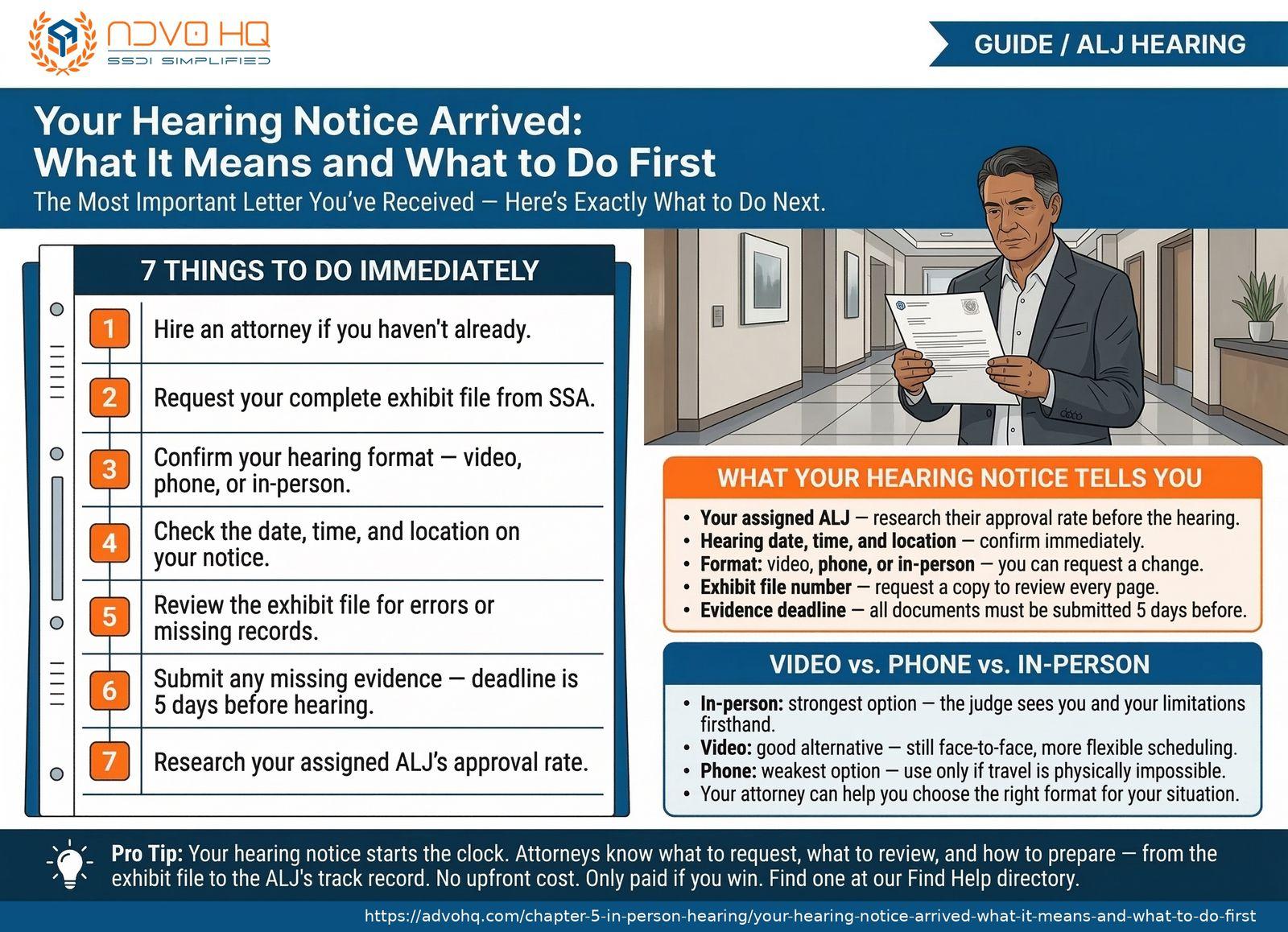
Decoding Your Hearing Notice
Your Notice of Hearing contains critical information. Here’s what to look for:
- Hearing date and time — The scheduled date and time of your hearing. You’ll typically receive 75 days’ notice. Mark it immediately—this is the most important appointment of your case.
- Hearing location / format — Whether your hearing is in-person at an ODAR (Office of Disability Adjudication and Review) hearing office, by video teleconference (VTC), or by telephone. Since the pandemic, most hearings are video or phone.
- ALJ name — The name of the Administrative Law Judge assigned to your case. This matters—ALJs have individual approval rates that can range from under 30% to over 70%. Your attorney should research this judge.
- Expert witnesses — Whether a medical expert (ME) or vocational expert (VE) will testify. Most hearings include a VE. Some also include an ME. The notice should identify them by name.
- Issues to be decided — What the ALJ will be evaluating. Typically: whether you are disabled under SSA rules as of the alleged onset date.
- Your rights — A reminder of your right to review your file, submit additional evidence, bring witnesses, and have a representative (attorney or non-attorney). You also have the right to object to the hearing format.
The 7 Things To Do Immediately
This is the most important step. If you don't have an attorney yet, get one now. You need time for them to review your file, develop strategy, and prepare. Most work on contingency—no fee unless you win.
If you or your attorney have a conflict, request a postponement as soon as possible. Valid reasons include: you just retained an attorney who needs time to prepare, key medical evidence is pending, or you have a medical procedure scheduled.
You have the right to review your complete file before the hearing. Request it from SSA or your hearing office. Your attorney needs this to identify weaknesses and prepare strategy. This is called the “exhibit file.”
Your attorney should look up the ALJ's approval rate and tendencies. This informs strategy—some ALJs focus heavily on the vocational expert, others on medical evidence, others on your testimony.
Review your file for gaps: Do you have an updated treating physician RFC? Recent treatment records? Mental health documentation? Any evidence not yet submitted needs to be gathered now.
If a medical expert is listed, your attorney needs to prepare for their testimony. If only a vocational expert is listed, your attorney needs to prepare hypothetical questions for cross-examination.
If it's video or phone and you strongly prefer in-person (or vice versa), you can object. You generally have the right to an in-person hearing, but requesting a change may delay your hearing date.
When To Request A Postponement
Your attorney needs time to review the file, develop strategy, and prepare.
A specialist appointment, diagnostic test, or RFC form is scheduled but won’t be complete before the hearing date.
You have surgery or a procedure near the hearing date.
Your condition makes it impossible to attend on the scheduled date.
Every postponement adds months to your wait. Only request one if there's a genuine strategic reason — like needing time for critical evidence. If your case is ready, take the hearing date you're given.
Your Exhibit File: What SSA Has On You
Before the hearing, SSA compiles your complete case file into numbered exhibits. Your attorney needs to review every page. The file typically includes:
- Medical records — Every medical record SSA collected—treatment notes, hospital records, diagnostic tests, CE reports.
- SSA forms you completed — Your initial application, SSA-3441 (Disability Report – Appeal), SSA-3373 (Function Report), work history forms.
- DDS determination documents — The Disability Determination Rationale from both the initial and reconsideration levels—explains why you were denied.
- RFC assessments — Any RFC completed by DDS examiners, CE doctors, or your treating physicians.
- Correspondence — Letters between SSA and your doctors, any letters you submitted, appeal forms.
- Work history records — Your earnings record, job descriptions, and physical/mental demands of past work.
Review the file for errors. Sometimes records are attributed to the wrong person, pages are missing, or CE reports contain inaccuracies you’ve never seen before. If you submitted evidence that’s not in the file, flag it immediately and resubmit.
The Evidence Submission Deadline
Under SSA rules, you must submit all written evidence at least 5 business days before the hearing. Evidence submitted after this deadline may not be admitted unless you show good cause for the delay.
- 5 business days before hearing: All new medical records, RFC forms, supporting letters, and other evidence must be submitted by this date.
- Good cause exceptions: If evidence becomes available after the deadline (e.g., a doctor’s appointment the week before the hearing), you can argue good cause for late submission.
- Pre-hearing brief: Your attorney’s written legal argument should also be submitted before the hearing—typically 1–2 weeks prior.
- Keep submitting until the deadline: Don’t stop building evidence just because the hearing is scheduled. Every new treatment record, test result, or updated RFC strengthens your case.
Frequently Asked Questions
In-Person
- ALJ observation: Fully — posture, pain behavior, difficulty sitting, assistive devices
- Convenience: Must travel to hearing office, which may be far away
- Technical issues: None
- Emotional impact: Strongest — ALJ sees you in person
- Best for: Visible physical limitations, assistive device use, difficulty sitting/standing
Video
- ALJ observation: Yes — on camera. Limited but effective.
- Convenience: From your attorney’s office, a local SSA office, or your home
- Technical issues: Possible connection problems, camera/audio quality
- Emotional impact: Good — ALJ sees your face and reactions
- Best for: Most cases — good balance of observation and convenience
Phone
- ALJ observation: No — ALJ can only hear your voice
- Convenience: From your phone anywhere
- Technical issues: Audio quality only concern
- Emotional impact: Weakest — no visual cues
- Best for: Simple cases, claimants with severe travel limitations
If SSA schedules a phone hearing but your case benefits from the ALJ seeing you (visible pain, assistive devices, difficulty sitting), you or your attorney can request video or in-person. Put the objection in writing and submit it promptly. Requesting a change may delay your hearing date.
What They Don't Tell You
Insider knowledge that can make or break your application:
ALJ approval rates vary dramatically
Individual judges differ widely — some approve a large majority of the cases they hear while others approve well under a third (illustrative ranges drawn from SSA OHO ALJ disposition data, which is published per judge). Your attorney should look up the assigned ALJ's statistics and adjust strategy accordingly. This information is publicly available.
You can submit evidence after filing but before the hearing
The wait between requesting a hearing and the hearing date — often roughly 9 months to a year, though it varies by office (SSA OHO average processing time was about 267 days as of May 2026) — is your window to build the strongest possible case. Don't just wait — use every month to add medical records, get specialist evaluations, and update your RFC.
The hearing notice arrives roughly 75 days before the hearing
That's less time than most people expect. If you don't have an attorney yet, 75 days is tight for proper preparation. Hiring earlier gives your attorney the full waiting period to prepare.
You can bring witnesses
Family members, friends, or former coworkers who can testify about your limitations can appear at the hearing. Your attorney will decide if a witness strengthens or complicates your case.
The hearing is recorded
Every hearing is recorded and a transcript is created. Everything you say goes on the record — which is why preparation and honesty are critical.
Your hearing notice comes at least 75 days out
By law, SSA has to mail your Notice of Hearing at least 75 days before the date — a full 2.5 months, not a few weeks (20 CFR 404.938(a)). Treat that notice as a starting gun, not a countdown to wait out: it names the exact "issues" the judge will decide and often lists the vocational or medical expert who will testify, so you learn in advance who you're up against and what to prepare to rebut. The strongest cases put that runway to work — closing evidence gaps and researching your ALJ. We cover the attorney's role in detail in Hiring A Disability Attorney Before Your Hearing.
Your hearing notice is the starting gun for the most important phase of your disability case.
Your hearing notice is the starting gun for the most important phase of your disability case. Don't panic — get organized. Hire an attorney if you haven't. Request your exhibit file. Identify missing evidence and get it submitted before the 5-business-day deadline. Research your ALJ. And start preparing for the hearing itself.
Up Next: Hiring A Disability Attorney Before Your Hearing—how to find one, what to ask, fee structure, and what they actually do for your case.
Don’t Go To Your Hearing Without An Attorney
The hearing is where cases are won or lost. An experienced disability attorney reviews your file, identifies weaknesses, prepares your testimony, cross-examines the vocational expert, and presents your case to the judge. No fee unless you win.
→ Find A Disability Attorney In Your County
→ Request Free Hearing Preparation Help
Not affiliated with SSA or any government agency. For informational purposes only — not legal advice.
- 20 CFR § 404.929 — Hearing before an administrative law judge — general (de novo review). ecfr.gov
- 20 CFR § 404.935 — Submitting written evidence to an administrative law judge (evidence due no later than 5 business days before the hearing). ecfr.gov
- 20 CFR § 404.936 — Time and place for a hearing before an administrative law judge (format: in-person, video, or telephone; objections). ecfr.gov
- 20 CFR § 404.938 — Notice of a hearing before an administrative law judge ("We will mail or serve the notice of hearing at least 75 days before the date of the hearing," § 404.938(a)). ecfr.gov
- Social Security Administration — Office of Hearings Operations (OHO), Hearing Before an Administrative Law Judge. ssa.gov