
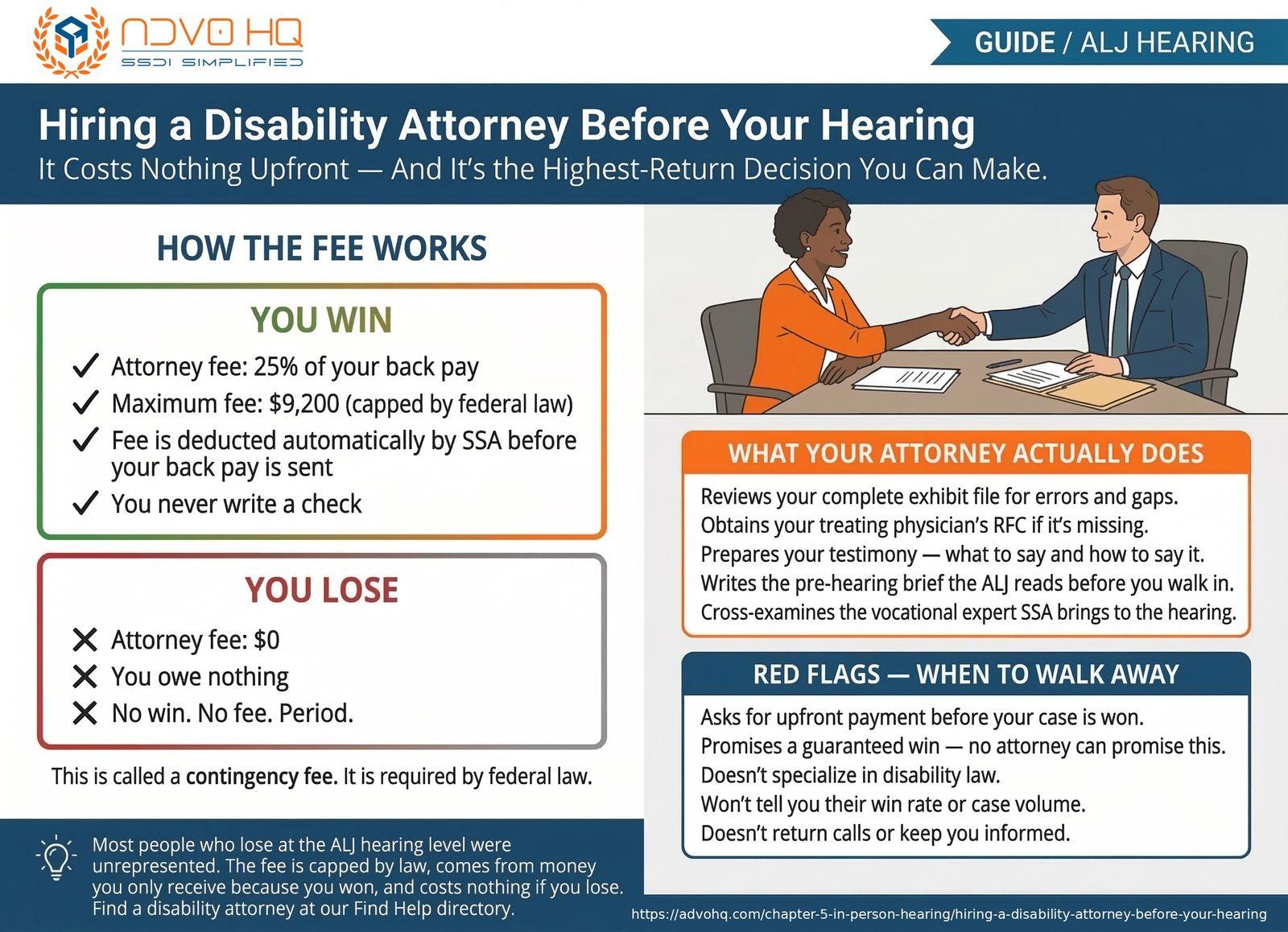
Claimants with attorney representation win at the ALJ hearing level at significantly higher rates than those who represent themselves. That's not a coincidence. A disability attorney knows the law, knows the judges, knows how to prepare your testimony, and knows how to cross-examine the vocational expert—the witness whose testimony often determines whether you win or lose. And here's the part most people don't realize: it costs you nothing upfront. Disability attorneys work on contingency, meaning they only get paid if you win. This article explains exactly how the fee works, what a good attorney does for your case, and how to find the right one.
The Fee Structure: How Disability Attorneys Get Paid
- How they get paid — Contingency—the attorney only gets paid if you win your case. If you lose, you owe nothing for their time.
- The fee amount — 25% of your back pay (past-due benefits), capped at $9,200 as of 2025. SSA withholds this from your back pay and pays the attorney directly.
- What "back pay" means — The benefits you would have received from 5 months after your disability onset date through the approval date. If you applied in January 2024 and are approved in March 2026, that's roughly 21 months of back pay.
- Upfront costs — Most attorneys charge nothing upfront. Some may charge small costs for medical record copies, but many cover these and deduct them from your award.
- If you lose — You owe nothing for the attorney's time and work. This is the entire point of contingency—they share your risk.
- The fee agreement — You'll sign a fee agreement that SSA must approve. The agreement spells out the 25%/$9,200 cap terms. SSA reviews every fee to ensure compliance.
If your monthly SSDI benefit is $2,000 and you have 20 months of back pay, that's $40,000. A straight 25% would be $10,000 — but the fee is capped at $9,200, so the attorney receives the lesser of the two, which here is $9,200. You keep the remaining $30,800 of your back pay plus your ongoing monthly benefits. The attorney's fee comes from money you wouldn't have received without their help.
What A Disability Attorney Actually Does For Your Case
- Reviews your complete file — They read every page of your exhibit file—medical records, CE reports, function reports, DDS determinations—to identify strengths, weaknesses, and inconsistencies.
- Develops case theory — They create a legal strategy: which listing you might meet, what RFC level your evidence supports, which Grid Rules apply, and how to present the strongest possible argument.
- Gathers additional evidence — They send RFC forms to your doctors, request missing records, arrange specialist evaluations, and ensure every piece of helpful evidence is in the file before the hearing.
- Writes the pre-hearing brief — A written legal argument submitted to the ALJ before the hearing that frames your case, cites the evidence, and tells the judge exactly why you should be approved.
- Prepares your testimony — They practice with you—what questions you'll be asked, how to describe your limitations effectively, what to emphasize, what to avoid. This preparation is critical.
- Questions you at the hearing — Your attorney asks you questions under oath designed to bring out the specific functional limitations that matter for your RFC and the vocational analysis.
- Cross-examines the VE — The vocational expert testifies about what jobs exist for someone with your limitations. Your attorney asks hypothetical questions that add each limitation until the VE admits no jobs remain. This is often the decisive moment.
- Handles the medical expert — If an ME testifies, your attorney challenges any unfavorable opinions and highlights favorable ones. They know the medical evidence and can point out what the ME may have missed.
- Researches the ALJ — They know the assigned judge's approval rate, tendencies, and what kind of evidence and testimony that judge responds to.
How To Find The Right Disability Attorney
- MyGoveBenefits directory — Search for disability attorneys in your county who specialize in SSDI cases. Our directory shows attorneys who are actively accepting cases in your area.
- NOSSCR referral — The National Organization of Social Security Claimants' Representatives maintains a referral network. Visit nosscr.org.
- Your state bar association — Most state bars have a lawyer referral service that can connect you with disability attorneys in your area.
- Legal aid organizations — If you have very low income, legal aid may provide free representation. Visit lawhelp.org to find local legal aid.
- Word of mouth — Ask anyone you know who has been through the SSDI process. Personal recommendations from people who won their cases are valuable.
10 Questions To Ask Before Hiring
Experience at the hearing level is what matters—not general legal experience.
Good disability attorneys win more than half their hearings.
Some firms assign a different attorney or paralegal to the actual hearing than the person you initially spoke with.
Testimony preparation is one of the highest-leverage things an attorney does before your hearing.
VE cross-examination is often the decisive moment in a hearing. This is where cases are won.
The best attorneys actively build your file—they don't just work with what's already there.
Most disability attorneys charge nothing upfront—the fee comes from your back pay if you win.
You need to know who your point of contact is and how to reach them with questions throughout your case.
Experienced local attorneys know the judges in their hearing office—their tendencies, approval rates, and preferences.
A good attorney gives you an honest assessment after reviewing your file—not a sales pitch.
Red Flags: When To Walk Away
- Asks for money upfront beyond small costs — Legitimate disability attorneys work on contingency. Large upfront fees are a warning sign.
- Guarantees you'll win — No honest attorney guarantees a result. They should tell you the strengths and weaknesses of your case.
- Doesn't specialize in disability — A divorce lawyer or personal injury attorney handling a disability case won't know the specific rules, grid regulations, or VE cross-examination strategies.
- Won't meet with you before the hearing — If they won't invest time in preparation, they won't be effective at the hearing.
- Handles your case through a "mill" — High-volume firms that process hundreds of cases sometimes provide minimal individual attention. Ask how many active cases the attorney has.
- Pressures you to sign immediately — A reputable attorney gives you time to decide. High-pressure sales tactics are a concern.
Attorney vs. Non-Attorney Representative
SSA allows both attorneys and non-attorney representatives (advocates) to represent you at hearings. Here's how they compare:
- Legal training: Law degree, bar admission, continuing legal education
- Fee: 25% of back pay, capped at $9,200
- Federal court: Yes—can take your case to federal court if needed
- Cross-examination: Trained in questioning witnesses and courtroom procedure
- Best for: Complex cases, cases with medical experts, cases that may need further appeal
- Legal training: Varies—some are highly experienced, others are not. No law degree required.
- Fee: Same fee structure applies—25% of back pay, capped at $9,200
- Federal court: No—non-attorneys cannot represent you in federal court
- Cross-examination: Varies widely
- Best for: Straightforward cases with strong medical evidence
Frequently Asked Questions
Nothing upfront. Attorneys work on contingency and are paid only if you win — 25% of your back pay, capped at $9,200 (the cap effective November 30, 2024). SSA withholds the fee from your back pay and pays the attorney directly, and it must approve the fee agreement first.
You owe nothing for the attorney's time and work. That's the entire point of contingency — the attorney shares your risk. You may owe small out-of-pocket costs (like copies of medical records) if your agreement provides for them, but not a fee for their representation.
For many cases decided at the hearing level, an experienced advocate can be just as effective, and they charge the same 25% contingency fee under the same $9,200 cap. The key difference: a non-attorney cannot take your case to federal court if you need to appeal beyond the Appeals Council.
As early as possible — ideally when you file your hearing request. That gives your attorney close to a year — often 9 to 12 months, though it varies by office — to gather evidence, develop case theory, and prepare your testimony. Attorneys hired two weeks before a hearing are playing catch-up.
The fee is a percentage of your past-due benefits, so if your back pay is small, the fee is small — and it never comes out of your ongoing monthly benefits or your own pocket. A representative is paid only from back pay: whichever is less of 25% or $9,200 (the cap effective November 30, 2024). If a case is approved with no past-due benefits at all, there is effectively nothing for a contingency fee to come from.
What They Don't Tell You
Insider knowledge that can make or break your application:
The earlier you hire, the better
Many disability attorneys find that being involved from the hearing-request stage — often roughly 9 months to a year before the hearing itself, though it varies by office (SSA, May 2026) — gives them the runway to build your case, gather evidence, and develop strategy. Attorneys hired 2 weeks before the hearing are playing catch-up. The ideal time to hire is when you file the hearing request.
You can switch attorneys
If you're unhappy with your representation, you can change attorneys at any time before the hearing. The new attorney submits a new fee agreement, and SSA handles the fee split if both attorneys contributed to the case.
A good attorney turns down cases they can't win
Many disability attorneys will only take cases they believe they can win, so if an attorney reviews your case and declines to take it, that's information — it may mean your evidence needs work. Ask them what would make your case stronger and address those gaps before finding another attorney.
The attorney fee comes from money you wouldn't have without them
Some people hesitate to hire an attorney because of the fee. Remember: the fee comes from your back pay, which you only receive if you win. Even if representation mainly speeds your award rather than guaranteeing it (NBER WP 29871, 2022), a well-built case that reaches approval sooner almost always leaves more money in your pocket than going alone — and the fee only ever comes out of benefits you actually receive.
Non-attorney representatives can be excellent
Some disability advocates have decades of experience, and many disability practitioners find their outcomes comparable to attorneys at the hearing level. The key difference is they can't take your case to federal court if needed. For most cases decided at the hearing level, an experienced advocate can be just as effective.
You can object to an unfair judge — but timing is everything
If you have real reason to believe your assigned judge can't be fair, you can formally object to that ALJ — but you have to do it at the earliest opportunity, not after you hear a ruling you dislike (HALLEX I-2-1-60). The judge rules on your objection first; if they refuse to step aside, that refusal itself becomes an issue you can raise later before the Appeals Council. This is exactly the kind of narrow, deadline-driven right a good representative knows to spot and preserve — one more reason to get someone on your case early rather than the week before you walk in.
Hiring a disability attorney for your hearing is the highest-return decision you can make in your SSDI case.
Hiring a disability attorney for your hearing is the highest-return decision you can make in your SSDI case. It costs nothing upfront. The fee comes from money you only receive because they helped you win. They prepare your testimony, cross-examine experts, write the legal brief, and present your case to the judge. Find one who specializes in disability, ask the right questions, watch for red flags, and get them involved as early as possible.
Up Next: The Pre-Hearing Brief: The Document That Frames Your Case—what it is, what your attorney writes, and why the ALJ reads it before you ever walk in the room.
Find A Disability Attorney In Your County Today
Our directory connects you with disability attorneys actively accepting SSDI cases in your area. Contingency fee—no upfront cost. Free consultation to review your case.
→ Search Attorneys By County
→ Request A Free Case Review
Not affiliated with SSA or any government agency. For informational purposes only — not legal advice.
- Social Security Act, Title II — 42 U.S.C. § 406(a)(2) (fee agreement process; representative fees and the maximum dollar limit). law.cornell.edu
- 20 C.F.R. § 404.1720 (fee for a representative's services). ecfr.gov
- Federal Register — "Maximum Dollar Limit in the Fee Agreement Process," 89 FR (May 10, 2024), doc. 2024-10248 (cap raised to $9,200 effective November 30, 2024). federalregister.gov
- Federal Register — "Maximum Dollar Limit in the Fee Agreement Process; Partial Rescission," 90 FR (May 6, 2025), doc. 2025-07813 ($9,200 cap unchanged). federalregister.gov
- Social Security Administration — Appointed Representatives / Fee Agreements — and. ssa.gov
- Social Security Administration — HALLEX I-2-1-60, "Objections to the Administrative Law Judge" (right to object to the assigned ALJ; must be raised at the earliest opportunity; ALJ rules on the objection and a refusal to withdraw is preserved for Appeals Council review). ssa.gov
- National Organization of Social Security Claimants' Representatives — [nosscr.org](. nosscr.org
- U.S. Government Accountability Office — "Social Security Disability: Additional Measures and Evaluation Needed to Enhance Accuracy and Consistency of Hearings Decisions," GAO-18-37 (2017) (represented claimants allowed at nearly 3× the rate of unrepresented — descriptive/correlational). gao.gov
- Hoynes, Maestas & Strand — "Legal Representation in Disability Claims," NBER Working Paper 29871 (2022) (representation speeds awards and reduces appeals but does not change the ultimate probability of an award). nber.org