
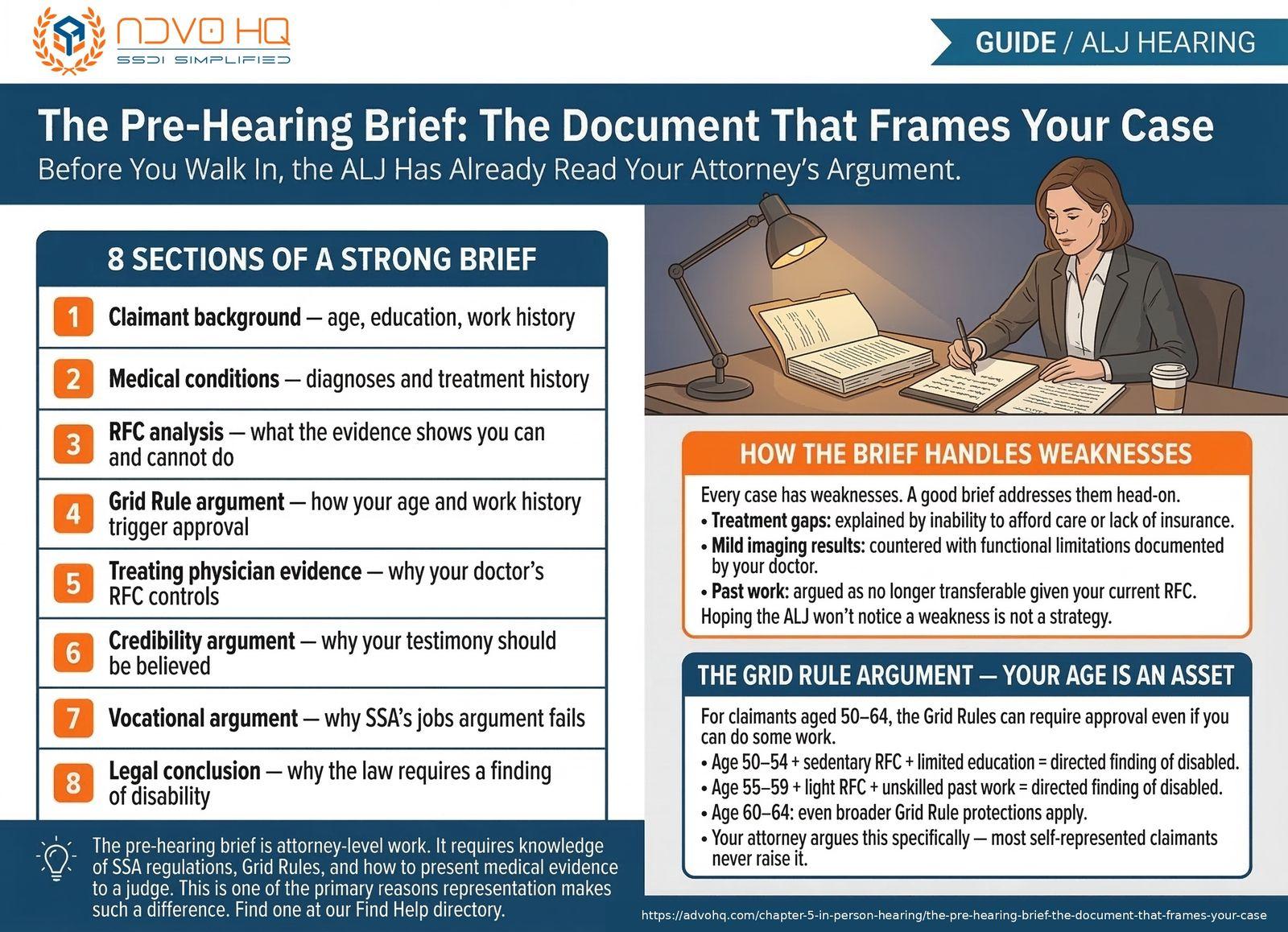
What A Pre-Hearing Brief Is And Why It Matters
- What is it? — A written legal memorandum your attorney submits to the ALJ before the hearing—typically 5–15 pages—that presents your legal argument for disability.
- When is it submitted? — Usually 1–2 weeks before the hearing date. Some attorneys submit it with the final evidence package at the 5-day deadline.
- Does the ALJ read it? — Most ALJs read the brief before the hearing. It’s often the first comprehensive summary of your case they see. This is your attorney’s chance to shape the ALJ’s understanding.
- Is it required? — No—it’s not legally required. But experienced disability attorneys submit one in virtually every case because it significantly improves outcomes.
- Can you write your own? — Technically yes, but it requires legal knowledge of SSA regulations, rulings, and how to cite medical evidence effectively. This is attorney-level work.
The 8 Sections Of A Strong Pre-Hearing Brief
Your age, education, work history, alleged onset date, and the conditions at issue. Sets the stage in 1–2 paragraphs.
Timeline of your application: when you applied, when you were denied, when you filed reconsideration, when you requested a hearing. Shows the ALJ where you are in the process.
A chronological summary of your medical records—diagnoses, treatment notes, imaging results, specialist evaluations, CE reports, and treating physician RFC findings. The attorney highlights the evidence that supports your case.
If your condition meets or equals a Blue Book listing, the brief explains exactly how. Cites the specific listing, its criteria, and the medical evidence that satisfies each requirement.
Your attorney explains what your RFC should be—how much you can lift, how long you can sit/stand/walk, whether you need to lie down, absences, off-task time. Cites treating physician RFC, medical records, and your testimony.
For claimants 50+, the brief explains how your age, education, work history, and RFC trigger the Medical-Vocational Guidelines (Grid Rules) that direct a finding of disability.
Explains why someone with your RFC cannot perform your past work, and why the remaining jobs in the economy are eliminated by your combined physical and mental limitations.
Directly asks the ALJ to find you disabled as of your alleged onset date. Clear, specific, and confident.
How The Brief Addresses Weaknesses In Your Case
Every case has weaknesses. A good brief addresses them head-on rather than hoping the ALJ won’t notice:
- Unfavorable CE report — Argues the treating physician’s opinion should carry more weight due to longer treatment relationship, more detailed findings, and consistency with the full medical record.
- Treatment gaps — Explains the gaps: loss of insurance, financial hardship, mental health barriers, transportation issues. Cites SSA rulings that require consideration of reasons for non-treatment.
- Inconsistencies in the record — Addresses contradictions directly—explains why certain records are more reliable than others, or provides context (e.g., "good day" at appointment vs. typical limitations).
- Past work that seems similar to current RFC — Distinguishes your past work demands from what you can do now—specific physical requirements, pace, schedule, or mental demands that exceed your current RFC.
- Young age (under 50) — Argues specific, non-exertional limitations (mental health, pain, absences, off-task time) that eliminate even sedentary work regardless of age.
ALJs notice gaps and contradictions whether the brief mentions them or not. An attorney who proactively addresses weaknesses demonstrates credibility and prevents the ALJ from drawing negative inferences. Silence on a weakness looks like you have no answer for it.
How The Brief Uses Medical Evidence
- Treating physician RFC — Highlighted as the most probative evidence of functional limitations. The brief explains the doctor’s treatment relationship, frequency of visits, and consistency with clinical findings.
- Diagnostic imaging — Cited as objective evidence: "MRI dated [date] at Exhibit [X] shows multi-level disc disease with nerve impingement." Connects imaging to specific functional limitations.
- Treatment notes — Quoted selectively to show ongoing symptoms, failed treatments, and documented limitations. "Treatment notes from [date] document patient reports of pain at 8/10 with difficulty walking more than 50 feet."
- Mental health records — Connected to functional limitations in the four Paragraph B areas. Shows how depression, anxiety, or cognitive issues create work-preclusive limitations.
- CE report (if favorable) — If the CE supports disability, the brief highlights those findings. If unfavorable, the brief explains why the treating physician’s opinion is more reliable.
The Grid Rule Argument: How The Brief Uses Your Age
For claimants aged 50–64, the brief makes a specific Grid Rule argument:
- Age 50–54, limited education, medium/heavy past work, RFC: sedentary — Grid Rule 201.14 directs a finding of "disabled." The brief cites the rule, shows your RFC restricts you to sedentary, and demonstrates your past work was medium or heavy.
- Age 55+, limited education, medium/heavy past work, RFC: light — Grid Rule 202.01–202.02 direct disability at light RFC for older individuals who cannot do past work and have no transferable skills.
- Any age, RFC: less than sedentary — The brief argues no competitive employment is possible when limitations exceed sedentary—need to lie down, excessive absences, off-task 15%+. Grid Rules framework supports this.
The Grid Rules are complex regulatory tables. Your attorney knows exactly which rule applies to your combination of age, education, work history, and RFC. They write the brief to walk the ALJ directly to the rule that says "disabled." Without this legal analysis, the ALJ has to figure it out themselves — and they may not reach the same conclusion.
Frequently Asked Questions
No. Nothing in SSA's rules requires a brief. But experienced disability attorneys submit one in nearly every case because it lets them frame the ALJ's understanding before the hearing begins and measurably improves outcomes.
Usually 1–2 weeks before the hearing. Some attorneys file it alongside the final evidence package at the 5-business-day deadline, so the ALJ has the full picture at once.
You can, but it's genuinely attorney-level work. A persuasive brief requires knowing the five-step sequential evaluation, the Blue Book listings, the Medical-Vocational Guidelines, and how to cite medical evidence under SSA's rules. Most unrepresented claimants don't file one.
No. Writing the brief is part of what your representative does under the standard contingency arrangement — there's no separate charge for it, and it doesn't change your fee. You still pay the same 25%-of-back-pay contingency fee (subject to SSA's cap) whether or not a brief is filed. See Hiring A Disability Attorney Before Your Hearing for exactly how the fee and cap work.
For claimants 50 and older, the brief matches your age, education, past work, and RFC to the specific Medical-Vocational Guideline rule that directs a finding of "disabled" — then shows the ALJ the evidence that satisfies each factor.
What They Don't Tell You
Insider knowledge that can make or break your application:
The brief is often more important than your testimony
Many disability attorneys consider the written brief to carry more weight than the hearing itself: your testimony lasts perhaps 20–45 minutes, but the brief sits in the ALJ's file permanently. When the ALJ writes the decision weeks later, they're working from the brief and the evidence — not from memory of what you said. A strong brief makes a favorable decision easier to write.
Not every attorney writes a brief
Some representatives show up to hearings without submitting one. That's a significant missed opportunity. If you're interviewing attorneys, ask whether they submit a brief in every case. The answer should be yes.
The brief tells the ALJ exactly what to ask the VE
A well-crafted brief sets up the vocational expert cross-examination. It identifies the specific limitations that eliminate jobs and gives the ALJ the framework to evaluate the VE's testimony.
You should read your own brief
Ask your attorney for a copy before the hearing. Reading it helps you understand the legal theory of your case and prepares you for the questions you'll be asked.
A strong brief can win your case before you testify
A strong pre-hearing brief can win your case before you ever testify. Your attorney can ask the ALJ for an "on-the-record" (OTR) decision — a fully favorable ruling made on the written file alone, with no hearing and no additional wait. It works best when the brief ties your evidence to a specific winning rule, such as showing you meet a Medical-Vocational Guideline ("grid") that directs a finding of disabled. So when you interview a representative, ask whether they pursue OTR decisions in strong cases — a favorable one can shave months off your timeline.
The pre-hearing brief is your attorney’s written argument for why you’re disabled under SSA’s rules.
The pre-hearing brief is your attorney's written argument for why you're disabled under SSA's rules. It frames the ALJ's understanding of your case before the hearing starts, addresses weaknesses, highlights the strongest evidence, and walks the judge through the legal analysis. This is attorney-level work that requires knowledge of SSA regulations, the Grid Rules, and how to present medical evidence persuasively. It's one of the primary reasons attorney representation makes such a significant difference at the hearing level.
Up Next: Preparing Your Testimony: What The ALJ Needs To Hear From You—the questions you’ll be asked, how to answer effectively, and how to practice with your attorney.
Your Attorney’s Brief Sets The Stage For Everything
A strong pre-hearing brief is the foundation of a winning hearing strategy. Find an experienced disability attorney who writes comprehensive briefs for every case. Free consultation. No upfront cost.
→ Find A Disability Attorney In Your County
→ Request A Free Case Review
Not affiliated with SSA or any government agency. For informational purposes only — not legal advice.
- 20 CFR § 404.1520 — "Evaluation of disability in general" (five-step sequential evaluation). ecfr.gov
- 20 CFR Part 404, Subpart P, Appendix 2 — "Medical-Vocational Guidelines" (the Grid Rules), Tables 1 & 2 and § 200.00 (grid rules 201.14 and 202.01–202.02 verified against Appendix 2). ecfr.gov
- 20 CFR § 404.1545 — "Your residual functional capacity" (RFC) — ; SSR 96-8p, "Assessing Residual Functional Capacity in Initial Claims". ecfr.gov
- 20 CFR § 404.1526 — "Medical equivalence for adults and children" — ; SSR 17-2p (evidence needed for equivalence findings at the hearing level). ecfr.gov
- 20 CFR § 404.1520c — "How we consider and articulate medical opinions and prior administrative medical findings" (supportability and consistency; treating-physician rule eliminated for claims filed on/after March 27, 2017). ecfr.gov
- 20 CFR § 404.935 — 5-business-day evidence rule. ecfr.gov
- Social Security Administration — HALLEX I-2-1-82, "Reviewing and Deciding a Case Without a Hearing" (on-the-record / fully favorable decision without a hearing) — ; SSA on-the-record (OTR) request guidance. ssa.gov
- Social Security Act, Title II — 42 U.S.C. §§ 401–434.