
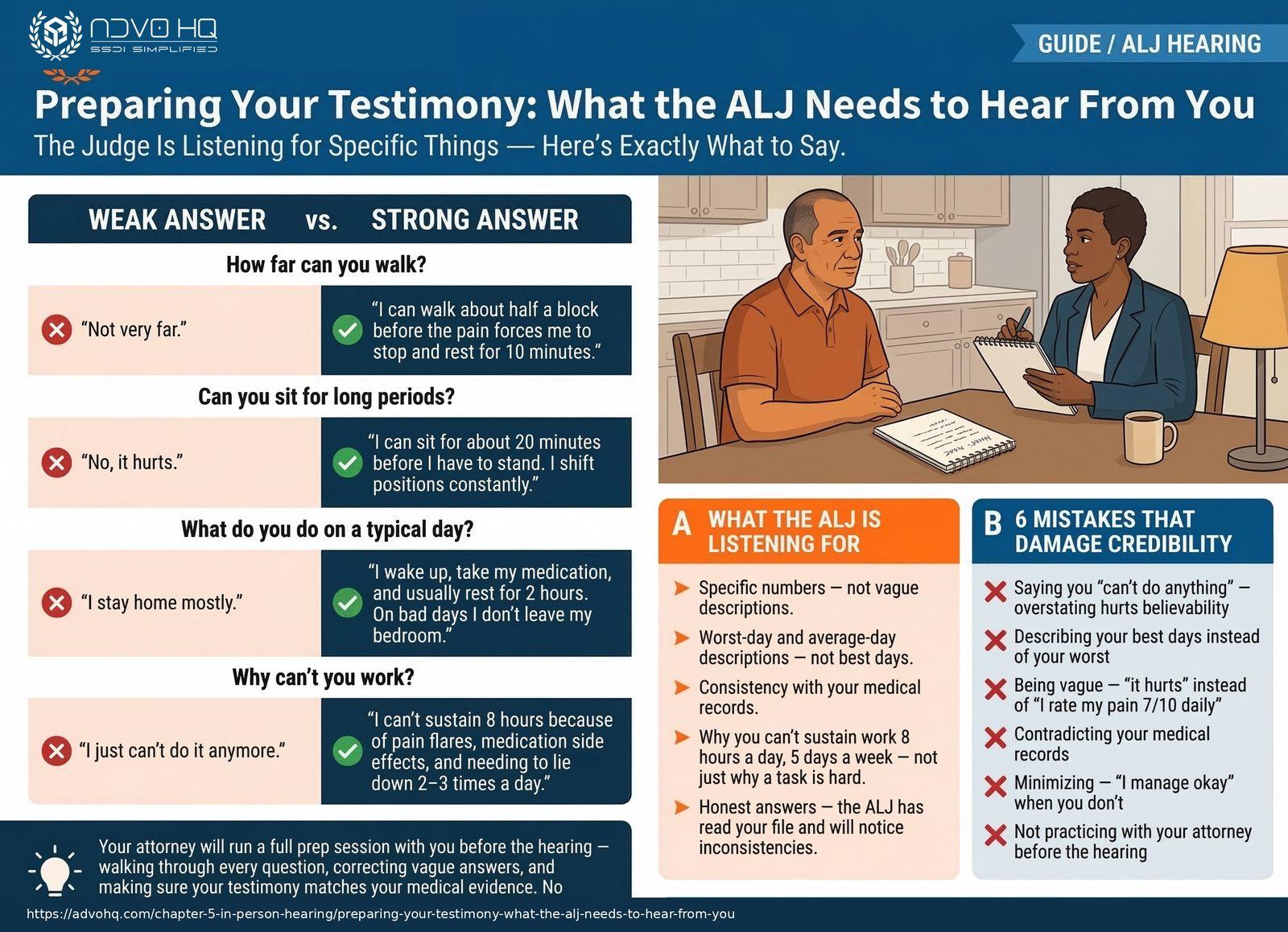
What The ALJ Is Actually Listening For
- Credibility — Is your testimony consistent with the medical records? With your function report? With what you told the CE doctor? Inconsistencies destroy credibility.
- Specific functional limitations — Can you give concrete numbers—how long you can sit, stand, walk, how much you can lift? Vague answers like "I can’t do much" tell the ALJ nothing.
- Why you can’t sustain work — Not just whether you can do a task once, but whether you can do it consistently for 8 hours a day, 5 days a week. The distinction between "I can" and "I can sustain" is everything.
- Daily activities — What does your day actually look like? What can’t you do? What do you need help with? Daily activities paint the picture of someone who can or cannot work.
- Medication effects — Do your medications help? What side effects do they cause? How do they affect your ability to think, concentrate, and stay awake?
- Emotional state — Are you depressed? Anxious? Struggling to cope? The ALJ observes your demeanor, affect, and emotional presentation during testimony.
The Questions You’ll Be Asked: Weak vs. Strong Answers
Your attorney asks most of the questions, but the ALJ may also ask follow-ups. Here are the key topics with examples of effective and ineffective answers:
Describe the timeline and medical context, not just the symptom.
Give specific minutes and what must happen once you hit that limit.
Anchor your answer with a real-world landmark and assistive device use.
Walk through your actual morning-to-evening routine, including what you cannot do.
Name each medication and describe how its side effects limit your daily function.
Include your diagnosis, daily impact, and treatment history.
Describe the realistic range—good days, bad days, and what’s typical.
The 10 Rules Of Effective Testimony
- Be specific with numbers — 15 minutes of sitting, 200 feet of walking, 5 lbs of lifting. The ALJ needs numbers to determine your RFC. Vague answers get ignored.
- Describe your worst and average days — Don’t describe your best day. The ALJ needs to know what most days look like and how bad the worst days get.
- Explain the "sustain" problem — You might be able to sit for 20 minutes, but you can’t sustain sitting for 6 hours in a workday. Explain the difference between doing something once and doing it all day.
- Don’t exaggerate — If you say you can’t walk at all but you walked into the hearing room, you’ve damaged your credibility. Be honest about what you can do in short bursts.
- Don’t minimize — Being tough or stoic hurts your case. If you’re in pain, say you’re in pain. If you need help getting dressed, say so. This isn’t the time for pride.
- Answer the question asked — Don’t ramble or go off on tangents. Listen to the question, answer it directly, then stop. Your attorney will ask follow-up questions to draw out more detail.
- If you don’t know, say so — "I’m not sure" is a perfectly acceptable answer. Guessing or making up an answer damages credibility.
- Describe what you’ve lost — Talk about what you used to be able to do—coaching your kid’s team, working on cars, going fishing. The contrast between your life before and after disability is powerful.
- Include medication side effects — Don’t just list medications. Describe how they affect your daily functioning: drowsiness, brain fog, nausea, dizziness. These are functional limitations.
- Be consistent with your records — Your testimony must match your function report, medical records, and what you told the CE doctor. Review these before the hearing.
The 6 Mistakes That Destroy Testimony Credibility
- Contradicting your own records — If your function report says you can sit 20 minutes but you testify you can only sit 5 minutes, the ALJ questions everything you’ve said.
- Claiming you can’t do anything at all — Total helplessness is rarely credible and contradicts most medical records. Honest, specific limitations are far more persuasive.
- Focusing on diagnosis instead of function — "I have degenerative disc disease" isn’t testimony. "I can’t bend to tie my shoes, I can’t sit through a meal, and I need to lie down 3 times a day" is testimony.
- Appearing coached or rehearsed — Natural, honest answers are more credible than polished performance. Preparation is essential, but you should testify in your own words, not memorized scripts.
- Getting angry or confrontational — The hearing is stressful, but hostility toward the ALJ or experts hurts your case. Stay calm and respectful even if questions feel unfair.
- Failing to mention mental health — If you have depression, anxiety, or cognitive issues and don’t mention them in testimony, the ALJ may assume they’re not significant. Your attorney should prompt you, but be ready to discuss mental health openly.
Preparing With Your Attorney: The Pre-Hearing Session
- Review of your file — Your attorney walks you through the key medical evidence, CE reports, and DDS determinations. They identify what’s strong and what needs to be addressed.
- Practice questions — Your attorney asks you the same questions you’ll face at the hearing. They’ll help you refine vague answers into specific, compelling testimony.
- Identify key limitations — Together you identify the 3–5 most important functional limitations to emphasize—the ones that drive your RFC below the threshold for available work.
- Review for consistency — Your attorney compares your planned testimony to your function report, medical records, and prior statements to catch and address any inconsistencies.
- Discuss the ALJ — Your attorney shares what they know about the assigned judge’s tendencies and adjusts the testimony strategy accordingly.
If your attorney doesn't offer a pre-hearing preparation session, request one. Going into a hearing without practicing your testimony is like walking into a job interview without preparing. The preparation session is where good testimony is built.
Frequently Asked Questions
Yes. An ALJ hearing is a de novo proceeding where you give sworn testimony, usually for 30–60 minutes. That's exactly why consistency matters so much — everything you say is on the record and compared against your written statements and medical file.
Under SSR 16-3p, the ALJ no longer makes a "credibility" judgment about you as a person. Instead they evaluate whether your reported symptoms are consistent with the objective medical evidence and the rest of the record. The practical takeaway is the same: keep your testimony specific and aligned with your records.
Your residual functional capacity (RFC) — the most you can still do despite your limitations, on a regular and continuing basis (8 hours a day, 5 days a week). Concrete numbers about sitting, standing, walking, and lifting feed directly into that finding.
Neither alone. Describe your average day and your worst day, and be clear about how often bad days happen. The ALJ needs to understand what a typical week looks like, not a cherry-picked good moment.
That's fine. Genuine emotion is appropriate, and "I'm not sure" is a valid answer. Guessing or overstating to fill a silence does more harm than an honest "I don't know."
What They Don't Tell You
Insider knowledge that can make or break your application:
The ALJ is observing you the entire time
From the moment the hearing starts, the ALJ is watching how you sit, whether you shift positions, whether you grimace, whether you're on the verge of tears. If sitting through a 45-minute hearing is painful, let it show. Don't suffer in silence — ask if you can stand or shift positions. That request itself is evidence.
Your testimony about "sustaining" work is the most important part
The question isn't whether you can sit in a chair. It's whether you can sit in a chair for 6 hours a day, 5 days a week, 52 weeks a year, while also concentrating on work tasks, meeting deadlines, and being reliable. Frame every answer around sustainability, not capability.
Tears are OK
If talking about what you've lost makes you emotional, that's genuine and the ALJ recognizes it. Don't hold back authentic emotion. Forced emotion is obvious and damaging, but real emotion demonstrates the impact of disability on your life.
The ALJ may ask tough questions
Some ALJs ask pointed questions to test consistency: "Do you drive?" "Do you watch TV?" "Do you go to the grocery store?" These aren't trick questions. Answer honestly with context: "I drive short distances on good days, never on the highway, and not when I've taken my pain medication."
The judge is testing full-time reliability, not a good day
The judge isn't deciding whether you can do one task once on a good day — they're deciding whether you could hold down a full-time job week after week. SSR 96-8p defines the standard as work "on a regular and continuing basis," 8 hours a day, 5 days a week. So testify about a realistic bad day and, above all, why you couldn't sustain a 40-hour week: how long you last before you have to lie down, how many days a month you'd miss, why you can't be reliable. Describing a "good day" ("I can walk the dog") without that sustainability context is how honest claimants accidentally talk themselves out of benefits.
Your testimony is your chance to show the ALJ who you are and what your life is really like.
Your testimony is your chance to show the ALJ who you are and what your life is really like. Be honest. Be specific. Use numbers. Describe your worst and average days. Explain why you can't sustain work, not just why you can't do a task once. Practice with your attorney. And remember: the ALJ has read your medical records. Your testimony puts a human face on the evidence and fills in the gaps that paperwork can't capture.
Up Next: The Vocational Expert: The Witness Who Decides Your Case—how hypothetical questions work, why the cross-examination matters, and how your attorney eliminates the jobs SSA says you can do.
Your Attorney Prepares You To Testify Effectively
Testimony preparation is one of the most valuable things a disability attorney does. They know what the ALJ needs to hear, how to draw it out of you, and how to avoid the mistakes that damage credibility. Free consultation. No upfront cost.
→ Find A Disability Attorney In Your County
→ Get Free Help Preparing For Your Hearing
Not affiliated with SSA or any government agency. For informational purposes only — not legal advice.
- SSR 16-3p, Evaluation of Symptoms in Disability Claims — Social Security Administration. Adjudicators evaluate whether a claimant's statements about the intensity, persistence, and limiting effects of symptoms are consistent with the objective medical and other evidence of record; SSA eliminated the term "credibility." Applicable to determinations/decisions on or after March 28, 2016 (republished October 25, 2017); supersedes SSR 96-7p. ssa.gov
- 20 C.F.R. § 404.1529, How we evaluate symptoms, including pain — Social Security Administration / eCFR. Governs the two-step evaluation of symptoms and their consistency with the record. ecfr.gov
- 20 C.F.R. § 404.950, Presenting evidence at a hearing before an administrative law judge — Social Security Administration / eCFR. A party has the right to appear and present sworn testimony; the ALJ receives evidence and may examine witnesses under oath. ecfr.gov
- 20 C.F.R. § 404.929, Hearing before an administrative law judge — general — Social Security Administration / eCFR. Establishes the right to a de novo ALJ hearing; the ALJ looks at all issues and may consider evidence not before the state agency. ecfr.gov
- SSR 96-8p, Assessing Residual Functional Capacity in Initial Claims — Social Security Administration. RFC is the most a claimant can still do despite limitations, assessed function-by-function on a regular and continuing basis (8 hours/day, 5 days/week). ssa.gov