
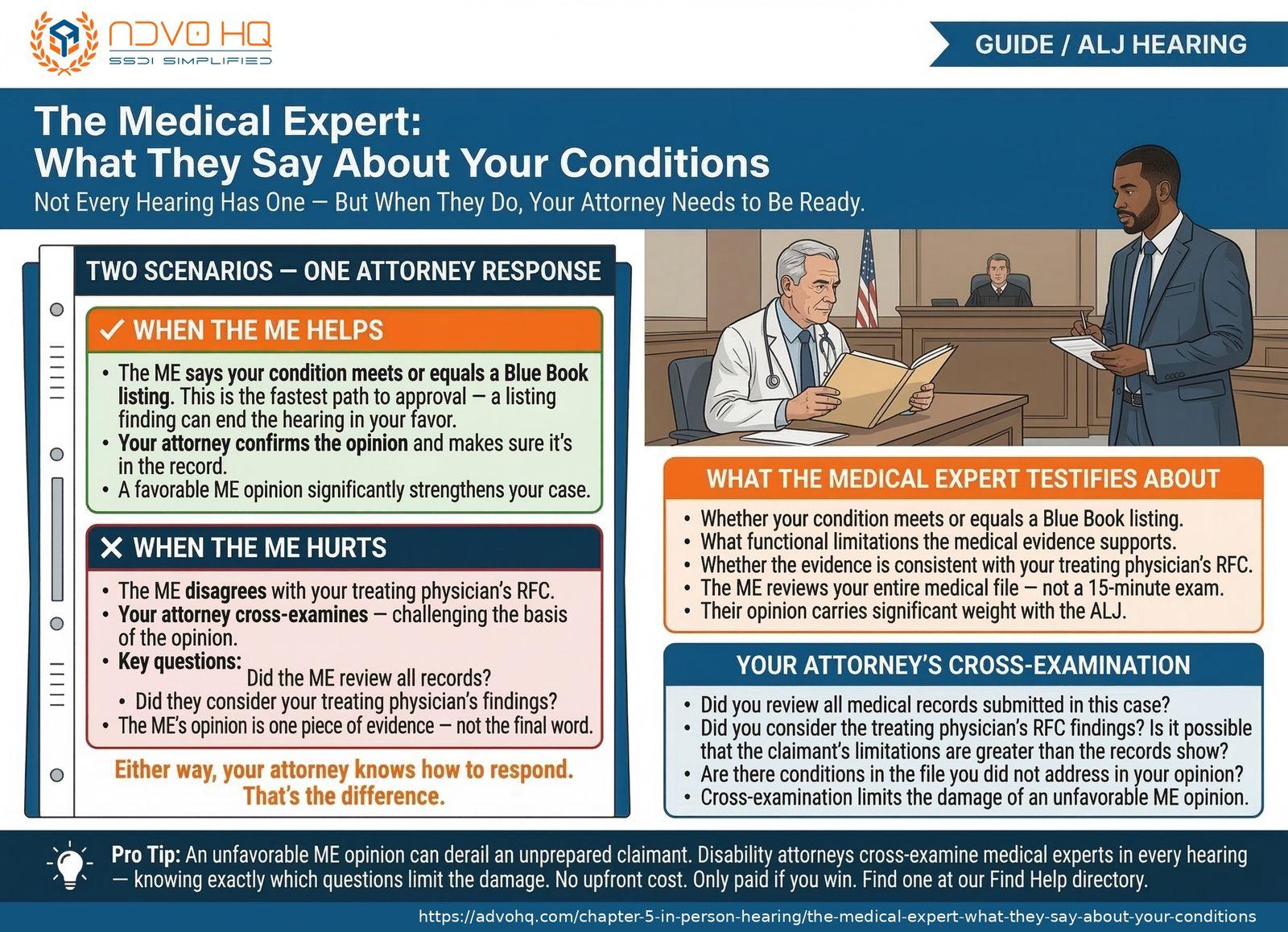
When And Why A Medical Expert Appears
- Your conditions may meet a listing — The ALJ wants a medical opinion on whether your conditions meet or equal a specific Blue Book listing. This could lead to an approval at Step 3 of the evaluation.
- Medical evidence is complex or conflicting — Different doctors have different opinions. The Medical Expert provides an independent medical perspective to help the ALJ sort through contradictions.
- The onset date is unclear — The ALJ needs help determining when your disability began—particularly important for back pay calculations.
- The ALJ wants RFC guidance — The Medical Expert may testify about what physical or mental limitations the medical evidence supports, helping the ALJ determine your RFC.
- Multiple impairments need evaluation — When you have several conditions that interact, the ALJ may want a Medical Expert to assess the combined effect.
When an ALJ calls a Medical Expert, it often means the ALJ is taking your case seriously and wants expert help evaluating the medical evidence. This is particularly true if the ALJ wants to know whether you meet a listing — they may be looking for a way to approve you.
What The Medical Expert Testifies About
- Your diagnoses — Confirms or clarifies the medical conditions documented in your file. May identify conditions not previously diagnosed.
- Listing equivalence — Whether your conditions meet or "medically equal" a specific Blue Book listing. If yes, the ALJ can approve your case without further vocational analysis.
- Severity of conditions — Whether your conditions are "severe" under SSA's definition—meaning they significantly limit your ability to do basic work activities.
- Onset date — When the medical evidence shows your condition became disabling. This affects your back pay calculation.
- Functional limitations — What the medical evidence supports in terms of physical and/or mental limitations. May provide an RFC opinion.
- Treating physician opinions — Whether they agree or disagree with your treating physician's RFC and why. May support or challenge your doctor's findings.
When The Medical Expert Helps Your Case
"The claimant's conditions meet Listing 1.04 for disorders of the spine." This is the strongest possible outcome — approval without needing vocational analysis.
"I agree with Dr. Smith's assessment that the claimant is limited to less than sedentary work." Independent confirmation of your doctor's opinion carries significant weight.
"The medical evidence also supports limitations in concentration and persistence due to medication side effects." The Medical Expert may surface limitations your own doctor didn't document.
"The MRI from 2023 shows significant disc disease. The claimant's condition was likely disabling as of that date." Earlier onset means more back pay.
When The Medical Expert Hurts Your Case—And How Your Attorney Responds
Closes the Step 3 path to approval. But doesn't mean your case is lost — the vocational analysis at Step 5 still applies.
Medical Expert says your limitations aren't as severe as your doctor indicated.
Medical Expert says records don't support the severity you claim.
Reduces your back pay.
Your attorney can always point out that the Medical Expert's testimony is based solely on reviewing paper records. They never examined you, never observed your pain, and never assessed your functional limitations in person. Your treating physician who has examined you over months or years has a more complete picture. This is a legitimate challenge to unfavorable Medical Expert testimony.
Your Attorney's Cross-Examination Of The Medical Expert
- Highlight what the Medical Expert agrees with — If the Medical Expert supports some of your limitations, your attorney establishes those points clearly. Even partial agreement is valuable.
- Challenge overlooked evidence — Asks the Medical Expert: "Doctor, did you review the MRI from [date] showing [finding]?" Points to specific records the Medical Expert may not have focused on.
- Emphasize the treating physician relationship — Asks the Medical Expert to confirm they never examined you, didn't observe your pain, and based their opinion entirely on record review.
- Ask about combined effects — If the Medical Expert addressed conditions individually, asks about how conditions interact: "Would the combination of chronic pain, depression, and medication side effects create greater limitations than any single condition?"
- Establish uncertainty — If the Medical Expert is uncertain about limitations, attorney gets that uncertainty on the record: "So you can't rule out that the claimant has the limitations Dr. Smith described?"
Frequently Asked Questions
Not often. Medical experts appear at a minority of hearings. Your hearing notice will tell you whether one is scheduled. If it doesn't list a medical expert, you'll only face the vocational expert.
The consultative exam (CE) doctor physically examines you, usually in a single short appointment SSA schedules when your records are incomplete. The medical expert never examines you — they review your entire file and testify at the hearing about what the records show. A CE is one piece of evidence; the medical expert interprets the whole record.
Yes. If the medical expert testifies that your conditions meet or "medically equal" a Blue Book listing at Step 3, the ALJ can approve you without any vocational analysis — the fastest path to a favorable decision. Because the medical expert is a neutral expert (not your doctor, not SSA's), favorable testimony is especially persuasive.
Under 20 CFR § 404.1526 and SSR 17-2p, you can be found disabled even if you don't satisfy every criterion of a listing, so long as your impairment (or combination of impairments) is at least equal in medical severity to a listed one. A medical expert is frequently the person the ALJ asks to opine on equivalence.
It's not the end of your case. Failing at Step 3 simply moves the analysis to Steps 4 and 5, where the ALJ and vocational expert evaluate whether your RFC allows any work. Not meeting a listing does not mean you can work full-time. See The Vocational Expert: The Witness Who Decides Your Case for how that Step 5 analysis plays out.
What They Don't Tell You
Insider knowledge that can make or break your application:
Most hearings don't have a medical expert
Medical experts are present at only a minority of hearings. If your hearing notice doesn't list one, you'll only face the vocational expert. If a medical expert is listed, your attorney needs to review their background and prepare cross-examination questions specific to your conditions.
The medical expert may testify by phone or video
Medical experts don't always appear in person. They may testify remotely, which can make cross-examination more challenging — but the same strategies apply.
Your attorney can object to the medical expert's testimony
If the medical expert offers opinions outside their area of expertise, or makes errors about your medical history, your attorney can object. These objections go on the record and can be raised on appeal.
A medical expert who helps you is extremely powerful
Because the medical expert is an independent expert — not your doctor, not SSA's doctor — favorable testimony is particularly persuasive. When a neutral expert agrees with your treating physician's assessment, the ALJ has strong support for a disability finding.
They review the whole file — so old records matter
Unlike a CE doctor who sees a snapshot, the medical expert reads everything. Imaging, hospital stays, and specialist notes from years ago can drive their onset-date and equivalence opinions, which is why building a complete longitudinal record pays off at the hearing.
You can cross-examine a live medical expert
If a medical expert testifies live — in person, by phone, or by video — you and your representative have the right to question that expert right then; you are not a spectator (HALLEX I-2-5-42). And if the ALJ instead wants to rely on a medical expert's written answers (interrogatories), you can insist on the chance to respond and to request live testimony, because interrogatories give you no real-time way to challenge the opinion. Quietly accepting written answers waives your best shot at pushing back — so speak up and ask to cross-examine.
The medical expert is an independent physician who reviews your file and testifies about your conditions.
The medical expert is an independent physician who reviews your file and testifies about your conditions. Their testimony can be the fastest path to approval (if they say you meet a listing) or a hurdle your attorney needs to address (if they disagree with your treating physician). Either way, your attorney's preparation and cross-examination are critical. The medical expert's opinion is important, but it's not the final word — it's one more piece of evidence the ALJ weighs alongside everything else in your file.
Up Next: Hearing Day: Minute By Minute From Parking Lot To Decision—logistics, what to wear, what to bring, and a complete walkthrough of the hearing itself.
Your Attorney Handles The Medical Expert For You
When a medical expert testifies at your hearing, your attorney knows how to highlight favorable opinions and challenge unfavorable ones. This requires medical knowledge and cross-examination skill. Free consultation. No upfront cost.
→ Find A Disability Attorney In Your County
→ Request A Free Case Review
Not affiliated with SSA or any government agency. For informational purposes only — not legal advice.
- 20 C.F.R. § 404.1526 — Medical equivalence for adults and children. ecfr.gov
- SSR 17-2p — Evidence Needed by Adjudicators at the Hearings and Appeals Council Levels to Make Findings About Medical Equivalence. ssa.gov
- 20 C.F.R. Part 404, Subpart P, Appendix 1, § 1.15 — Disorders of the skeletal spine resulting in compromise of a nerve root(s). ecfr.gov
- 20 C.F.R. Part 404, Subpart P, Appendix 1 — [Listing of Impairments (Blue Book)](. ecfr.gov
- 20 C.F.R. § 404.950 — Presenting and questioning witnesses at an ALJ hearing. ecfr.gov
- Social Security Administration — HALLEX I-2-5-42, "Opportunity to Question the Medical Expert". ssa.gov
- 20 C.F.R. § 404.1513a — Evidence from our Federal or State agency medical or psychological consultants. ecfr.gov
- 20 C.F.R. § 404.1520c — How we consider and articulate medical opinions. ecfr.gov
- 20 C.F.R. § 404.1520 — [Evaluation of disability in general (five-step sequential evaluation)](. ecfr.gov