
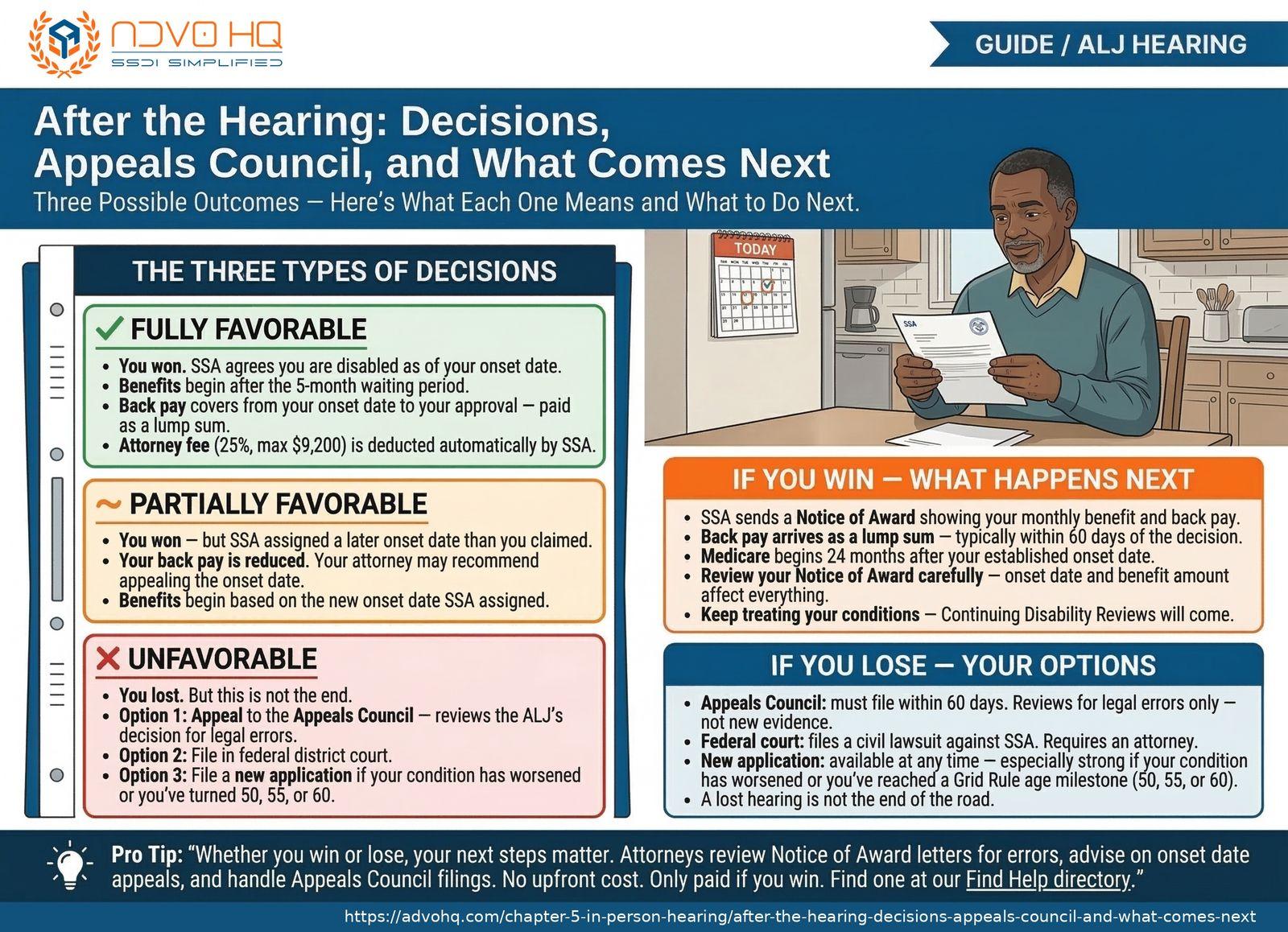
The Three Types Of Decisions
The ALJ found you disabled as of your alleged onset date. You receive the full amount of back pay from 5 months after that date through the decision date. SSA processes your award, disburses a lump sum, and begins monthly benefits. Your attorney’s fee is deducted from back pay by SSA.
The ALJ found you disabled but used a later onset date than you claimed. You receive benefits and back pay, calculated from the ALJ’s onset date. You or your attorney can accept this outcome or appeal the onset date to the Appeals Council.
The ALJ found you are not disabled. No benefits are awarded. You have 60 days to request review by the Appeals Council. Your attorney should review the written decision to determine whether an appeal has merit.
If You Win: What Happens To Your Benefits
- Back pay timing: SSA typically processes the back pay lump sum within 60 days of the decision, though it can take longer. The first payment may take 1–2 months after the decision is issued.
- Back pay amount: Calculated from 5 months after your disability onset date through the month of the decision. If your monthly benefit is $2,200 and you have 24 months of back pay, that’s $52,800 before attorney fees.
- Attorney fee: 25% of back pay, capped at $9,200. SSA withholds this and pays your attorney directly. You don’t write them a check.
- Monthly benefits start: Your ongoing monthly SSDI payment typically begins 1–2 months after the decision. The amount depends on your work history and earnings record.
- Medicare eligibility: You become eligible for Medicare 24 months after your disability onset date (not 24 months after approval). If your onset date was 2+ years ago, you may already be eligible.
- Continuing Disability Reviews: SSA will periodically review your case to see if your condition has improved. These happen every 1–7 years depending on the expected improvement of your condition.
Even after you're approved, continue medical treatment. SSA conducts Continuing Disability Reviews (CDRs), and your ongoing treatment records demonstrate that your condition persists. Stopping treatment after approval can lead to benefits being terminated at your next CDR.
If You Lose: Your Options After An Unfavorable Decision
File Form HA-520 (Request for Review of Hearing Decision) within 60 days.
If the Appeals Council denies review or upholds the denial, you can file a civil action in federal district court within 60 days.
You can file a completely new SSDI application at any time, starting the process over. This makes sense if your condition has significantly worsened since the hearing.
The Appeals Council: What They Do And Don’t Do
- What is the Appeals Council? — A body within SSA that reviews ALJ decisions for legal errors. They don’t hold a new hearing—they review the existing written record and decide whether the ALJ applied the law correctly.
- What do they look for? — Legal errors by the ALJ: failure to properly evaluate medical evidence, incorrect application of the Grid Rules, failure to explain the RFC determination, ignoring a treating physician’s opinion without cause, or abuse of discretion.
- Can they approve your case outright? — Yes. They can issue a fully favorable decision, remand the case back to the ALJ for a new hearing with corrected instructions, or deny review entirely (leaving the ALJ’s decision in place).
- Can you submit new evidence? — Yes, but only if it’s new, material, and relates to the period before the ALJ’s decision. You must also show good cause for not submitting it earlier.
- What’s the success rate? — Low—roughly 10–15% of requests are granted review. But when they do grant review, outcomes often improve.
- Do you need an attorney? — Strongly recommended. Appeals Council review requires identifying specific legal errors in the ALJ’s written decision—legal analysis, not storytelling.
Decoding The ALJ’s Written Decision
The ALJ’s decision is a written document (typically 5–20 pages) that follows SSA’s 5-step evaluation process. Here’s what each section means:
Did the ALJ correctly find you haven’t been working at SGA levels since your onset date?
Did the ALJ identify ALL your severe impairments, including mental health conditions?
Did the ALJ properly evaluate whether your conditions meet or equal a Blue Book listing? Did the Medical Expert’s testimony support this?
What RFC did the ALJ assign? Does it match your treating physician’s RFC? Did the ALJ explain why they rejected any evidence? Can you do past work at this RFC?
Did the ALJ rely on the Vocational Expert’s testimony? Did the VE identify jobs that actually exist? Did the ALJ use the correct Grid Rule for your age/education/RFC?
The ALJ must explain their reasoning at each step. If they rejected your treating physician's RFC, they must say why. If they ignored the VE's testimony that no jobs exist with your limitations, that's a potential legal error. Your attorney reviews this decision for errors that support an Appeals Council request.
The Complete ALJ Hearing Series: What You’ve Learned
- Your Hearing Notice Arrived: decoding the notice, immediate action items, hearing formats, evidence deadlines.
- Hiring A Disability Attorney: fee structure, what they do, how to find one, questions to ask, red flags.
- The Pre-Hearing Brief: the 8 sections, how it addresses weaknesses, Grid Rule arguments, why it frames the hearing.
- Preparing Your Testimony: the questions, weak vs. strong answers, 10 rules of testimony, credibility destroyers.
- The Vocational Expert: hypothetical questions, job-eliminating limitations, the cross-examination that wins cases.
- The Medical Expert: when they appear, favorable and unfavorable testimony, your attorney’s cross-examination.
- Hearing Day: minute-by-minute walkthrough, what to wear, what to bring, video hearing tips, dos and don’ts.
- After The Hearing: three decision types, back pay, Appeals Council, federal court, when to file a new application.
Frequently Asked Questions
It varies — SSA publishes no official post-hearing decision timetable. In practice it typically runs from a few weeks to a few months. Fully favorable decisions sometimes come faster; complex or unfavorable decisions can take longer because the ALJ must write out the reasoning at each step.
SSA usually processes the lump sum within about 60 days of the decision, though it can take longer. Your first ongoing monthly payment typically begins 1–2 months after the decision is issued.
The fee is 25% of your back pay, capped at $9,200 (the current fee-agreement maximum, effective November 30, 2024), and SSA pays it directly out of your award — you never write a check. If you don't win back pay, there's generally no fee.
Low. By commonly cited (though not officially published) estimates, the Appeals Council issues a direct favorable decision in only about 1–2% of AC requests and remands roughly 10–15% back to the ALJ for a new hearing; these describe outcomes among people who request Appeals Council review, not shares of all applicants. (SSA's own published figures — the Annual Statistical Report, 2024 — track a different metric: the share of all applicants awarded at each stage.) Most requests are denied, which is why identifying specific legal errors matters so much. What The Appeals Council Actually Does With Your Case covers this stage in depth.
It depends. If the ALJ made a legal error, an Appeals Council appeal (Form HA-520, filed within 60 days) protects your original onset date. If your condition has significantly worsened since the hearing, a fresh application with updated evidence may be faster and stronger. Your attorney can help you weigh both. See Filing A New Application vs. Continuing Your Appeal for a full comparison.
What They Don't Tell You
Insider knowledge that can make or break your application:
Most cases that win at hearing stay won
If the ALJ issues a favorable decision, it's usually done. SSA rarely disturbs its own ALJ's favorable decisions. The one caveat: the Appeals Council can, in rare cases, review a favorable decision on its own motion within 60 days of the decision (20 CFR 404.969) — but for the vast majority of claimants, a win at hearing means benefits are secure.
Back pay can be substantial
For someone who applied in early 2024 and wins at hearing in mid-2026, back pay could reach tens of thousands of dollars before attorney fees — the exact amount depends entirely on your own benefit rate and how many months are owed (the dollar figures used here are illustrative, not a promise). This lump sum usually arrives within 1–2 months of the decision.
A new application is sometimes better than an appeal — don't decide alone
If you receive a partially favorable or unfavorable decision, weigh your options with your attorney rather than deciding by yourself; an experienced representative has seen many decisions and can assess whether an appeal has a realistic chance. In particular, if your condition has significantly worsened since the hearing, a new application with updated evidence may be faster and more likely to succeed than an Appeals Council review of old evidence.
You must report changes after winning
After approval, you must report any return to work, improvement in your condition, or other changes. Failing to report can lead to overpayment and repayment demands.
The decision comes weeks later, by mail
The hearing rarely ends with a decision — the judge takes it "under advisement" and mails a written decision later, often weeks or a couple of months out. If the ALJ left the record open for a specific document — a missing test result, a form from your doctor — get it in by the stated deadline: that single item can be the difference-maker, and once the decision is written the window to add it is gone. So don't check out when the hearing ends; the post-hearing "record open" period is a live, still-winnable phase with its own hard deadline.
The ALJ hearing is where most contested SSDI cases are decided.
The ALJ hearing is where most contested SSDI cases are decided. Whether the decision is favorable, partially favorable, or unfavorable, you now know what each outcome means and what your options are. If you win, benefits and back pay are on the way. If you lose, the Appeals Council and federal court provide additional chances — and a new application is always available if your condition has changed. Every step of this process, from your initial application through the hearing and beyond, has been working toward one goal: getting the benefits you've earned.
Need Help At Any Stage? Find A Disability Attorney Now.
Whether you’re waiting for a decision, considering an appeal, or thinking about a new application, an experienced disability attorney can evaluate your options and guide your next step. Contingency fee—no upfront cost.
→ Find A Disability Attorney In Your County
→ Request A Free Case Review
Start From The Beginning
New to MyGoveBenefits? Start with our Initial Application Series to learn the complete SSDI process, or jump to the Reconsideration Series if you’ve already been denied.
Not affiliated with SSA or any government agency. For informational purposes only — not legal advice.
- 20 C.F.R. § 404.967 — Appeals Council review; general (right to request review):. ecfr.gov
- 20 C.F.R. § 404.968 — How to request Appeals Council review (60-day deadline; Form HA-520):. ecfr.gov
- 20 C.F.R. § 404.970 — Cases the Appeals Council will review (abuse of discretion, error of law, findings not supported by substantial evidence, broad policy/procedural issue, new and material evidence):. ecfr.gov
- 20 C.F.R. § 404.981 — Effect of Appeals Council action; 60-day deadline to commence a federal civil action:. ecfr.gov
- Social Security Administration — Form HA-520, "Request for Review of Hearing Decision/Order":. ssa.gov
- Social Security Act § 205(g), 42 U.S.C. § 405(g) — judicial review; civil action within 60 days; findings conclusive if supported by substantial evidence:. ssa.gov
- Attorney fee cap — 42 U.S.C. § 406(a)(2); 20 C.F.R. § 404.1720; "Maximum Dollar Limit in the Fee Agreement Process," 89 Fed. Reg. (May 10, 2024) — 25% of past-due benefits capped at $9,200 effective Nov. 30, 2024:. federalregister.gov
- Continuing Disability Reviews — 20 C.F.R. § 404.1590:. ecfr.gov
- Five-month waiting period — 20 C.F.R. § 404.315(a)(4); 42 U.S.C. § 423(c)(2).
- Medicare 24-month qualifying period — 42 U.S.C. § 426(b).
- Substantial Gainful Activity (2026, $1,690/mo non-blind) — SSA:. ssa.gov
- Social Security Administration — HALLEX I-2-7-20, "Holding the Record Open After the Hearing" (ALJ may leave the record open for specified post-hearing evidence with a set deadline); HALLEX I-2-8-20, "Decision Writing Instructions" (written decision issued after the hearing). ssa.gov
- Social Security Administration — [Appeal a Decision](. ssa.gov
- SSA Annual Statistical Report on the SSDI Program, 2024, Sec. 4 (Outcomes of Applications) — application-outcome "waterfall" (~20% initial / ~2% reconsideration / ~7% hearing-and-above; ~29% ultimately awarded) reflects shares of ALL applicants, not per-stage grant rates and not Appeals Council request outcomes:. ssa.gov